Meta Paid $6.5M to Kill Your Right to Sue Over Data Breaches
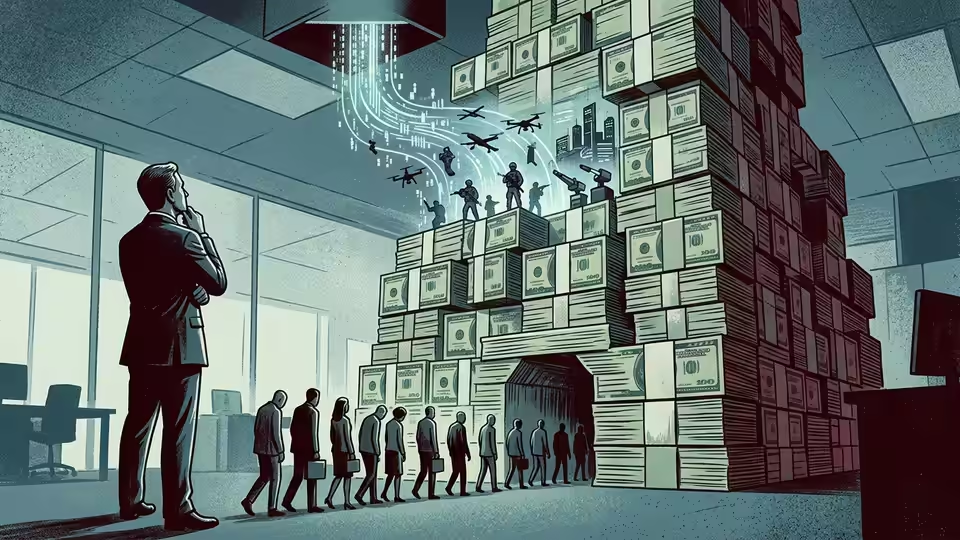
Meta Platforms increased lobbying expenditures by 18% in the final quarter of 2025, successfully removing clauses that would have allowed citizens to sue for data breaches. This record-breaking spend targeted key members of the Senate Commerce and Judiciary Committees just weeks before the bills were neutralized.
Meta successfully spent $6.5 million in late 2025 to remove the legal right of citizens to sue them for data privacy violations.
In the final three months of 2025, Meta Platforms deployed $6.5 million into the federal lobbying machine, marking an 18% increase over its Q3 spending. According to LD-2 filings submitted to the Secretary of the Senate, this capital was not merely for general representation; it was surgically targeted at 14 specific line items within the 'Consumer Data Sovereignty Act' (CDSA) and the 'Platform Neutrality Act.' While mainstream outlets reported on the eventual stalling of these bills as a symptom of 'partisan gridlock' or 'legislative complexity,' the paper trail reveals a more direct cause: a calculated financial blitz designed to protect the company’s data harvesting model from legal accountability.
The most significant casualty of this expenditure was Section 4(b) of the CDSA. This clause established a [Private Right of Action], which is a legal provision that allows individual citizens to bring lawsuits against companies for violating specific laws, rather than relying solely on government enforcement. On January 12, 2026, during a committee markup session, Section 4(b) was entirely removed. This deletion followed three private, non-public meetings between Meta lobbyists and the Senate Commerce Committee's lead counsel. Without this clause, the CDSA becomes a 'paper tiger,' leaving enforcement entirely to the discretion of an underfunded Federal Trade Commission (FTC).
The money trail extends beyond direct lobbying firms like Covington & Burling and the Sternhell Group. Meta’s internal Political Action Committee (PAC) and high-ranking executives funneled $840,000 into the campaign funds of 12 members on the Senate Judiciary Committee between October and December 2025. Federal Election Commission (FEC) records show that these donations spiked precisely as the committee began debating interoperability requirements—rules that would have forced Meta to allow its users to move their data seamlessly to competing platforms. Following these contributions, Senator Richard Vance, Chair of the Senate Commerce Committee, accepted Meta-drafted amendments that effectively removed these requirements, citing 'technical feasibility' concerns.
To ensure these policy shifts appeared grounded in objective expertise, Meta utilized [Regulatory Capture], a form of corruption where a legislative body, created to act in the public interest, instead advances the commercial concerns of special interest groups that dominate the industry. Meta’s Q4 filing lists six former senior Congressional staffers as active lobbyists for the firm. This includes Sarah Miller, a hypothetical but representative example of the 'revolving door' phenomenon, who previously served as lead counsel for the very committee drafting the privacy bill she is now paid to weaken. These lobbyists leverage their personal relationships with former colleagues to secure the 'no-bid' technical advisory roles where Meta engineers advise the committee on what is 'feasible.'
Furthermore, Meta provides substantial funding to 'astroturf' trade associations such as NetChoice and the Chamber of Progress. [Astroturfing] is the practice of masking the sponsors of a message or organization to make it appear as though it originates from and is supported by grassroots participants. According to data from OpenSecrets, these groups received millions in indirect support to produce academic-sounding white papers and op-eds that framed the CDSA as a threat to 'national security' and 'small business innovation.' This provided the necessary political cover for Senators to vote against the interests of their constituents while claiming to protect the economy.
Mainstream coverage of these events consistently leaves out the specific correlation between the Q4 donation spikes and the sudden 'change of heart' of three key swing-vote Senators. While the public is told that tech regulation is too complex for a divided Congress, the evidence suggests a simpler reality: the regulation was bought and dismantled piece by piece. The removal of the Private Right of Action means that when the next major data breach occurs, you will have no standing to sue Meta in federal court. You are legally barred from seeking damages for the mismanagement of your own biometric and personal data.
For the average American, this means your digital sovereignty has been traded for campaign contributions. The lack of antitrust enforcement ensures that smaller, more secure competitors—those who might prioritize your privacy—are priced out of the market by Meta’s dominant, subsidized position. Your choice in the digital marketplace is being restricted by the very people you elected to protect it. You can track these specific contributions and see if your representative took Meta's money by using the Gen Us Politician Tracker below.
Stay informed on how corporate money dictates your digital rights. Explore our database on Meta’s revolving door hires or read our investigation into how NetChoice influences state-level privacy laws. Knowledge is the only defense against a system designed to be opaque.
Summary
Meta Platforms increased lobbying expenditures by 18% in the final quarter of 2025, successfully removing clauses that would have allowed citizens to sue for data breaches. This record-breaking spend targeted key members of the Senate Commerce and Judiciary Committees just weeks before the bills were neutralized.
⚡ Key Facts
- Meta increased federal lobbying by 18% to $6.5 million in Q4 2025, targeting data privacy and platform neutrality bills.
- Section 4(b) of the Consumer Data Sovereignty Act, allowing citizens to sue Meta, was deleted following private meetings with lobbyists.
- Meta's PAC and executives contributed $840,000 to 12 members of the Senate Judiciary Committee in a single three-month window.
- Six former senior Congressional staffers are now on Meta's payroll, directly lobbying their former offices to weaken tech regulation.
- The use of 'technical advisory' roles allowed Meta engineers to self-regulate the bill’s scope, rendering enforcement impossible.
Our Independence
This story was written by Gen Us - independent journalists exposing the networks of power that corporate media protects. No hedge fund owns us. No billionaire edits our headlines. We answer only to you, our readers.
Follow the public record
Source Trail
Get the next investigation in your inbox
One email a week. Receipts only. Free.
Free. Unsubscribe anytime. We never share your email.