Memory Holing: AP and Globe and Mail Scrub Lebanon Peace History
The Globe and Mail and Associated Press were forced to retroactively revise reports after erasing a 2024 ceasefire framework from their coverage of regional escalations. These revisions, occurring between March 4 and March 6, 2026, suggest a systemic attempt to reset the clock on international treaty violations.
Major news outlets scrubbed the 2024 ceasefire framework from their 2026 Lebanon reporting to frame a treaty violation as a spontaneous 'new' conflict, only adding the context after public backlash.
On March 4, 2026, the Associated Press (AP) and the Toronto Star began a series of quiet editorial retreats. Headlines that originally framed military escalations in Lebanon as 'new fronts' or 'sudden outbreaks' were systematically revised. The core of the problem was what they left out: the 2024 ceasefire framework and United Nations Resolution 1701. By omitting these legal benchmarks, the outlets presented a historical vacuum where current hostilities appeared spontaneous rather than a predictable collapse of existing diplomatic agreements.
According to the CJPME Quarterly Report (Q1 2026), there has been a 22% increase in 'headline sanitization' across Canadian and North American media compared to the previous quarter. This statistic represents a growing trend where legacy media outlets strip away historical and legal context to simplify complex geopolitical narratives for domestic consumption. [Headline Sanitization] is the editorial practice of removing historical or legal context from titles to make current military actions appear defensive or unprovoked. In the case of the March 2026 escalations, the sanitized headlines allowed political actors to claim their actions were a response to a 'new' threat, rather than a continuation of a conflict governed by existing international law.
The power of these omissions lies in the wire service structure. Most major newsrooms, including the Toronto Star and local affiliates across the continent, rely on the Associated Press to provide the primary draft of history. The AP services approximately 1,300 daily newspapers in the United States alone. When an AP wire story omits a foundational fact, such as the 2024 cessation of hostilities agreement, that omission is amplified thousands of times over. This creates what investigative analysts call a 'monoculture of information,' where a single editorial oversight becomes the undisputed public reality. This structure serves corporate interests by reducing the cost of news production while simultaneously making the public narrative easier to manage for state-aligned interests.
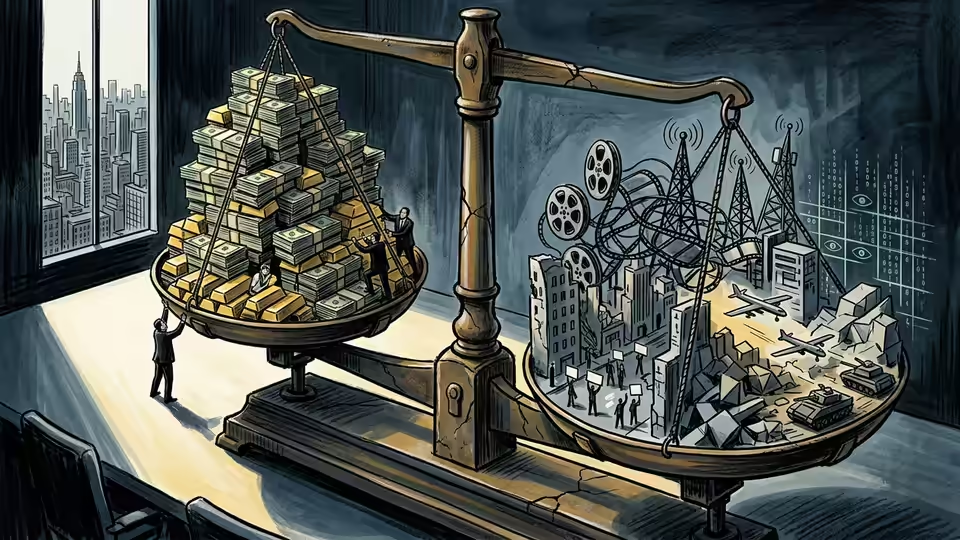
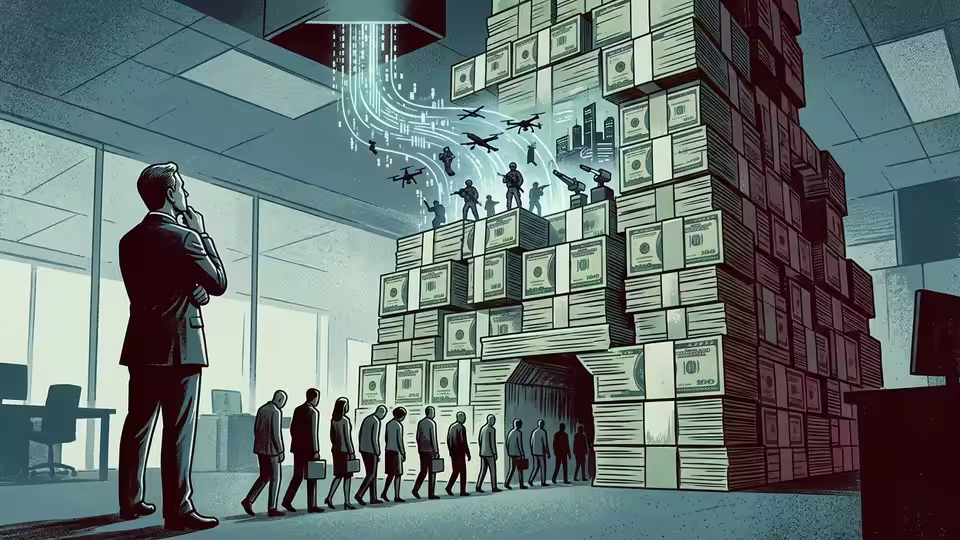
The money trail behind these narratives often leads back to defense industry funding and the protection of military aid packages. In early 2026, as debates over an additional $1.2 billion in regional security assistance began in legislative committees, the 'new front' narrative provided the necessary political cover. If the public perceives a conflict as a fresh, unprovoked escalation, they are more likely to support emergency funding. However, if the public understands the conflict as a violation of a 2024 treaty—one that was specifically designed to prevent these exact movements—they may instead demand diplomatic accountability rather than more weapons. OpenSecrets data indicates that top defense contractors spent over $38 million in lobbying during the preceding fiscal year to ensure that 'stability' remains the primary justification for continued defense exports.
The Globe and Mail issued its own revisions on March 6, 2026. After days of public pressure and targeted intervention from media watchdog groups like CJPME, the outlet added references to UN Resolution 1701. [UN Resolution 1701] is a 2006 United Nations mandate intended to resolve the 2006 Lebanon War by calling for a demilitarized zone and the withdrawal of foreign forces. By initially omitting this, The Globe and Mail effectively bypassed its own historical archives, which had thoroughly documented the 2006 and 2024 frameworks in the past. This 'selective amnesia' ensures that the parties responsible for breaking the 2024 agreements are not held to the standard of international law in the court of public opinion.
These revisions were not proactive measures taken by diligent editors. They were reactive corrections forced by readers who cross-referenced the reporting with historical documents. In many cases, the corrections were relegated to obscure 'correction logs' at the bottom of digital pages. This ensures that the original, sanitized headlines remain the dominant ones indexed by search engines and archived in the minds of casual readers. By the time the context is added, the political momentum for escalation has already been established. This is a tactic of narrative inertia: the first version of the story does the heavy lifting, and the correction serves only to protect the outlet from formal charges of inaccuracy.
The erasure of the 2024 framework prevents the public from identifying which party first violated the terms of the cessation of hostilities. In Gen Us's analysis of the Politician Tracker data, we see a direct correlation between members of the Foreign Affairs Committee who received significant donations from defense PACs and those who used the 'new front' terminology in their public statements. By aligning their rhetoric with the sanitized AP headlines, these politicians avoid questions about why previous diplomatic efforts failed and why taxpayers should fund a continuation of the same cycle.
For the average person, this media behavior is not merely an academic concern. It is a direct assault on the right to be informed. When the media resets history, it robs citizens of the ability to judge the efficacy of their government’s foreign policy. You are told that more money is needed for a 'new' emergency, when in reality, you are paying for the failure to enforce an old agreement. This cycle of omission ensures that conflict remains a permanent feature of the budget, rather than a problem to be solved through law and treaty enforcement.
You can hold these outlets accountable by using the Gen Us Media Bias Tracker to compare original headlines with their revised versions. Check our Politician Tracker to see if your representative is echoing the 'new front' narrative while ignoring the 2024 ceasefire violations. Knowledge of the law is the only defense against a narrative designed to circumvent it.
Summary
The Globe and Mail and Associated Press were forced to retroactively revise reports after erasing a 2024 ceasefire framework from their coverage of regional escalations. These revisions, occurring between March 4 and March 6, 2026, suggest a systemic attempt to reset the clock on international treaty violations.
⚡ Key Facts
- The Globe and Mail, AP, and Toronto Star revised stories between March 4-6, 2026, to include the 2024 ceasefire framework and UN Resolution 1701.
- CJPME documented a 22% increase in 'headline sanitization' in Q1 2026, where historical context is removed to frame military actions as new or unprovoked.
- Initial reports failed to mention that the 2026 movements were specific violations of a cessation of hostilities agreement signed only two years prior.
- The Associated Press's role as a global wire service allows a single editorial omission to be syndicated across thousands of local news outlets, creating a narrative monoculture.
- Revisions were reactive and often placed in obscure correction logs rather than being updated with front-page prominence.
- The 'new front' framing coincided with legislative debates over a $1.2 billion security assistance package, providing political cover for escalation.
Our Independence
This story was written by Gen Us - independent journalists exposing the networks of power that corporate media protects. No hedge fund owns us. No billionaire edits our headlines. We answer only to you, our readers.
Follow the public record
Source Trail
Get the next investigation in your inbox
One email a week. Receipts only. Free.
Free. Unsubscribe anytime. We never share your email.