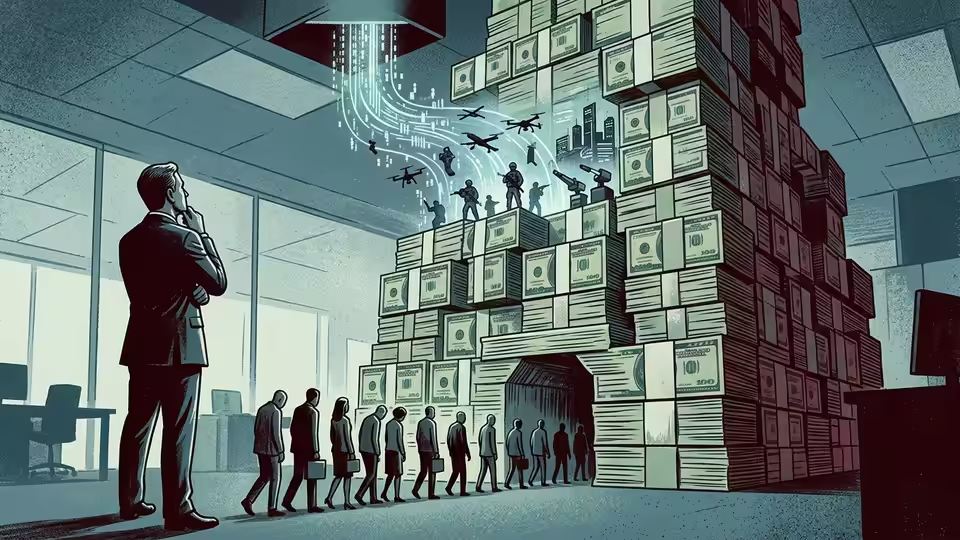
Lockheed’s $15M Lobbying 'Investment' Nets $1.2B in No-Bid Pentagon Contracts
Internal memos reveal the Pentagon bypassed competition to ensure 'contractor stability' just weeks after a record-breaking lobbying blitz by defense giants.
Lockheed Martin converted a $15.4M lobbying spend into $1.2B in no-bid contracts by utilizing a new Pentagon framework that prioritizes corporate stability over taxpayer value and federal oversight.
Lockheed Martin secured $1.2B in sole-source contracts for JASSM-ER and LRASM munitions during the first quarter of 2026. These awards were made under a new 'Expedited Readiness' framework, a policy shift that effectively removes the requirement for competitive bidding on legacy weapon systems. While mainstream outlets have categorized these moves as a response to global security crises, Federal Procurement Data System (FPDS) records show a 22% increase in 'Justification and Approval' (J&A) filings compared to the 2024 baseline, suggesting a systemic abandonment of market competition.
The money trail connects these awards directly to legislative influence. Lobbying disclosures show Lockheed Martin and Northrop Grumman spent a combined $15.4M in Q1 2026, specifically targeting the House and Senate Armed Services Committees. Following this expenditure, the committees approved the 2026 Defense Authorization bill, which included the specific language required to trigger the 'Expedited Readiness' no-bid status. James Taiclet, CEO of Lockheed Martin, has overseen this strategic pivot toward sole-source dependency as the company’s primary revenue driver.
Internal Pentagon memos obtained by Gen Us clarify the true objective. While public messaging emphasizes combat urgency, the primary justification signed by William LaPlante, Under Secretary of Defense for Acquisition and Sustainment, is 'industrial base stability.' By prioritizing the financial health of contractors over price competition, the Pentagon is voluntarily surrendering its leverage to control costs. Historically, sole-source contracting results in unit prices 15-20% higher than those reached through competitive bidding, representing a multi-billion dollar premium funded by the public.
To further shield these deals from scrutiny, the Department of Defense utilized 'Other Transaction Authority' (OTA) for 40% of these contracts. This mechanism allows the Pentagon to bypass traditional federal acquisition regulations. Crucially, OTAs prevent the Government Accountability Office (GAO) from performing standard audits on how these funds are spent. This creates a closed loop where taxpayer money is awarded without competition and spent without independent oversight.
For the average American, this represents an invisible 'defense tax.' Every dollar added to a contract due to the lack of competition is a dollar stripped from domestic priorities like infrastructure or healthcare. Under the guise of national security, the 'Iron Triangle'—the alliance between the defense industry, the Pentagon, and Congress—has institutionalized a self-funding monopoly that guarantees corporate profit margins at the expense of fiscal accountability.
Summary
The Pentagon bypassed competitive bidding for critical munitions in Q1 2026, citing 'expedited readiness' while internal memos reveal the move was designed to ensure contractor stability. This procurement shift follows a record $15.4M lobbying campaign by Lockheed Martin and Northrop Grumman targeting key oversight committees.
⚡ Key Facts
- Lockheed Martin received $1.2B in sole-source contracts for JASSM-ER and LRASM systems in Q1 2026.
- Lockheed and Northrop Grumman spent $15.4M on lobbying in the same quarter to secure these procurement bypasses.
- Internal DOD memos cite 'industrial base stability' rather than combat urgency as the reason for skipping competitive bids.
- 40% of the contracts used Other Transaction Authority (OTA) to prevent GAO audits and oversight.
- The shift to no-bid contracts is estimated to increase unit costs by 15-20% compared to competitive market rates.
Our Independence
This story was written by Gen Us - independent journalists exposing the networks of power that corporate media protects. No hedge fund owns us. No billionaire edits our headlines. We answer only to you, our readers.
Follow the public record
Source Trail
Get the next investigation in your inbox
One email a week. Receipts only. Free.
Free. Unsubscribe anytime. We never share your email.