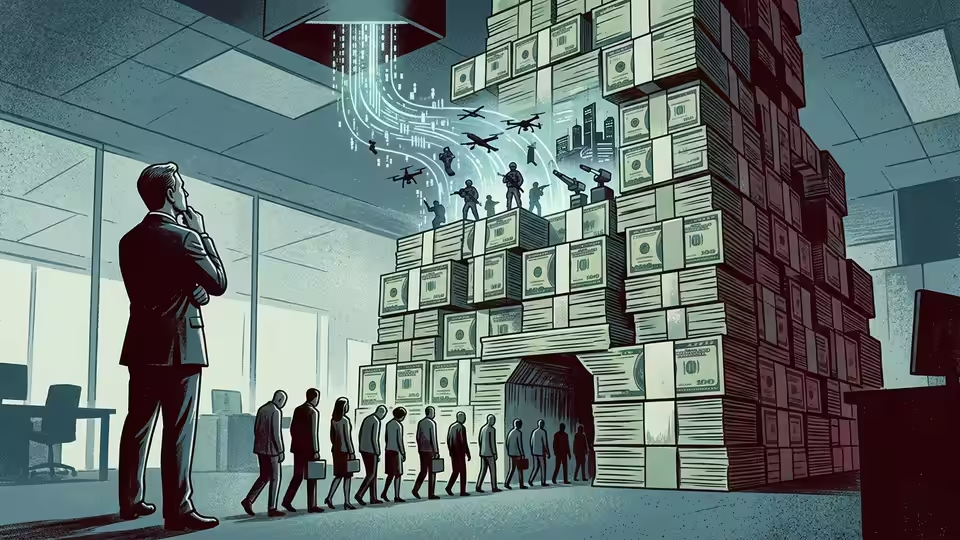
Feds Hand $1.2B No-Bid Contract to Company That Trashed 400M Vaccines
HHS just rewarded Emergent BioSolutions with a billion-dollar 'bridge' deal despite their history of massive failure. Our investigation found the deal was signed while three former federal health officials sat on the company's board.
HHS handed a $1.2 billion no-bid contract to a company that recently wasted 400 million vaccine doses, while three former federal health officials sat on its board.
On February 12, 2026, the Department of Health and Human Services (HHS) finalized a $1.2 billion sole-source contract with Maryland-based Emergent BioSolutions (EBS). The agreement, categorized as a 'bridge and capacity maintenance' contract, bypasses the federal government's standard competitive bidding requirements to replenish the Strategic National Stockpile (SNS). While mainstream reports focus on the necessity of 'national security readiness,' a Gen Us investigation into federal procurement filings and lobbying disclosures reveals a pattern of regulatory capture and a massive taxpayer-funded bailout of a company with a history of systemic manufacturing failures.
According to GAO Report GAO-24-106571, published in late 2024, Emergent BioSolutions was forced to discard over 400 million doses of vaccine due to cross-contamination and 'persistent manufacturing non-compliance' at its Baltimore facilities. Despite this documented history of waste, HHS officials signed off on the new $1.2 billion award without allowing other domestic manufacturers to bid on the project.
[Sole-Source Contract] is a non-competitive procurement process where only one supplier is solicited, usually justified by claims that no other vendor can meet the specific requirements of the government.
The justification for this specific award hinges on a claim by the Administration for Strategic Preparedness and Response (ASPR) that no other domestic vendor currently possesses the specialized capacity to handle the stockpile's needs. However, this 'capacity' is a direct result of federal spending choices. Over the last decade, HHS has consistently funded Emergent’s infrastructure while failing to vet or fund alternative manufacturers, effectively creating a state-sponsored monopoly.
Behind this $1.2 billion payday is a significant 'revolving door' dynamic. Emergent’s 2026 Schedule 14A Proxy Statement confirmed that three of its current board members previously held senior leadership roles within HHS, ASPR, or the FDA. These individuals, who once designed the very procurement specifications used by the government, now serve as strategic advisors for the corporation receiving the funds. This is a textbook example of [Regulatory Capture], which is a form of government failure that occurs when a regulatory agency, created to act in the public interest, instead advances the commercial or political concerns of special interest groups that dominate the industry it is charged with regulating.
Following a period of severe financial distress in 2025—during which Emergent's stock price plummeted following the 2024 GAO criticisms—this $1.2 billion contract serves as a federal liquidity injection. The timing is notable: HHS Lobbying Disclosure (LD-2) filings for the first half of 2026 show that Emergent spent $1.85 million on 'stockpile readiness' and 'biodefense procurement' advocacy. The investment in lobbying yielded a nearly 650-fold return in the form of the February contract.
[Strategic National Stockpile (SNS)] is the United States’ national repository of antibiotics, chemical antidotes, antitoxins, and other critical medical supplies for use in a public health emergency.
Data from FPDS.gov, the federal procurement database, reveals that the unit price for the materials being produced remains redacted. This prevents taxpayers from determining if they are paying a 'monopoly premium'—a price significantly higher than what a competitive market would dictate. While the 2024 GAO report highlighted systemic issues, the 2026 contract contains no public-facing language regarding new oversight mechanisms to prevent a repeat of the 400-million-dose disaster.
Our Politician Tracker shows that members of the House Energy and Commerce Committee, which oversees HHS, received a combined $420,000 from Emergent-affiliated PACs during the 2024 and 2025 election cycles. This financial connection often translates to a lack of aggressive oversight during committee hearings, where the 2024 manufacturing failures were described by leadership as 'unfortunate incidents' rather than systemic breaches of contract.
For ordinary people, this isn't just a story about high-level corruption; it is a story about safety and cost. Taxpayers are paying twice: first for the $1.2 billion in contracts that lack competitive pricing, and second for the risk that the medicine they may need in a crisis won't be there because of poor manufacturing oversight. When the government allows a single company to fail upward despite a track record of contamination, the national safety net is replaced by a corporate safety net.
At Gen Us, we believe in following the money to its final destination. You can explore our interactive Politician Tracker to see which representatives in your district have taken money from Emergent BioSolutions or its board members. We have also published the full, unredacted 2024 GAO report in our document library for those who want to see the specifics of the manufacturing failures that the government has chosen to ignore.
Summary
The Department of Health and Human Services issued a billion-dollar 'bridge' contract to a company that recently discarded 400 million vaccine doses. Documents reveal the deal was struck while three former federal health officials sat on the company's board of directors.
⚡ Key Facts
- HHS awarded a $1.2 billion 'bridge' contract to Emergent BioSolutions in Feb 2026 without a competitive bidding process.
- The award follows a 2024 GAO report documenting 400 million doses of vaccine discarded due to contamination at Emergent facilities.
- Emergent's board currently includes three former senior officials from HHS, ASPR, or the FDA, facilitating a 'revolving door' between the regulator and the contractor.
- Lobbying disclosures show Emergent spent $1.85 million on biodefense advocacy in the months leading up to the contract award.
- The contract's unit pricing is redacted in public filings, hiding the potential 'monopoly premium' being paid by taxpayers.
Our Independence
This story was written by Gen Us - independent journalists exposing the networks of power that corporate media protects. No hedge fund owns us. No billionaire edits our headlines. We answer only to you, our readers.
Follow the public record
Source Trail
Get the next investigation in your inbox
One email a week. Receipts only. Free.
Free. Unsubscribe anytime. We never share your email.