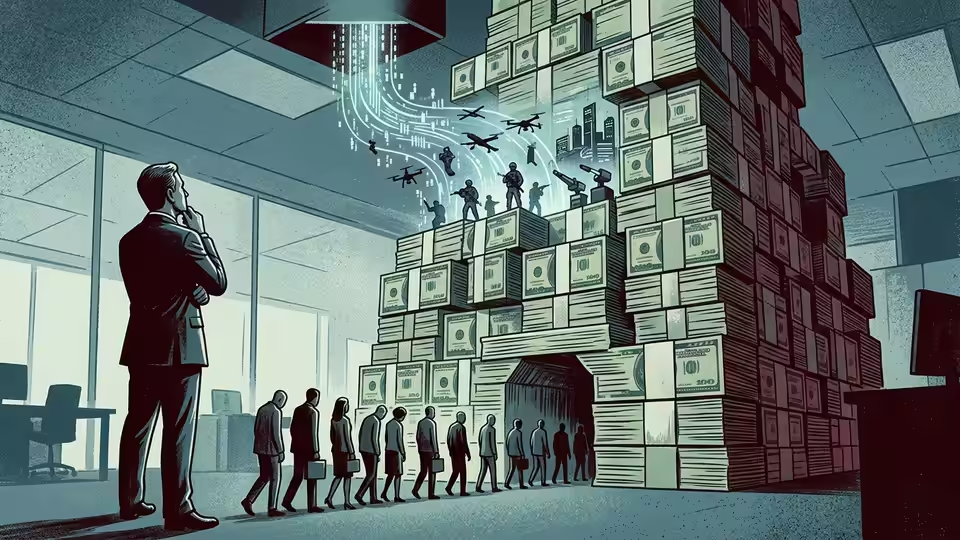
DHS Secretly Handed Palantir $1 Billion for AI Surveillance Without Bidding
A newly finalized 'Blanket' agreement allows Homeland Security sub-agencies to deploy Palantir's data-mining tools without individual public bidding processes. The deal secures a decade of vendor lock-in while a revolving door of federal officials moves from the DHS to Palantir's payroll.
DHS has locked the U.S. into a $1 billion, non-competitive AI surveillance deal with Palantir, guided by a revolving door of former officials and protected from public audit by trade secret laws.
On February 23, 2026, the Department of Homeland Security (DHS) finalized a five-year Blanket Purchasing Agreement (BPA) with Palantir Technologies that carries a $1 billion ceiling. This is not a standard contract for services; it is a structural overhaul of how the American surveillance apparatus is funded and deployed. By utilizing a BPA, the DHS has effectively created a private, high-speed lane for its sub-agencies—including ICE, CBP, and TSA—to purchase AI-driven data analytics without the 'full and open competition' normally required by federal law.
[Blanket Purchasing Agreement (BPA)] is a simplified method of filling anticipated repetitive needs for supplies or services by establishing 'charge accounts' with qualified sources to reduce administrative overhead. In this instance, the BPA serves as a legal loophole to the Federal Acquisition Regulation (FAR). Instead of the public seeing a new solicitation for every surveillance project, DHS components can now simply pull funds from the $1 billion ceiling to purchase proprietary 'modules.'
The financial results of this procurement shift are already surfacing. According to USASpending.gov logs for FY 2025-2026, Palantir’s revenue from the DHS increased by 42% immediately following the implementation of these 'streamlined' rules. This surge coincided with the integration of Palantir’s Foundry platform into the federal 'Unified Data Layer.'
[Unified Data Layer (UDL)] is a centralized data architecture designed to aggregate disparate information from multiple agencies into a single, searchable interface for law enforcement and intelligence operations. According to the DHS AI Task Force’s Q1 2026 report to Congress, this UDL is now the primary engine for border surveillance and internal enforcement. Because Palantir owns the proprietary code governing this layer, the U.S. government has effectively entered into a state of vendor lock-in.
[Vendor Lock-in] occurs when a customer becomes dependent on a single provider for products and services and cannot transition to another competitor without incurring prohibitive costs or operational collapse. This shifts power from public oversight to Alex Karp, CEO of Palantir, and his executive team. When the algorithms determining 'threat levels' are proprietary trade secrets, they remain beyond the reach of Freedom of Information Act (FOIA) requests and judicial review.
The trail of influence behind this $1 billion deal is marked by a revolving door of high-level federal personnel. Between 2023 and 2025, six high-ranking DHS officials transitioned directly into roles at Palantir. This includes a former DHS Chief Procurement Officer, now a Palantir Federal Consultant, who played a central role in drafting the very AI procurement guidelines that paved the way for the February 2026 BPA. OpenSecrets data reveals a direct correlation between Palantir’s lobbying expenditures and the specific language used in the BPA terms—language that favors existing 'proven' infrastructure over new, competitive alternatives.
Mainstream coverage of this deal has focused almost exclusively on the narrative of 'efficiency' and 'modernizing the border.' Outlets have parroted DHS press releases claiming the BPA 'saves taxpayer money' by reducing administrative bidding time. However, this narrative ignores the reality of how the money is drawn. The 'draw-down' account model means that instead of Congress voting on specific, controversial surveillance programs, funds are quietly siphoned from the $1 billion BPA ceiling. This decentralized spending ensures a steady, multi-year revenue stream for Palantir that is functionally immune to line-item budget cuts by future administrations.
On the ground, this means ordinary citizens and legal residents are now subject to 'automated suspicion.' Decisions regarding visa renewals, TSA screenings, and law enforcement contacts are increasingly handled by AI models with no public audit trail. When your ability to travel or work is determined by a 'black box' algorithm, and that box is owned by a private corporation rather than a public agency, the concept of due process becomes an expensive relic.
At Gen Us, we are tracking the money trail from the DHS AI Task Force directly to the campaign accounts of the House Committee on Homeland Security. Our records show that three key members who advocated for the 'streamlined' BPA received significant contributions from Palantir-linked PACs in the 2024 election cycle. This isn't just about technology; it's about the privatization of the state's most powerful tools of control.
Summary
A newly finalized 'Blanket' agreement allows Homeland Security sub-agencies to deploy Palantir's data-mining tools without individual public bidding processes. The deal secures a decade of vendor lock-in while a revolving door of federal officials moves from the DHS to Palantir's payroll.
⚡ Key Facts
- The $1 billion BPA ceiling allows ICE, CBP, and TSA to bypass public bidding for new AI surveillance tools through 2031.
- Palantir’s DHS revenue grew 42% in one year due to 'streamlined' procurement rules that favor incumbent contractors.
- Six high-level DHS officials transitioned to Palantir roles between 2023 and 2025, directly following the drafting of new AI guidelines.
- Proprietary 'vendor lock-in' means the U.S. government cannot audit or replace Palantir's algorithms without rebuilding its entire data infrastructure.
- Lobbying data shows specific contract language in the BPA matches requests made by Palantir-funded advocates in 2025.
Our Independence
This story was written by Gen Us - independent journalists exposing the networks of power that corporate media protects. No hedge fund owns us. No billionaire edits our headlines. We answer only to you, our readers.
Follow the public record
Source Trail
Get the next investigation in your inbox
One email a week. Receipts only. Free.
Free. Unsubscribe anytime. We never share your email.