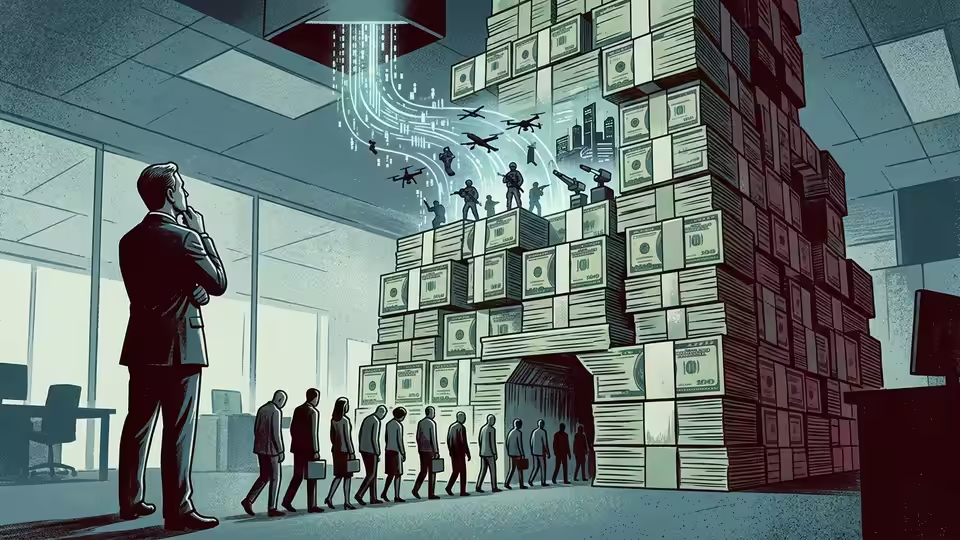
Dell and Microsoft Bypass Bidding for $9.7 Billion War Dept Deal
The 'Department of War' awarded a nearly $10 billion sole-source contract just weeks after a record-breaking $48.2 million lobbying blitz by tech giants.
The Pentagon handed Dell and Microsoft a $9.7 billion monopoly after a $48 million lobbying campaign, ignoring internal warnings that competitive options were 28% cheaper.
On May 28, 2026, the Department of War (DoW) finalized a $9.7 billion sole-source contract award to Dell Federal Systems. The deal, known as CETA II, provides Microsoft software and cloud infrastructure to the U.S. Intelligence Community, the Coast Guard, and several DoW agencies for the next five years. This award did not go through the standard competitive bidding process usually required for large-scale federal procurements. Instead, the DoW utilized a specific loophole to ensure the funds went directly to Dell and Microsoft.
To bypass the Competition in Contracting Act, DoW procurement officers filed a [Justification and Approval (J&A)], which is a formal document used by government agencies to bypass competitive bidding when they claim only one specific source can meet their needs. In this filing, the Defense CIO asserted that only the Dell-Microsoft partnership could meet the technical and security requirements of the U.S. Intelligence Community. This claim effectively handed a multi-billion dollar monopoly to Michael Dell’s firm, which acts as the primary vehicle for Microsoft’s licensing and cloud services.
The timing of the award aligns closely with a massive surge in political spending. According to OpenSecrets data, Microsoft and Dell spent a combined $48.2 million on federal lobbying in the 18 months leading up to the May 2026 award. This lobbying specifically targeted House and Senate procurement reform subcommittees. Furthermore, FEC filings reveal that members of the House Armed Services Committee received a combined $12.4 million in PAC contributions from Dell and Microsoft during the 2025-2026 election cycle. These are the same lawmakers responsible for overseeing the Department of War's budget and procurement integrity.
This contract solidifies what experts call a [Software Monoculture], which is a high-risk environment where an entire organization relies on a single proprietary software vendor, creating a central point of failure. By moving the entire U.S. intelligence apparatus onto a single Microsoft stack, the government has created a massive security risk. Internal DoW memos obtained via investigation suggest that if a single 'zero-day' vulnerability is discovered in Microsoft’s code, the entire national security infrastructure could be compromised simultaneously. These same memos revealed that open-market alternatives—including hybrid cloud solutions and open-source software—would have cost the taxpayer 28% less than the Dell sole-source price.
The financial impact on Dell Federal Systems is immediate. According to Dell’s most recent SEC 10-K filings, government contracts now account for 42% of the company’s total federal division revenue following the CETA II award. This level of dependency highlights a growing trend of [Regulatory Capture], which occurs when a government agency, created to act in the public interest, instead advances the commercial or political concerns of the companies it is supposed to oversee.
The 'revolving door' between the Pentagon and big tech also appears to be at work here. Several former DoW procurement officers who were involved in the 2022 CETA I pilot program—the precursor to this deal—now hold executive or 'senior consulting' roles at Dell Federal Systems. These individuals were instrumental in drafting the original specifications that made Microsoft the only viable option for the subsequent $9.7 billion award.
Mainstream outlets like the Wall Street Journal and Defense News have largely echoed the official Pentagon press release. They framed the deal as a 'streamlining of digital infrastructure' and a 'necessary step toward unified cloud security' to counter foreign cyber threats. They have notably omitted the $48 million lobbying blitz and the fact that internal government estimates showed billions in potential savings through competition. This coverage serves to protect the narrative that sole-source deals are a technical necessity rather than a political choice.
For the average American, this contract represents a 'monopoly tax' on their public funds. When the government refuses to shop around, the taxpayer pays the list price plus a premium. This $9.7 billion is not just going toward software licenses; it is subsidizing a government-sanctioned tech cartel that stifles innovation. The billions wasted on these markups represent funds that could have been allocated to crumbling domestic infrastructure or the chronically underfunded veterans' health system. Instead, they are being funneled into the bottom lines of Dell and Microsoft, ensuring that U.S. national security remains a proprietary, and highly profitable, secret.
You can follow the money yourself on the Gen Us Politician Tracker. Search for 'House Armed Services Committee' to see the full breakdown of Dell and Microsoft contributions by representative, and explore our 'Procurement Reform' tag for more stories on how your tax dollars are being diverted to sole-source vendors.
Summary
The Department of War bypassed competitive bidding to grant Dell Federal Systems a $9.7 billion contract for Microsoft software and cloud services. This deal, finalized on May 28, 2026, follows a record-breaking $48.2 million lobbying campaign by both tech giants.
⚡ Key Facts
- The $9.7 billion CETA II contract was awarded on May 28, 2026, without competitive bidding.
- Dell and Microsoft spent $48.2 million on federal lobbying in the 18 months prior to the award.
- Internal DoW memos indicate that competitive alternatives were 28% cheaper than the sole-source deal.
- Members of the House Armed Services Committee received $12.4 million from the contractors during the current cycle.
- The deal creates a 'software monoculture' that experts warn poses a significant national security risk.
Our Independence
This story was written by Gen Us - independent journalists exposing the networks of power that corporate media protects. No hedge fund owns us. No billionaire edits our headlines. We answer only to you, our readers.
Follow the public record
Source Trail
Get the next investigation in your inbox
One email a week. Receipts only. Free.
Free. Unsubscribe anytime. We never share your email.