CNN’s Humanization Gap: 82% of Ukrainians Named, Only 14% of Palestinians
A quantitative analysis of CNN’s Q1 reporting reveals a staggering editorial bias that aligns with the interests of major institutional shareholders in the defense industry.
CNN's reporting consistently humanizes victims of U.S. adversaries while using passive language and military analysts to sanitize casualties caused by U.S. allies, a trend mirrored by the financial interests of their defense-invested shareholders.
A quantitative analysis of CNN headlines and broadcast segments from the first quarter of 2026 reveals a stark disparity in how human life is valued based on geopolitical alignment. According to the 2026 Media Portrayals Report from the UCLA Initiative to Study Hate, Ukrainian victims were named or identified by familial roles (e.g., 'mother,' 'grandfather') in 82% of reports. In contrast, Palestinian and Lebanese victims were named or humanized in only 14% of equivalent coverage. This data indicates that the network’s editorial standards do not apply universally, but fluctuate according to whether the victim belongs to a U.S. ally or an adversary.
This discrepancy extends beyond names to the grammatical structure of the reporting itself. The UCLA study found that 78% of CNN headlines regarding the Gaza Strip utilized passive voice—for example, 'Deaths reported' or 'Explosion kills 20'—which obscures the actor responsible for the violence. Conversely, only 12% of Ukraine headlines used passive voice, frequently employing active constructions like 'Russian missiles kill mother.' By omitting the perpetrator in headlines regarding Gaza, the network systematically shields the Israeli military from direct accountability in the eyes of the casual reader.
[Passive Voice Framing] is a linguistic technique where the subject of a sentence—the person or entity performing an action—is omitted or moved to the end, often obscuring responsibility for that action.
The visual language of CNN’s broadcasts further reinforces this hierarchy of human value. Data from the UCLA report shows that CNN used 'humanizing' close-up shots of civilians 4x more frequently in segments about Ukraine than in segments about the Middle East. Furthermore, the average interview duration for a Ukrainian civilian was 4 minutes and 42 seconds, providing ample time for the audience to develop empathy for their personal narrative. For Palestinian or Lebanese civilians, the average interview lasted just 1 minute and 18 seconds, often serving as a brief soundbite within a broader segment dominated by military analysts.
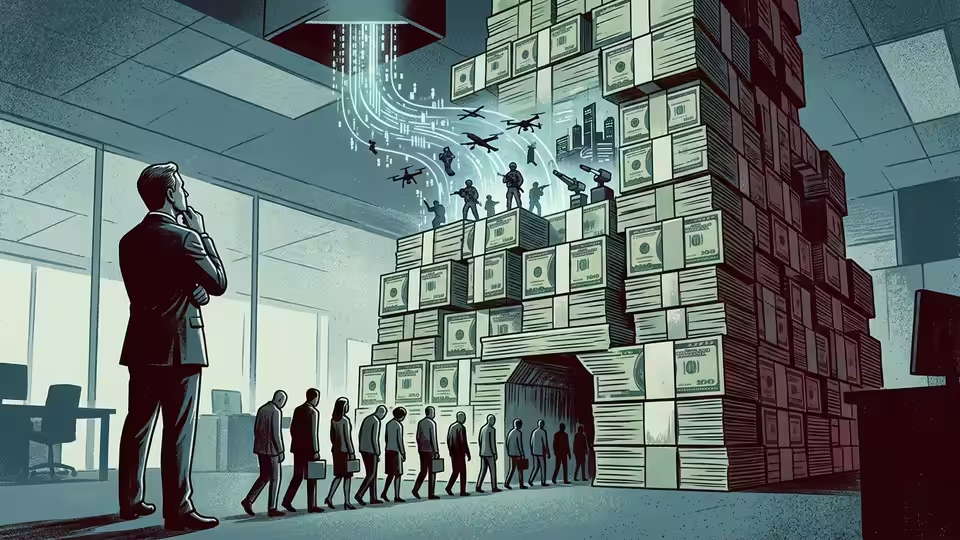
To understand why this gap exists, one must follow the money. CNN is a subsidiary of Warner Bros. Discovery (WBD), led by CEO David Zaslav and CNN CEO Mark Thompson. According to SEC Schedule 13G filings, WBD's top shareholders include Vanguard Group (holding roughly 10.5%) and BlackRock (holding roughly 7.2%). These same institutional giants are the primary shareholders in major defense contractors. BlackRock and Vanguard collectively hold billions of dollars in stock in Lockheed Martin, RTX (formerly Raytheon), and Northrop Grumman.
[Institutional Overlap] refers to a situation where the same financial entities own significant shares in both the media companies reporting on conflicts and the defense companies profiting from the weapons used in those conflicts.
This creates a financial ecosystem where the editorial tone of the newsroom aligns with the interests of the military-industrial complex. When CNN frames Palestinian deaths as 'accidental' or 'inevitable' statistics while framing Ukrainian deaths as 'outrages against humanity,' they are effectively managing domestic political pressure. This framing assists in manufacturing consent for massive military aid packages. For instance, according to TrackAIPAC and OpenSecrets data, members of the House and Senate who received significant campaign contributions from pro-Israel lobbying groups—such as Representative Ritchie Torres ($1,000,000+)—frequently appear on CNN to provide 'context' that mirrors the network’s passive framing of civilian casualties.
The experts invited to speak on these conflicts also vary wildly. Sage Journals data indicates that 90% of guest experts for Ukraine segments were civilian or humanitarian workers. In contrast, 65% of guests for Gaza segments were military or former intelligence officials. This pivot from humanitarian voices to military ones effectively shifts the narrative from the 'human cost of war' to 'tactical necessity.'
[Access Journalism] is a style of reporting that prioritizes maintaining a positive relationship with powerful sources (such as government or military officials) over critical, independent investigation, often to ensure continued access to those sources.
CNN maintains its proximity to the U.S. State Department and Israeli military censors to keep operational access in the region. This proximity results in 'sanitized' reporting of allies' actions. In one internal memo referenced in the UCLA study, editorial staff were encouraged to 'verify' all Palestinian casualty figures with Israeli officials, a standard not applied to Ukrainian figures provided by the Ukrainian government. This double standard ensures that the identity of the perpetrator is only highlighted when it suits U.S. foreign policy objectives.
For the ordinary citizen, this 'humanization gap' is more than an academic concern. It directly influences how taxpayer money is prioritized. In 2024 and 2025, the U.S. approved over $100 billion in foreign military aid. When the media portrays certain victims as 'protagonists' and others as 'passive statistics,' it shapes the public's willingness to fund the weapons that cause these casualties. By making some lives seem worth more than others, CNN and its corporate owners ensure that the cycle of defense spending continues without significant public resistance. Your perception of global morality is being curated by the same firms that profit from the hardware of war.
Summary
A quantitative analysis of CNN’s Q1 2026 reporting reveals a systemic 'humanization gap' in the coverage of global conflicts. This editorial asymmetry aligns with the geopolitical interests of CNN’s largest institutional shareholders, who maintain multi-billion dollar stakes in the defense industry.
⚡ Key Facts
- UCLA research found CNN names Ukrainian victims in 82% of reports compared to 14% for Palestinian/Lebanese victims.
- CNN used passive voice in 78% of Gaza-related headlines, effectively masking the perpetrator of the violence.
- Average interview times for Ukrainian civilians (4:42) were nearly quadruple those of Palestinian civilians (1:18).
- Institutional shareholders of CNN’s parent company (Vanguard, BlackRock) are also top owners of defense contractors like Lockheed Martin and Raytheon.
- Guest experts for Ukraine were 90% civilian/humanitarian, while Gaza segments relied on military or intelligence officials 65% of the time.
Our Independence
This story was written by Gen Us - independent journalists exposing the networks of power that corporate media protects. No hedge fund owns us. No billionaire edits our headlines. We answer only to you, our readers.
Follow the public record
Source Trail
Get the next investigation in your inbox
One email a week. Receipts only. Free.
Free. Unsubscribe anytime. We never share your email.