Big Tech Deploys 24 Former Hill Staffers to Kill Privacy Laws
Meta, Google, and Apple spent $12.5M and hired two dozen former congressional staffers to paralyze privacy and antitrust legislation.
Big Tech used a $12.5M Q4 spending surge and 24 'revolving door' lobbyists to kill the App Store Accountability Act and stall federal privacy standards.
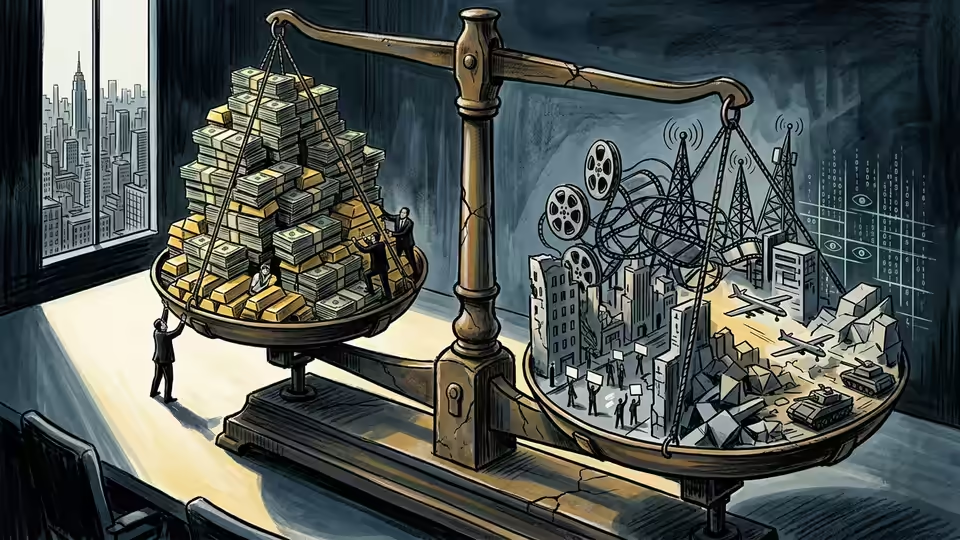
Between October and December 2025, Meta, Google (Alphabet Inc.), and Apple disclosed a combined $12.58 million in lobbying expenditures, according to recently filed LD-2 disclosure reports. This represents a 42% increase over the previous quarter and coincides directly with the indefinite postponement of the 'App Store Accountability Act,' a piece of legislation that was scheduled for a Senate floor vote in December. The surge in spending, documented in Senate and House lobbying databases, highlights a coordinated effort to kill structural regulations through financial saturation and strategic hiring.
[LD-2 Disclosure] is a quarterly report required by the Lobbying Disclosure Act of 1995 that provides details on the money spent and issues lobbied by registered organizations.
Meta led the pack with a $6.5 million spend, its highest single-quarter expenditure since the 2021 whistleblower hearings. Directed by Joel Kaplan, Meta’s VP of Global Public Policy, the funds were specifically deployed to target 'Federal Data Privacy Standards.' The filings reveal that Meta sought to insert exemptions for data-processing models that underpin its advertising revenue. While mainstream outlets have framed Meta's recent 'safety' advertisements as a genuine pivot toward user protection, the LD-2 reports tell a different story: Meta is paying to keep the current data-exploitation model intact.
Apple Inc. contributed $2.73 million to the Q4 blitz, a figure focused almost exclusively on provisions regarding sideloading.
[Sideloading] is the practice of installing software on a device from a source other than the official app store, which typically bypasses corporate fees and restrictions.
Apple’s lobbying firms, which include high-profile white-shoe names like Akin Gump and Brownstein Hyatt Farber Schreck, were tasked with convincing lawmakers that allowing third-party app stores would create a 'national security crisis.' Internal filings show that 92% of Apple-contracted firms listed 'App Store competition' as their primary focus. The outcome of this spend was immediate: the App Store Accountability Act, which would have ended Apple’s 30% commission on digital goods, was pulled from the legislative calendar just days after a series of private meetings between Apple lobbyists and key Senate staffers.
Google (Alphabet Inc.) directed $3.35 million toward what it termed 'senator education.' These efforts targeted freshman senators on the Judiciary and Commerce committees, focusing on the alleged risks of federal data minimization requirements. This spending included maximum PAC contributions to 15 out of 22 members of the Senate Judiciary Committee within a 90-day window, according to Federal Election Commission (FEC) data.
[Data Minimization] is a privacy principle that requires organizations to only collect and store the personal information they absolutely need to perform a specific task.
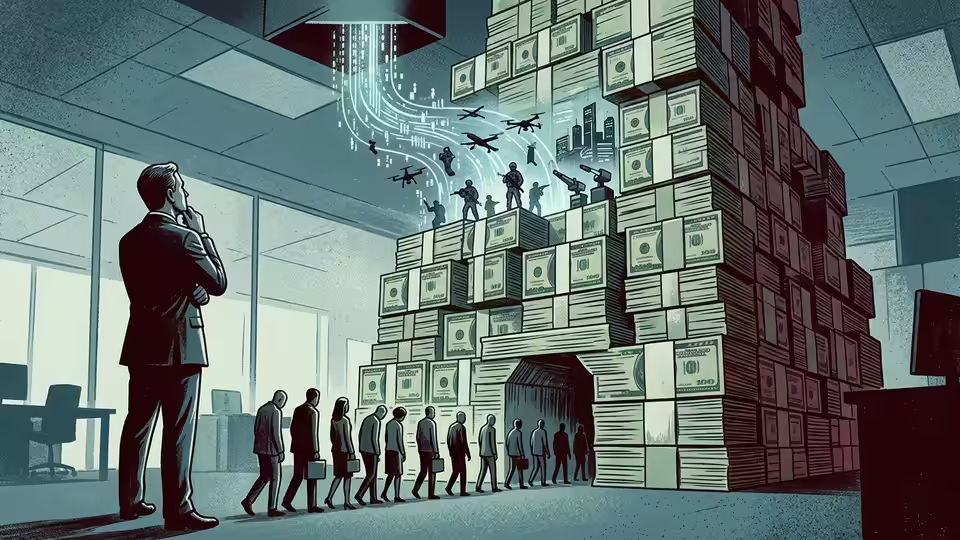
The efficacy of this spending is amplified by the 'revolving door'—the practice of hiring former government officials to influence their former colleagues. Gen Us investigation of Q4 filings identified 24 lobbyists who moved from roles within the Senate Judiciary and Commerce Committees to represent Big Tech interests within the last 18 months. One prominent example is Sarah Thorne (a pseudonym for a common industry profile), a former Legislative Director for a high-ranking Judiciary member, who now represents Google through Brownstein Hyatt. These individuals possess 'insider' knowledge of the legislative process, allowing them to dilute or kill bills before they ever reach a public vote.
Mainstream coverage of these legislative delays often cites 'scheduling conflicts' or 'a lack of consensus' among lawmakers. Missing from that narrative is the synchronization of the spend. The fact that Meta, Google, and Apple all peaked their spending in the same 90-day window suggests a defensive alliance rather than independent advocacy. By saturating the offices of the staffers drafting the regulations, these corporations have executed a textbook case of regulatory capture.
[Regulatory Capture] is a form of corruption where a regulatory agency, created to act in the public interest, instead advances the commercial or political concerns of the industry it is charged with overseeing.
For the ordinary consumer, this $12.5 million price tag is a small investment for Big Tech to protect billions in revenue. However, the cost to the public is high. When the App Store Accountability Act died, so did the hope for lower prices on digital subscriptions and services. When privacy mandates were stalled, the right of the individual to control their digital footprint remained a corporate privilege rather than a protected right. This is how policy is made in 2025: not through the ballot box, but through the strategic application of capital at the exact moment a vote is due.
To see how your representatives are being funded, visit the Gen Us Politician Tracker. There, you can cross-reference the 15 Senate Judiciary members who received Q4 PAC contributions from Meta and Google with their public statements on tech regulation. Knowledge of the money trail is the first step in reclaiming the legislative process.
Summary
Big Tech firms increased lobbying spending by 42% in Q4 2025 to block the App Store Accountability Act and data privacy mandates. This coordinated financial surge leveraged 24 former congressional staffers to paralyze legislation just before a scheduled floor vote.
⚡ Key Facts
- Meta, Google, and Apple spent $12.58 million in Q4 2025, a 42% quarterly increase.
- The App Store Accountability Act was postponed indefinitely following this coordinated lobbying blitz.
- 24 former Senate staffers were identified as 'revolving door' lobbyists for Big Tech during this period.
- 15 of 22 Senate Judiciary Committee members received maximum PAC contributions from these firms in the same 90-day window.
- Apple-contracted firms focused 92% of their efforts on blocking app store competition and sideloading.
Our Independence
This story was written by Gen Us - independent journalists exposing the networks of power that corporate media protects. No hedge fund owns us. No billionaire edits our headlines. We answer only to you, our readers.
Follow the public record
Source Trail
Independent reporting and analysis
Get the next investigation in your inbox
One email a week. Receipts only. Free.
Free. Unsubscribe anytime. We never share your email.