Army Bypasses Law to Hand Salesforce $5.5B Monopoly Until 2036
The U.S. Army ignored competitive bidding to award a $5.5 billion contract to Salesforce, citing a 'ten-year urgency.' A veteran-owned firm alleges the deal is a payoff for millions in corporate lobbying.
The Army gave Salesforce a $5.5 billion monopoly through 2036 by claiming a decade-long software deal was an 'emergency,' effectively bypassing small business laws and rewarding $2.4 million in corporate lobbying.
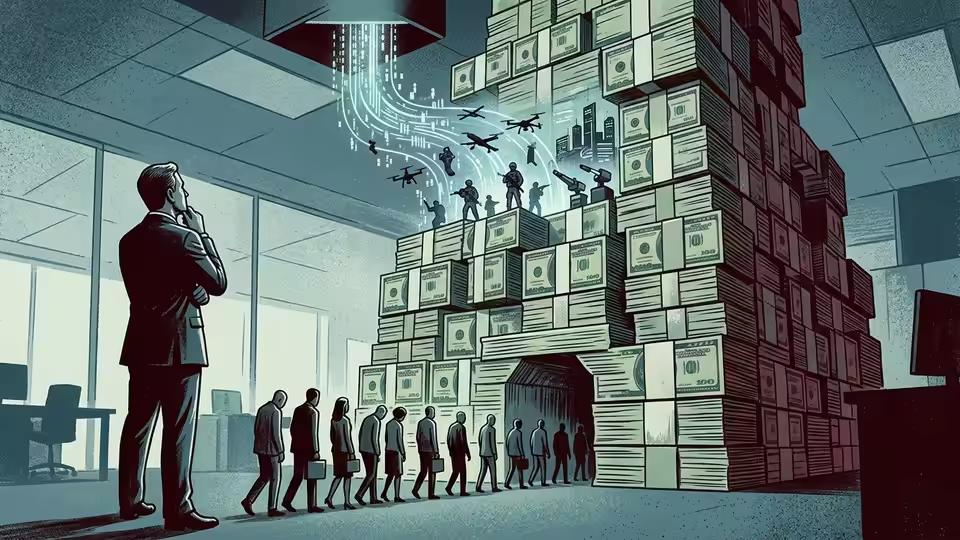
In February 2026, the Department of the Army finalized a $5.5 billion sole-source award to Salesforce Inc. for cloud-based software services. The contract, structured as a 10-year [Blanket Purchase Agreement (BPA)]—a simplified method of filling anticipated repetitive needs for supplies or services—locks the Department of Defense into a single software ecosystem for a decade. This transaction bypassed the Competition in Contracting Act of 1984, which generally requires government agencies to solicit bids from multiple vendors to ensure the best price for taxpayers. To skip this step, the Army Contracting Command (ACC) filed a Justification and Approval (J&A) document. The filing cited 'unusual and compelling urgency,' a legal loophole typically reserved for immediate battlefield needs or natural disasters. In this instance, the Army applied it to a ten-year administrative software overhaul.
The money trail suggests this 'urgency' followed a massive investment in influence. According to OpenSecrets and FEC lobbying disclosures, Salesforce Inc. spent over $2.4 million on federal lobbying in the fiscal year immediately preceding the award. These filings specifically targeted the National Defense Authorization Act (NDAA) and Army IT modernization accounts. Furthermore, Salesforce’s political action committee and top executives have contributed over $1.3 million to members of the House and Senate Armed Services Committees over the last two election cycles. When $5.5 billion is on the line, a $2.4 million lobbying budget represents a return on investment of roughly 229,000%. This is not just digital transformation; it is a calculated acquisition of government policy.
[Regulatory Capture] occurs when a government agency, created to act in the public interest, instead advances the commercial or political concerns of special interest groups that dominate the industry it is charged with regulating. The Salesforce deal is a textbook example. By labeling a decade-long software migration as an 'emergency,' the Army effectively silenced competitors who could have offered the same services at a lower price point. One of those competitors, Computable Insights, has refused to remain silent. The small, veteran-owned firm filed a formal protest (GAO B-421254) alleging the Army’s justification was a fabrication. The protest claims the Army ignored its own 'Rule of Two,' which mandates that contracts be set aside for small businesses if at least two capable small firms can do the work at a fair market price.
Mainstream coverage of the deal has been largely stenographic. Industry publications have framed the $5.5 billion payout as a 'bold step toward logistics modernization' and a 'streamlining of fragmented legacy systems.' These reports omit the financial cost of [Vendor Lock-in], a situation where a customer is so dependent on a vendor for products and services that they cannot move to another vendor without substantial switching costs. By the time the contract expires in 2036, the Army’s data will be so deeply integrated into Salesforce’s proprietary architecture that migrating to a competitor will be cost-prohibitive. This grants Salesforce a functional monopoly over Army cloud operations, allowing them to dictate pricing for renewals.
The human cost of this decision is measured in the erosion of the small business industrial base. The Army Enterprise Software Initiative (ESI) guidelines are written to prioritize American entrepreneurs and veterans. Instead, this deal funnels $5.5 billion in public funds toward a single multi-billion dollar corporation headquartered in San Francisco. According to data from the Project On Government Oversight (POGO), sole-source contracts of this magnitude typically result in 20% to 30% higher costs than competitively bid projects. For the American taxpayer, that is a potential 'lobbying tax' of $1.1 billion to $1.6 billion hidden within the contract price.
This deal also highlights a growing double standard in how the DoD treats small businesses versus tech giants. While a veteran-owned firm must navigate mountains of red tape to secure a $100,000 contract, Salesforce was able to secure $5.5 billion through a 'justification' that bypasses the law. Public records show that the Army official who signed off on the urgency claim formerly served on an advisory board closely linked to major Silicon Valley contractors—a classic 'revolving door' dynamic. For ordinary people, this means their tax dollars are being used to stifle innovation and cement a corporate aristocracy within the American military. It ensures that the future of defense infrastructure is owned by shareholders, not citizens.
You can track the specific members of the House Armed Services Committee who received Salesforce contributions using our Gen Us Politician Tracker. If you want to see how much your local representative took from the tech lobby before voting on the NDAA, explore our 'Defense Dollars' database. Knowledge is the only thing they can't lobby away.
Summary
The U.S. Army bypassed competitive bidding laws to hand Salesforce a $5.5 billion software monopoly that lasts until 2036. While the Army claims 'unusual and compelling urgency,' a protest by a veteran-owned firm alleges the deal is a payoff for millions in corporate lobbying.
⚡ Key Facts
- The Army bypassed the Competition in Contracting Act to award a $5.5B sole-source deal to Salesforce.
- The 10-year contract length contradicts the 'urgency' loophole used to avoid competitive bidding.
- Salesforce spent $2.4M on lobbying targeting Army IT and the NDAA prior to the award.
- Veteran-owned small business Computable Insights filed a GAO protest (B-421254) alleging the Army fabricated its justification.
- Lack of competition in this contract is estimated to cost taxpayers an additional $1.1B to $1.6B compared to competitive rates.
Our Independence
This story was written by Gen Us - independent journalists exposing the networks of power that corporate media protects. No hedge fund owns us. No billionaire edits our headlines. We answer only to you, our readers.
Follow the public record
Source Trail
Get the next investigation in your inbox
One email a week. Receipts only. Free.
Free. Unsubscribe anytime. We never share your email.