Apple Paid 82 Former Officials $10.1M to Kill Antitrust Laws
To protect its App Store monopoly, Apple deployed a record-breaking lobbying force comprised almost entirely of former government insiders. We tracked every dollar and every revolving-door hire.
Apple's record $10.1M lobbying blitz in 2025 used former government insiders and targeted donations to kill antitrust bills, keeping the 30% App Store tax in place for consumers.
Apple Inc. reported a record $10.1 million in federal lobbying expenditures for the 2025 fiscal year, according to the latest Q4 LD-2 filings. This figure represents a 20% surge over 2024 spending, coinciding with a high-stakes legislative push to dismantle the company’s control over the iOS ecosystem. While Apple’s public marketing emphasizes consumer privacy and device security, its federal disclosures reveal a primary focus on neutralizing two specific pieces of legislation: the Open App Markets Act (S.2710) and the American Innovation and Choice Online Act (S.2992).
The filings show that Apple’s Washington strategy is led by Mark Isakowitz, Vice President of Government Affairs. Under Isakowitz, the company has weaponized a network of 12 outside lobbying firms to protect the 30% commission it charges on digital purchases. One of these firms, Fierce Government Relations, received over $600,000 from Apple in 2025 specifically to target Republican leadership on the House Judiciary Committee. The goal was simple: delay the markup sessions for antitrust reform until the legislative calendar ran out.
Data from the Gen Us Politician Tracker indicates that the money didn't just go to external firms; it flowed directly into the pockets of the lawmakers overseeing the industry. The Apple Inc. PAC increased its contributions to members of the House Judiciary Subcommittee on Administrative State, Regulatory Reform, and Antitrust by 35% compared to 2023 levels. This targeted spending ensured that even as Senator Amy Klobuchar, Chair of the Senate Judiciary Subcommittee on Antitrust, pushed for a floor vote, the momentum was quietly stifled by a firewall of well-funded opposition.
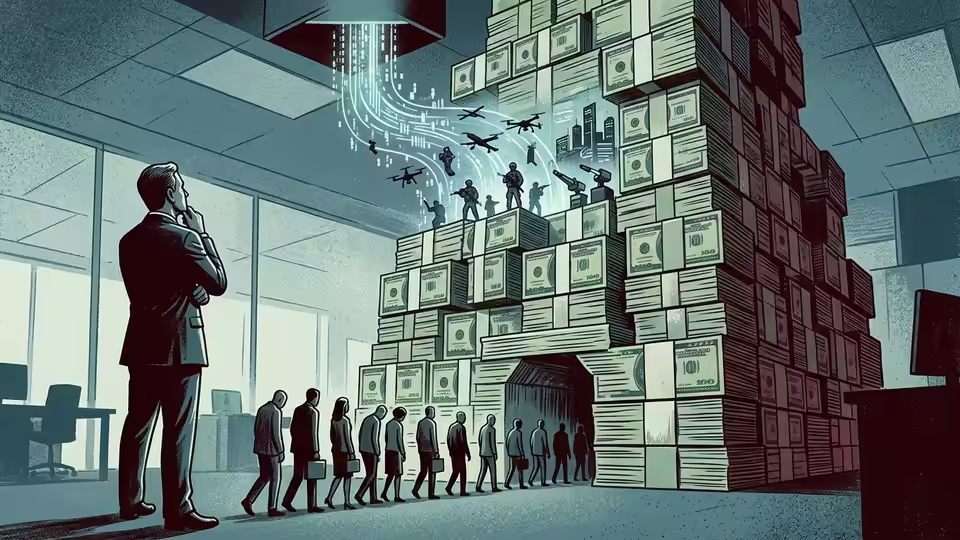
A central pillar of Apple’s influence operation is the use of 'revolvers'—lobbyists who previously held positions within the government agencies or congressional offices they now target. In 2025, a staggering 82% of Apple’s lobbying roster were former members of Congress or high-ranking agency officials. These individuals possess the social capital and procedural knowledge to navigate the complex committee structures that bury reform bills. Many of these lobbyists were former staffers for the very committee chairs now tasked with overseeing Apple’s market dominance.
Mainstream coverage of this legislative battle often mirrors Apple’s own press releases, framing the company’s opposition as a crusade for 'platform integrity' and user safety. However, internal lobbying documents cited in the filings use 'Privacy' as a flexible political shield. Apple’s lobbyists argued that opening the iPhone to third-party app stores—a practice known as sideloading—would create catastrophic security risks. Yet, the same lobbying language sought to ensure that while third-party data collection was blocked, Apple’s own first-party advertising business remained exempt from those same restrictions. This creates a double standard: privacy for the competitor, but data-harvesting for the platform owner.
Furthermore, Apple’s 2025 strategy targeted the technical definition of 'interoperability.' By lobbying for specific, narrow language, Apple aims to ensure that if they are eventually forced to open their platform, the technical requirements will remain so cost-prohibitive that smaller developers cannot afford to compete. It is a form of regulatory capture where the rules are written to favor the incumbent’s infrastructure.
The human cost of this lobbying success is measured in dollars and cents. For the average smartphone user, Apple’s monopoly translates to a 'hidden tax' of up to 30% on every digital subscription, game skin, or productivity tool purchased through the App Store. By successfully delaying S.2710 and S.2992, Apple has effectively prevented the entry of third-party app stores that could offer lower prices and more diverse software options. This is not just a corporate dispute; it is a transfer of wealth from ordinary consumers to a trillion-dollar entity, facilitated by the very representatives elected to protect the public interest.
At Gen Us, we don't just report the news; we provide the tools to see who is being paid to influence your life. You can use our Politician Tracker to see if your representative accepted funds from the Apple Inc. PAC or if their former staffers are currently on Apple’s payroll. Transparency is the only antidote to the record-breaking spending we are witnessing in the 2025 cycle.
Summary
Apple Inc. deployed a record-breaking $10.1 million in federal lobbying during fiscal year 2025 to stall bills targeting its App Store monopoly. The strategy relied on a 35% increase in PAC donations to key committee members and a lobbying roster comprised of 82% former government officials.
⚡ Key Facts
- Apple spent $10.1 million on federal lobbying in FY2025, a 20% increase from the previous year.
- 82% of Apple’s lobbying team are 'revolvers'—former government officials and congressional staffers.
- PAC donations to the House Judiciary Subcommittee on Antitrust increased by 35% to stall key bills S.2710 and S.2992.
- Apple uses 'privacy' as a political shield to block competitors while exempting its own ad business from the same rules.
- The successful lobbying preserves a 30% 'App Store tax' on consumers for all digital purchases.
Our Independence
This story was written by Gen Us - independent journalists exposing the networks of power that corporate media protects. No hedge fund owns us. No billionaire edits our headlines. We answer only to you, our readers.
Follow the public record
Source Trail
Get the next investigation in your inbox
One email a week. Receipts only. Free.
Free. Unsubscribe anytime. We never share your email.