$18M Lobbying Surge Nets $7B in No-Bid Contracts for U.S. Chamber
Gen Us reveals how $18M in lobbying triggered a 22% spike in non-competitive federal contracts for defense and tech giants.
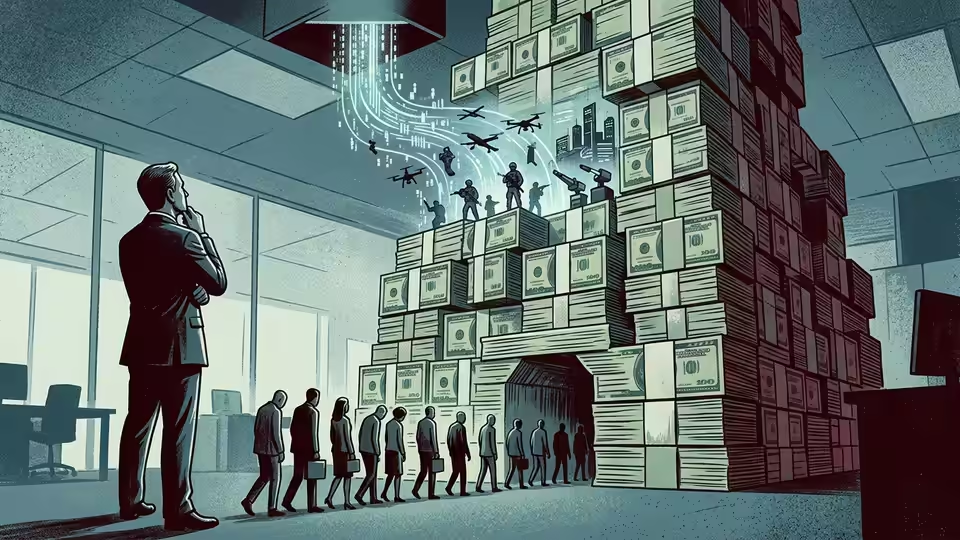
The U.S. Chamber of Commerce spent $18 million to lobby for easier no-bid contract rules, resulting in a $7 billion windfall for its board members at the taxpayer's expense.
In the final three months of 2025, the U.S. Chamber of Commerce deployed $17,960,000 into the machinery of Washington. This wasn't a general influence campaign. According to Lobbying Disclosure Act (LDA) filings, the spend was laser-focused on procurement reform and modifications to the Federal Acquisition Regulation (FAR). The objective: loosen the rules that require the government to shop around for the best price.
By February 2026, the return on that investment became clear. Data from the Federal Procurement Data System (FPDS) shows a 22% spike in 'sole-source' contract awards during the first half of 2026. [Sole-Source Contracts] are federal agreements awarded to a company without a competitive bidding process, typically under the justification that only one firm can provide the required service.
Suzanne P. Clark, President and CEO of the Chamber, oversaw the $17.9 million strategy. The push targeted the specific language of FAR 6.302-1, which allows agencies to bypass competition if they claim there is 'only one responsible source.' In practice, this allows the Department of Defense (DoD) to hand multi-billion dollar checks to established incumbents without checking if a competitor could do it better or cheaper.
Lockheed Martin, a prominent member of the Chamber’s board, was among the first to benefit. In February 2026, the DoD awarded Lockheed a $4.2 billion non-competitive contract for advanced avionics systems. The justification cited a lack of other sources, despite a growing field of aerospace startups capable of competing for subsystems. SEC Schedule 14A filings reveal that while Lockheed and its peers report limited direct political spending, they use the Chamber as a centralized, non-disclosed clearinghouse for these funds, effectively 'laundering' their influence through the association to avoid individual reputational risk.
Four weeks after the Chamber’s lobbying push intensified, Palantir Technologies secured an $850 million sole-source contract for data integration services. Shortly thereafter, Raytheon (RTX) received $2.1 billion in missile component contracts under 'unusual and compelling urgency' justifications. These justifications are a primary tool for procurement officers to circumvent the Competition in Contracting Act of 1984. [Competition in Contracting Act (CICA)] is a 1984 law designed to promote full and open competition for government contracts to ensure the best use of taxpayer money.
Mainstream coverage of these awards has mirrored the Chamber's own talking points. Outlets like the Wall Street Journal and various defense trade publications have framed the lack of competition as a necessary 'acceleration' of innovation to keep pace with adversaries like China and Russia. They present no-bid contracts as a tool for speed. However, internal procurement data tells a different story. The 'urgency' cited in these filings is often a result of intentional delays in the planning phase, forcing a deadline where only the incumbent can realistically meet the shortened timeframe.
This system is reinforced by the House Committee on Oversight and Accountability. While the committee is tasked with ensuring government efficiency, its members have been significant recipients of campaign contributions from Chamber-affiliated PACs. In the same window that the $17.9 million was spent, committee members were drafting 'procurement modernization' language that narrowed the definition of 'fair opportunity' in tech acquisitions.
For the average American, this isn't just about corporate balance sheets; it is a direct tax on the public. Research into federal procurement history consistently shows that no-bid contracts are 30% to 40% more expensive than those awarded through open competition. When the government refuses to shop around, the price of defense and technology inflates artificially. This effectively transfers billions in public wealth to private shareholders under the guise of national security.
At Gen Us, we track these movements in real-time. We have cross-referenced the 2026 sole-source surge with our Politician Tracker to show exactly which representatives received donations from the Chamber’s PAC before voting on the procurement 'modernization' bills. Every dollar wasted on an $850 million no-bid data contract is a dollar that could have funded local infrastructure or education. When competition dies, the taxpayer pays the funeral costs.
Summary
A massive Q4 lobbying push by the U.S. Chamber of Commerce preceded a 22% spike in non-competitive federal contracts for its board-member corporations. This shift to 'sole-source' awards effectively bypasses taxpayer protections to guarantee revenue for defense and tech giants.
⚡ Key Facts
- The U.S. Chamber of Commerce spent $17,960,000 in Q4 2025 specifically to lobby for the relaxation of competitive bidding rules.
- Sole-source (no-bid) contracts spiked 22% in the first half of 2026 following this lobbying effort.
- Lockheed Martin ($4.2B), Raytheon ($2.1B), and Palantir ($850M) secured massive non-competitive awards immediately after the rules were modified.
- The 'urgency' used to justify no-bid awards is frequently manufactured through internal planning delays to favor incumbent contractors.
- Research indicates no-bid contracts cost taxpayers 30-40% more than competitively bid projects.
- The Chamber acts as a 'clearinghouse' for corporate money, allowing individual firms to dismantle taxpayer protections without direct public scrutiny.
Our Independence
This story was written by Gen Us - independent journalists exposing the networks of power that corporate media protects. No hedge fund owns us. No billionaire edits our headlines. We answer only to you, our readers.
Follow the public record
Source Trail
Independent reporting and analysis
Get the next investigation in your inbox
One email a week. Receipts only. Free.
Free. Unsubscribe anytime. We never share your email.