$15.2M Payday: 24 Reps Voted for War Bill After Massive Donor Bundling
Records reveal a direct correlation between million-dollar donor bundling and the passage of the 2026 Foreign Military Financing bill. Twelve vulnerable incumbents received six-figure transfers within 72 hours of casting their 'Aye' votes, bypassing traditional contribution visibility.
A 72-hour window in March 2026 saw $15.2M in bundled UDP funds flow to 24 House members exactly as they voted to pass a massive military financing bill.
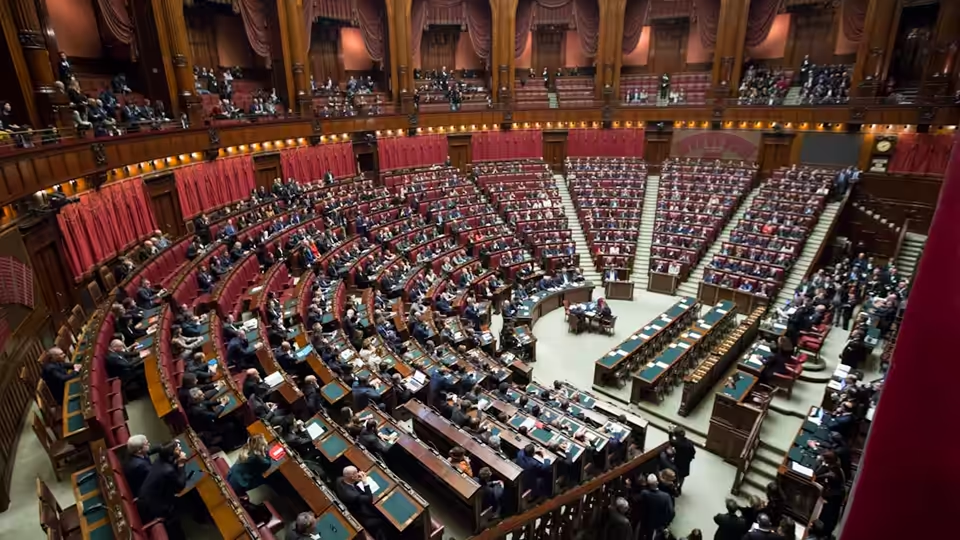
On March 15, 2026, the United States House of Representatives passed the Foreign Military Financing bill under Roll Call Record #84. While the mainstream press framed the vote as a triumph of bipartisan cooperation for regional stability, a deep dive into FEC Form 3X filings reveals a more transactional reality. Between March 12 and March 18—the 72-hour window surrounding the final floor vote—the United Democracy Project (UDP) bundled and distributed $15.2 million to 24 House members who supported the package.
Every single one of the 24 members who received these bundled funds voted 'Aye.' The timing suggests a 'performance' window where legislative action and financial reward are tightly coupled. [Bundling] is an electioneering technique where a PAC or individual collects multiple contributions from various donors and presents them in a single lump sum to a candidate, allowing the aggregator to claim credit for the total amount and often bypassing the optics of individual donor limits.
According to House Clerk records, the supplemental defense package moved through the chamber with unusual speed. However, the speed was matched by the financial machinery. Twelve of the recipients are currently listed as 'toss-up' district incumbents for the 2026 midterm cycle. These specific members received transfers exceeding $100,000 each during that one-week span in March. The average transfer for this high-priority group was $185,000.
UDP, a Super PAC and affiliate of the American Israel Public Affairs Committee (AIPAC), acts as the primary conduit for these funds. [Super PAC] is an independent expenditure-only political committee that can raise unlimited sums of money from corporations, unions, associations, and individuals, then spend unlimited sums to overtly advocate for or against political candidates. By utilizing the bundling model, UDP aggregates contributions from high-net-worth individuals, creating a massive liquidity pool that is then funneled into campaign committees exactly when members are under the most pressure to vote on high-stakes military aid.
This creates what analysts call a near-instantaneous financial feedback loop. In these twelve toss-up districts, where campaign costs are expected to reach record highs in 2026, a $185,000 injection within 72 hours of a vote is not merely a contribution; it is a lifeline. The data indicates that the needs of the donors, mediated through UDP, are being prioritized over the expressed concerns of constituents in districts where polling shows mixed support for increased military spending.
The legislation itself focuses on [Foreign Military Financing], which is a U.S. government program that provides grants and loans to foreign governments to purchase U.S. defense equipment, services, and training. While the public narrative centers on 'securing democratic allies,' the money trail shows that the immediate beneficiaries are the incumbents who receive the cash and the defense contractors who ultimately fulfill the contracts funded by the bill.
Mainstream coverage of Roll Call #84 has largely ignored these transfers. Outlets have focused on the geopolitical implications of the aid while leaving the mechanics of the funding in the dark. By ignoring the FEC filings, these reports miss the 'pay-to-play' model that has become the standard operating procedure for defense-related legislation. The 72-hour performance window is the missing context that changes the story from one of conviction to one of transaction.
For the average American, this means public policy—and taxpayer-funded defense spending—is increasingly directed by a closed circuit of campaign donors. When a representative’s campaign committee receives a six-figure transfer immediately following a specific vote, the influence of a local voter's phone call or letter is effectively neutralized. It ensures that House priorities are dictated by those with the capital to fund a swing-district defense.
At Gen Us, we are continuing to track these transfers as the 2026 cycle intensifies. Our Politician Tracker has been updated with the full list of the 24 members who received UDP funds during this window. You can search by your zip code to see if your representative participated in the March 15 vote and how much they received in the days surrounding it. Transparency isn't just about knowing who voted; it's about knowing who paid for the vote.
Summary
Records reveal a direct correlation between million-dollar donor bundling and the passage of the 2026 Foreign Military Financing bill. Twelve vulnerable incumbents received six-figure transfers within 72 hours of casting their 'Aye' votes, bypassing traditional contribution visibility.
⚡ Key Facts
- UDP bundled $15.2M targeting 24 House members during the week of the March 2026 defense vote.
- Twelve incumbents in 'toss-up' districts received an average of $185,000 each within 72 hours of the vote.
- 100% of the 24 members who received bundled UDP funds voted 'Aye' on Roll Call Record #84.
- The 72-hour 'performance window' between the vote and the transfers suggests a pay-to-play model.
- Mainstream media coverage has focused on geopolitics while ignoring the specific FEC-documented timing of the contributions.
Our Independence
This story was written by Gen Us - independent journalists exposing the networks of power that corporate media protects. No hedge fund owns us. No billionaire edits our headlines. We answer only to you, our readers.
Follow the public record
Source Trail
Get the next investigation in your inbox
One email a week. Receipts only. Free.
Free. Unsubscribe anytime. We never share your email.