GEN_US
All Topics

Surveillance & Privacy

Government surveillance and corporate data collection have created an unprecedented infrastructure of monitoring that most people do not fully understand. From NSA mass surveillance programs to tech company data harvesting, the erosion of privacy is a bipartisan project driven by national security budgets and advertising profits.

Gen Us covers surveillance and privacy because the combination of government surveillance powers and corporate data practices creates a system where virtually every digital action is tracked, stored, and potentially used — and the public has little meaningful ability to opt out.

We trace the funding behind surveillance technology companies, document the revolving door between intelligence agencies and Silicon Valley, and analyze how media coverage normalizes surveillance while marginalizing privacy advocates.


The reporting trail

Latest reporting on Surveillance & Privacy

New evidence joins the permanent record here, so each investigation remains connected to the larger system.

Search the full record
Netanyahu Had the UN Podium. Washington Went After the Court.
Analysis
0% BS
PoliticsSep 28

Netanyahu Had the UN Podium. Washington Went After the Court.

Netanyahu addressed the UN while Israel promoted its case near the organization's New York headquarters. Washington's earlier order authorized sanctions for specified ICC work involving protected U.S. and allied officials. Our verdict on that policy: coercion against accountability, not equal justice.

Trump Turned White House Access Into Leverage. TV Pulled Out.
Mainstream
0% BS
PoliticsSep 21

Trump Turned White House Access Into Leverage. TV Pulled Out.

President Donald Trump barred CNN, MS NOW and Politico after accusing them of reporting “fiction or lies,” and the television pool suspended designated presidential coverage after the White House prevented CNN from performing its scheduled assignment. The sequence supports an access-leverage inference, while the pool’s “no replacement” notice exposed the public’s dependence on a shared television system.

The $38 Billion Iran War Bill Has a Pentagon Blind Spot
Mainstream
0% BS
WarSep 15

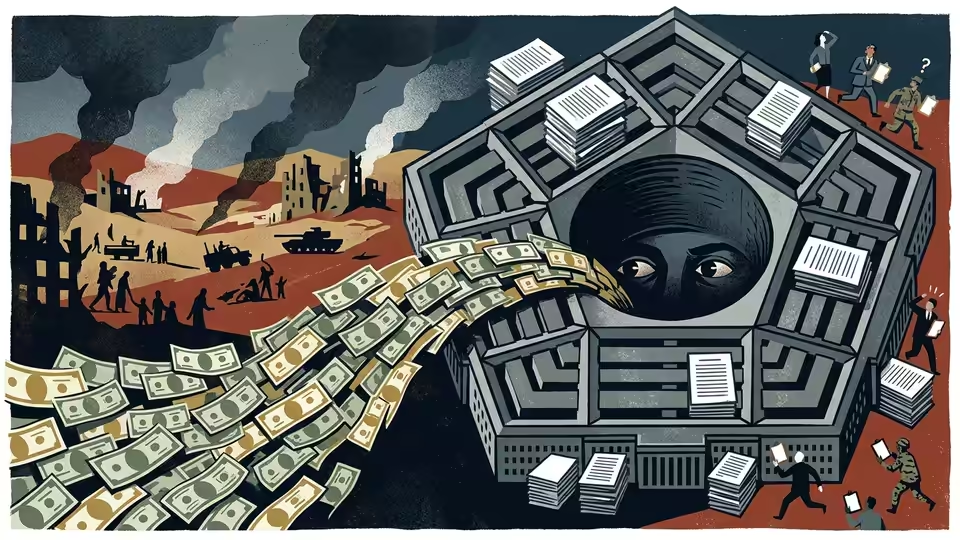
The $38 Billion Iran War Bill Has a Pentagon Blind Spot

The Congressional Budget Office, according to reporting by The Guardian, estimated that the Iran war had cost at least $38 billion and said the Defense Department did not respond to requests for information. The reported gap leaves repair and future diplomatic and foreign-aid costs unestimated, while the CBO could not examine $12.1 billion in classified programs included in a supplemental request.

Trump’s Mail Rule Lost at Court, But USPS Power Remains Unresolved
Mainstream
0% BS
PoliticsSep 14

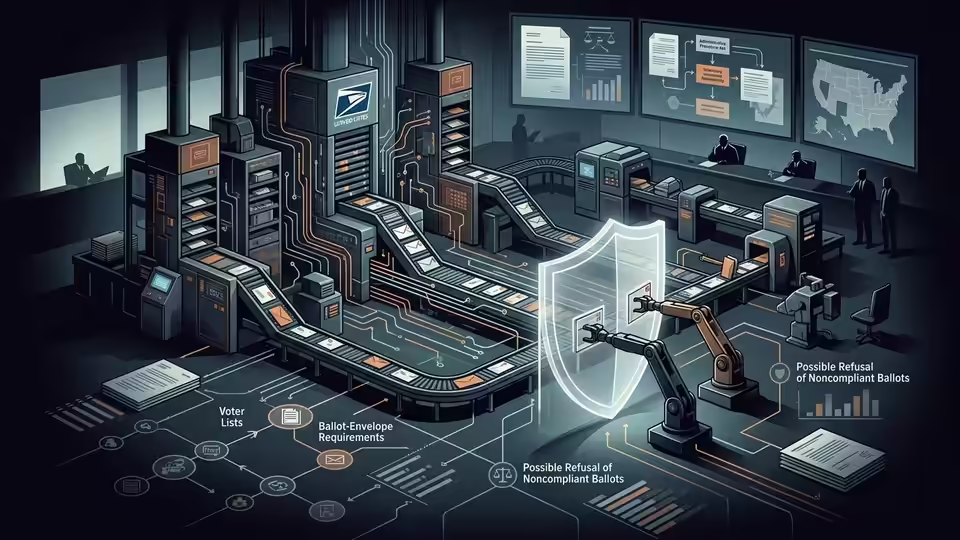
Trump’s Mail Rule Lost at Court, But USPS Power Remains Unresolved

The Supreme Court kept the Trump administration’s proposed mail-ballot restrictions from taking effect in the 2026 midterms and left the lower-court injunction in place until after November 3. The order did not decide whether the Postal Service rule is lawful, leaving the authority question open for a future proceeding.

Trump Turns Canada Trade Fight Into Consumer Market Pressure
Mainstream
0% BS
EconomySep 8

Trump Turns Canada Trade Fight Into Consumer Market Pressure

The White House announced bans on Canadian dairy, most alcoholic beverages and motorcycles, alongside a 50% surcharge on other goods and restrictions on Canadian products in federal contracts. The measures extend the dispute beyond tariffs into consumer markets and procurement, but the supplied reporting does not establish resulting price or job losses.

Supreme Court Asked to Halt or Continue White House Ballroom Construction
Mainstream
0% BS
PoliticsAug 18

Supreme Court Asked to Halt or Continue White House Ballroom Construction

The Trump administration is asking the Supreme Court to allow White House ballroom construction to continue during appeals, while the National Trust for Historic Preservation asks the justices to pause the work. A divided D.C. Circuit ruling is scheduled to halt aboveground construction, including East Wing renovations, on August 21, 2026.

AP Reports Josh Kushner and Bob Iger Agree to $12.5 Billion Lakers Deal
Mainstream
0% BS
PoliticsAug 16

AP Reports Josh Kushner and Bob Iger Agree to $12.5 Billion Lakers Deal

The Associated Press reported that Josh Kushner and Bob Iger agreed to acquire the Los Angeles Lakers for $12.5 billion, a record-breaking price in the team’s second sale in a year. The supplied records establish Kushner’s family connection to Donald Trump and his disclosed investment authority in a 2021 Oscar Health filing, but do not establish Lakers financing or White House involvement.

EIA Forecasts $3.90 Gasoline in 2026 After Hormuz Disruptions
Analysis
0% BS
EconomyAug 10

EIA Forecasts $3.90 Gasoline in 2026 After Hormuz Disruptions

The Energy Information Administration forecasts average U.S. retail gasoline prices of $3.90 per gallon in 2026, based on its June 9 outlook. EIA’s July review documents second-quarter volatility, inventory declines, stronger U.S. exports, and higher refinery-margin indicators during disruptions to oil flows through the Strait of Hormuz.

Ellison Trust’s $45.72B Guarantee Backs Proposed Parent of CNN, CBS News
Analysis
0% BS
CorporateAug 10

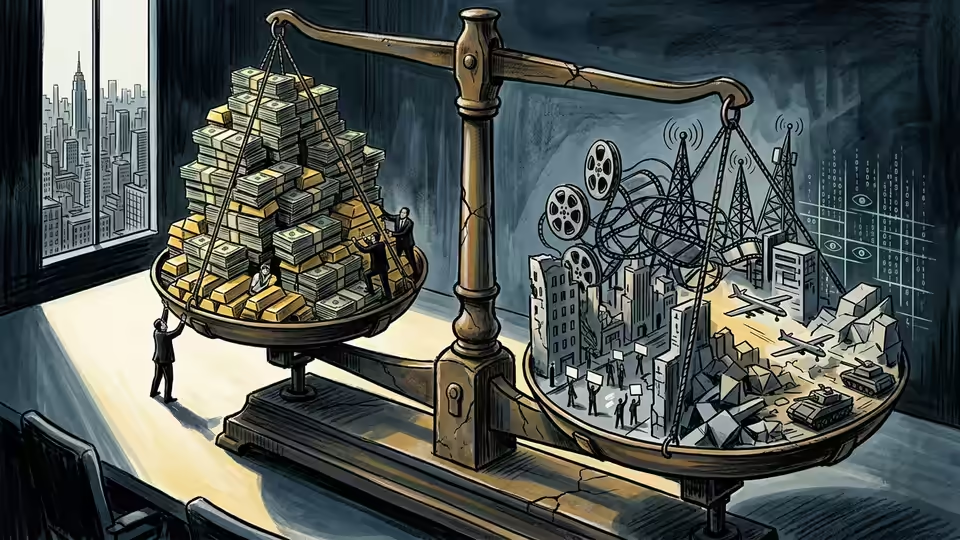
Ellison Trust’s $45.72B Guarantee Backs Proposed Parent of CNN, CBS News

A February 27, 2026 SEC-filed guarantee names Lawrence J. Ellison and his revocable trust as guarantors of $45.72 billion in merger consideration for Warner Bros. Discovery. A June 12 Justice Department statement said its investigation had closed and that the proposed transaction was not likely to harm competition or consumers in three specified areas, while the filings describe a possible future common parent for CBS News and CNN if the merger closes.

Key Questions We're Asking

  • •What surveillance programs operate without meaningful public oversight or judicial review?
  • •How do tech companies' data practices intersect with government surveillance capabilities?
  • •Which defense contractors profit most from surveillance technology, and what are their government connections?
  • •How is facial recognition technology being deployed by law enforcement, and what are the error rates across demographics?
  • •What data do data brokers collect, and how is it sold to government agencies that would need warrants to collect it directly?

What Mainstream Media Misses

  • •Coverage of surveillance typically focuses on individual scandals rather than the systemic architecture of mass data collection.
  • •The relationship between surveillance companies and the intelligence community is rarely examined in depth.
  • •Data broker sales to government agencies — a legal loophole around the Fourth Amendment — receive almost no sustained coverage.
  • •Facial recognition error rates are significantly higher for people of color, but this disparity is treated as a technical detail rather than a civil rights issue.

Follow the Money

  • •The U.S. intelligence community budget exceeds $90 billion annually, much of it flowing to private contractors.
  • •Companies like Palantir, Clearview AI, and Cellebrite profit from government surveillance contracts worth billions.
  • •Data brokers like Acxiom, LexisNexis Risk Solutions, and Oracle Data Cloud sell personal data to government agencies.
  • •Big Tech companies (Google, Apple, Meta, Amazon) collect massive user data that can be accessed through legal processes like FISA orders.

Related Learn Pages