War Profits: Defense Stocks Surge as Middle East Strikes Shake Tech
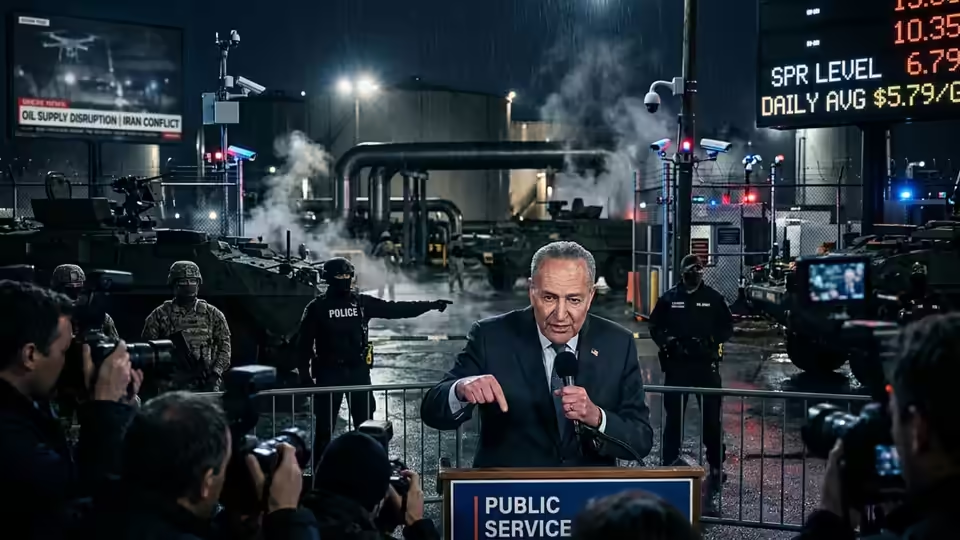
While retail investors panic over a 1.9% Nasdaq slide, defense contractors are seeing a massive payday. With Brent crude hitting $85 and drone strikes hitting AWS infrastructure, the 2026 market volatility is serving as a wealth transfer from tech to the military-industrial complex.
Markets took a hit after Saudi drone strikes, but it's standard volatility. Defense stocks are up, oil is expensive, and tech infrastructure is feeling the physical weight of the conflict.
The 1.4% dip in S&P futures and the Nasdaq’s 1.9% slide aren't exactly a shock. It's the market's way of processing reports of drones buzzing U.S. diplomatic sites in Saudi Arabia. You’ll see commentators throwing around words like ‘plungeLoaded Language’ or ‘collapse,’ but let’s be real: anything under 2% is a recalibration, not a meltdown. The real worry isn't just a scary headline; it’s the threat of a closed-off Strait of Hormuz. That’s already pushed Brent crude to $85, a price we haven't seen since 2024.
But it's not all red on the screens. Defense and aerospace stocks are actually winning today. With the U.S. keeping the possibility of a ground war on the table, investors are piling into military contracts. It's the ‘war premium’ in action. While your favorite retail stocks might be tanking, giants like Lockheed Martin and Northrop Grumman are seeing valuation spikes. It’s a stark reminder that even when the broader market bleeds, conflict creates very specific winners.
“A 1.4% decline in futures is a standard risk-off reaction to geopolitical news, not the 'global panic' some narrators are selling.”
The tech sector is getting hit from two sides at once. Amazon Web Services (AWS) confirmed three of its Middle East data centers were damaged, proving that the 'cloud' isn't safe from physical bombs. At the same time, rumors are swirling that the Commerce Department might slap new export caps on Nvidia’s AI chips to China. These reports aren't official yet, but that doesn’t matter to short-sellers—they're already using the uncertainty to hammer semiconductor stocks.
We still don't know the full scale of the Riyadh damage or when those energy routes will be secure. For most people, the daily Nasdaq ticker doesn't matter as much as the price at the pump. If Brent crude stays above $85, the Fed might have to scrap its plans to cut interest rates in late 2026. That means high borrowing costs are here to stay for a while longer. We’re keeping an eye on the Commerce Department for those Nvidia filings and the Pentagon for any word on troop movements.
Summary
Geopolitical tension in the Middle East rattled the markets on March 3, 2026, sending S&P 500 futures down 1.4% and the Nasdaq sliding 1.9%. Some outlets are calling it a 'panic,' but it's really just a classic risk-off reaction to drone strikes near Riyadh and damage to AWS data centers. Tech is taking a hit, but defense and energy are cleaning up. With Brent crude hitting $85, the Fed's 2026 inflation targets are suddenly looking a lot more complicated. Gen Us notes this volatility is a payday for defense contractors and short-sellers who feed off the fear.
⚡ Key Facts
- Global stocks and bonds plunged while Brent oil reached $85 per barrel due to escalating Iran-related tensions in early March 2026.
- Reports of drone strikes near the US Embassy in Riyadh and damage to three Amazon Web Services (AWS) data centers in the Middle East.
War Profits: Defense Stocks Surge as Middle East Strikes Shake Tech
Network of Influence
- Short-sellers and investors holding put options
- Gold, precious metal, and USD-centric asset holders
- Political entities looking to frame US foreign policy as chaotic or inflationary
- ZeroHedge (via ad revenue generated by fear-based engagement and 'perma-bear' clickbait)
- A 1.4% decline in S&P futures is a standard market fluctuation and does not historically qualify as a 'panic' or 'plunge'.
- The article presents specific events (attack on US embassy in Saudi Arabia) as confirmed facts without citing primary news sources or official government statements.
- The 1,586% surge in tanker rates is calculated from a 'recent low,' which likely refers to an extreme outlier or localized baseline to maximize the percentage figure.
The article frames standard market volatility and hypothetical/unverified geopolitical escalations as a definitive global catastrophe to validate a 'doom' narrative of economic and social collapse.
See how the story connects.
Select any actor or numbered connection, then inspect the evidence before drawing a conclusion.
ABC Media Ltd (Bulgaria) Owns ZeroHedge
Follow the public record
Source Trail
Independent reporting and analysis
Get the next investigation in your inbox
One email a week. Receipts only. Free.
Free. Unsubscribe anytime. We never share your email.