U.S. Cuts Ukraine Aid to Zero: The End of the Post-WWII Era?
After $100 billion, the U.S. pivot to protectionism is official. We analyze the fallout for European security as Washington pulls the plug on Kyiv.
The U.S. has pulled the plug on military support for Ukraine. Now, a divided Europe has to decide: start spending massive amounts on their own defense or prepare for a total Russian breakthrough.
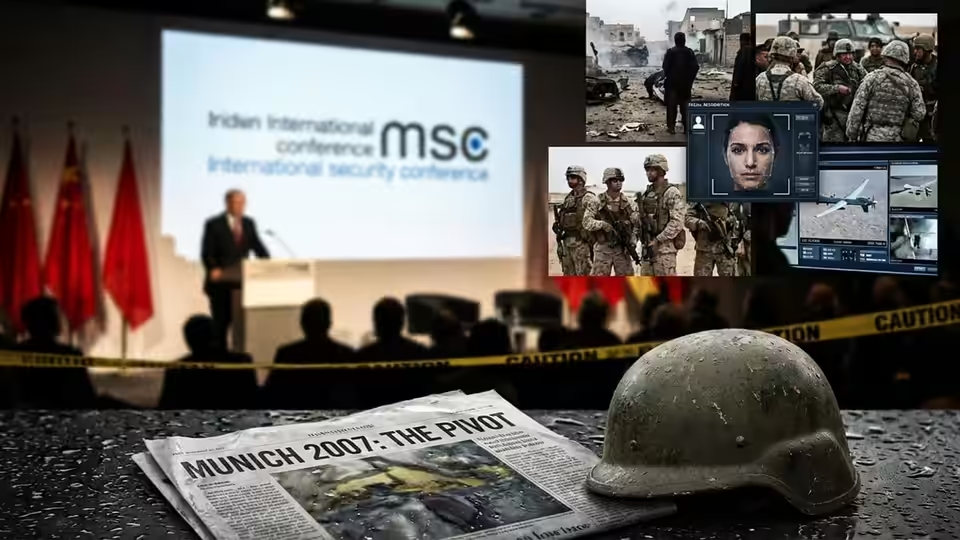
The formal breakup happened this month at the Munich Security Conference. Secretary of State Marco Rubio didn't mince words, signaling an end to "globalist interventionism" and calling internationalism a thing of the past. It’s not just rhetoric, either. The 2025 budget is already reflecting this new reality: the weapons shipments that once kept the Ukrainian resistance alive have stalled. This isn't a minor diplomatic tiff. It’s a total fiscal U-turn. According to data from the Kiel Institute, the U.S. dumped more than $100 billion into this fight before the current stalemate, but now that money is staying home, redirected toward the border and protectionist trade deals.
European critics are screaming about "perfidyLoaded Language," but while they vent, the money is already moving. Stock prices for defense giants like Rheinmetall and BAE Systems are through the roof. Why? Because EU leaders finally realize they're the ones who have to bankroll the continent's safety now. But here’s the kicker: they’re still dealing with the same internal rot the U.S. used to cover up. For years, the American security umbrella let Europe ignore the fact that members like Hungary could basically hold collective security hostage with a veto. Without Washington leaning on Brussels, the EU's chance of standing unified against Putin looks shaky at best.
“The U.S. poured over $100 billion into Ukraine before the 2025 cutoff—now Europe is scrambling to fill that hole while fighting its own internal battles.”
The administration is betting that the old post-WWII world order just isn't worth the price of admission anymore. By pushing for "concessions" and blaming the victim, the State Department is sending a loud message to autocrats everywhere: the cost of U.S. intervention is now too high for a divided Congress to stomach. This isn't just about personalities. It’s a fundamental shift in how America defines its own interests. Today, that means prioritizing Christian culture and shut borders over building democracies thousands of miles away.
There’s no hard proof yet that the U.S. is working with the Kremlin on some kind of "partition" plan for Ukraine. But when the administration publicly tells Kyiv to start making concessions, it certainly looks that way. What's undeniable is that the heavy lifting has shifted entirely to a European continent that isn't ready for it—not financially and definitely not militarily. For the average person, the "peace dividend" we've enjoyed for thirty years is dead. It's being replaced by high taxes to fund the military and a lot more regional volatility.
Keep an eye on the upcoming EU summit in Brussels. They're going to be fighting over the "Ukraine Facility" funding, but the vibe has changed. The debate is no longer about how to win the war; it’s about how to contain the mess without American backup. The real story isn't just that the U.S. walked away from Ukraine. It’s that the "American Century" in Europe just ended.
Summary
The Russia-Ukraine war is hitting its five-year mark this February, and the U.S. is officially calling it quits. After pumping over $100 billion into Kyiv, the current administration—led by Secretary of State Marco Rubio—has slashed direct military aid to nearly zero. Some call it a betrayal. But the reality is a hard pivot toward protectionism and a domestic agenda focused elsewhere. This withdrawal forces a fractured Europe to make a brutal choice: foot the massive bill for their own defense or watch Russia win at their front door. It's not just about the U.S. leaving, though; internal drama like Hungary’s constant blocking of aid made this alliance messy long before Washington pulled the plug.
⚡ Key Facts
- The full-scale war in Ukraine is entering its fifth year as of February 2026.
- Direct US weapons supplies to Ukraine were cut to almost zero in 2025.
- Marco Rubio serves as the US Secretary of State in the current administration (Feb 2026).
- Europe has replaced the US as the primary driver of military aid to Ukraine.
- Donald Trump proposed a 28-point 'peace plan' involving territorial concessions by Kyiv.
U.S. Cuts Ukraine Aid to Zero: The End of the Post-WWII Era?
Network of Influence
- Pro-interventionist political factions in Europe seeking to justify increased defense spending.
- The US Democratic Party and anti-Trump movements by framing the opposition as 'subservient' to a foreign adversary.
- European defense contractors benefiting from the call for Europe to 'take the fight... on its own terms'.
- The significant amount of military and financial aid (over $100 billion) the US has already provided to Ukraine prior to the current political stalemate.
- Internal European divisions regarding Ukraine, such as Hungary's repeated blocking of EU aid packages.
- The domestic economic and political constraints within the US that influence the debate over foreign spending.
- Constitutional requirements for congressional approval of funding which limits the executive's unilateral power.
The article frames the US-Ukraine relationship through a lens of moral 'betrayal' and personal villainy by Trump, positioning Europe as the righteous but abandoned victim of American bad faith.
See how the story connects.
Select any actor or numbered connection, then inspect the evidence before drawing a conclusion.
The Scott Trust Limited Sole shareholder of Guardian Media Group (GMG)
Follow the public record
Source Trail
Independent reporting and analysis
Get the next investigation in your inbox
One email a week. Receipts only. Free.
Free. Unsubscribe anytime. We never share your email.