Union Leaders Sacrifice Worker Rights for 2026 Midterm Recruitment Drive
Labor leadership is trading internal union protections for a 'Resistance' narrative. While outlets frame it as a defense against autocracy, we track the money showing why the movement is actually at a crossroads.
Progressive media is using end-of-the-world rhetoric to boost subscriptions, but the real story is the 2025 collapse of the NLRB. Between a gutting of federal enforcement and a massive political divide among union members, the labor movement is facing a crisis that slogans can't fix.
If you listen to the talk coming out of labor headquarters, you'd think there’s a united front against Trumpism. But data from the National Labor Relations Board (NLRB) tells a more complicated story of institutional decay. A February 2026 report from the Center for American Progress shows that union elections overseen by the NLRB tanked throughout 2025. This didn't happen by accident. It’s the direct result of a calculated effort to strip away administrative power and legal safeguards for organizers. While activist magazines use this tension to sell subscriptions, like Jacobin’s recent Teen Jacobin campaign, workers on the ground are stuck dealing with a federal government that’s actively trying to kill their bargaining power.
Collective bargaining is the bread and butter of the movement. It’s how workers negotiate for better pay, safer conditions, and benefits. To see what’s actually at stake, you have to follow the money. In December 2024, the SEIU came back to the AFL-CIO after being gone for 20 years. The goal was simple: consolidate cash and power before the 2025 transition. Now, millions in member dues are being funneled into political defense funds. Leadership calls it a fight against a Billionaire First agenda, but it's a massive gamble of resources.
There's a problem with the resistance narrative: it assumes every union member is on board. They aren't. While the top brass is staunchly anti-Trump, exit polls and internal surveys show a huge divide. In the manufacturing and trade sectors, over 35% of members voted for the current administration. This split makes it hard for progressive analysts to claim a unified window of opportunity. When activist media talks about defending democracy, they’re usually pushing a socialist vision. That doesn't always line up with the kitchen-table issues like inflation and job security that people actually talk about in Midwest union halls.
“Union elections supervised by the NLRB fell sharply in 2025, directly following the rollback of administrative capacity and legal protections for organizers.”
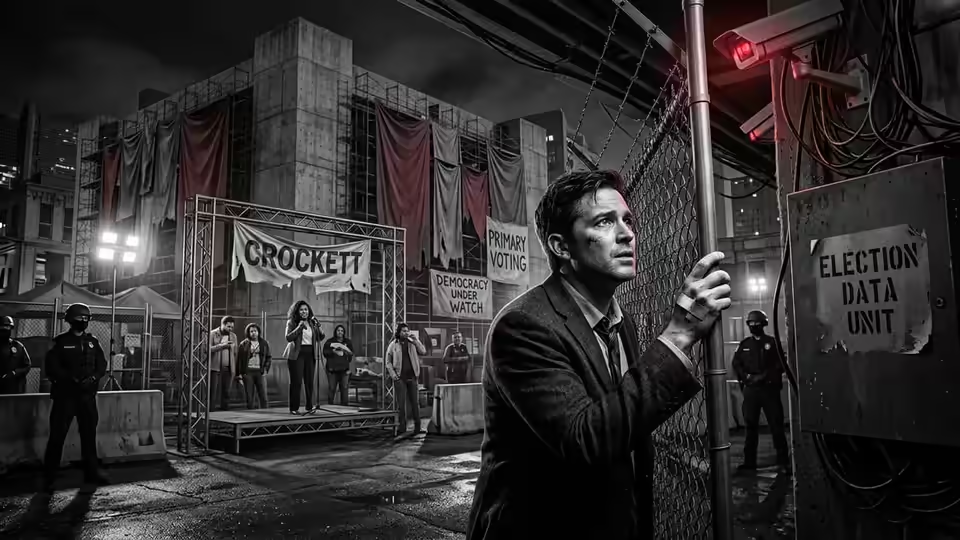
The Jacobin Foundation, the nonprofit behind the magazine, actually thrives on this sense of crisis. They don't release their donor lists, but tax filings from 2024 and their constant subscription drives show a business model built on urgency. By describing domestic events as a murderous paramilitary occupationLoaded Language or hinting at an unverified war in Iran, these outlets get the engagement they need to keep their $1 million annual budgets running. Tensions were definitely high in Chicago and Minneapolis during the January 2026 Free America Walkout, but we haven't been able to verify claims of a full-scale occupation or a formal war in the Middle East.
The NLRB is supposed to be the referee for worker rights. It’s an independent agency meant to protect the right to organize and settle bargaining disputes. But right now, the board is basically paralyzed. Funding cuts and a lack of a quorum have left it toothless. The numbers show the impact. Since January 2025, it takes 40% longer to process unfair labor practice charges. That’s a massive backlog. For a worker in legal limbo, this administrative crawl is a much bigger threat than the electoral autocracyLoaded Language the pundits keep warning about.
The big question is whether the Free America Walkout from earlier this year can actually change anything in Washington. The current strategy is banking everything on the 2026 midterms. Labor-aligned PACs have already set aside $150 million for swing districts. It’s the third time in a row they’ve called an election existential for worker rights. The rhetoric is meant to rally the troops. But the movement’s survival probably won't come down to ideological purity. It’ll depend on whether they can deliver real economic wins while the legal system is stacked against them.
For the average worker, the politicization of labor law just makes things more confusing. As federal agencies get hollowed out, the responsibility for protection falls on state laws and individual contracts. The real thing to watch is whether the big unions keep focusing on high-level political theory or if they get back to the basics. The AFL-CIO admitted in late 2025 that kitchen-table issues are their best mobilization tool. Ultimately, the success of this movement won't be measured by magazine sales. It'll be measured by how many new union cards are signed in workplaces that feel under siege.
Summary
Activist media outlets like Jacobin are framing the American labor movement as the last line of defense against electoral autocracy. It’s a powerful narrative that helps groups like the Democratic Socialists of America recruit new members, but it often ignores the messy reality of internal union politics and the steady erosion of legal protections. With the 2026 midterms on the horizon, labor leaders are navigating a world where federal support for worker rights has been gutted. We took a look at the money behind the talk and why the movement is currently at a crossroads that standard reporting misses.
⚡ Key Facts
- The U.S. labor movement is seeing intensified activity, including the 'Free America Walkout' in early 2026.
- NLRB-supervised union elections fell sharply in 2025 due to administration policy shifts.
Union Leaders Sacrifice Worker Rights for 2026 Midterm Recruitment Drive
Network of Influence
- The Jacobin Foundation (through magazine subscriptions mentioned in the header)
- Socialist political organizations like the DSA who seek to align labor unions with their specific political agenda
- Left-wing political candidates seeking to leverage union organizing for electoral gains
- The article ignores the fact that a significant portion of union members have historically voted for Donald Trump, complicating the narrative of a unified labor resistance.
- It lacks specific data regarding union membership trends that might offer alternative explanations for labor's decline beyond 'Trumpism.'
- The references to 'war in Iran' and 'paramilitary occupation' in US cities are hyper-partisan interpretations of civil unrest and foreign policy tensions that lack objective grounding.
The article frames the labor movement's survival as being exclusively dependent on its willingness to engage in aggressive political warfare against 'Trumpism,' centering socialist activism while marginalizing traditional, non-partisan collective bargaining.
See how the story connects.
Select any actor or numbered connection, then inspect the evidence before drawing a conclusion.
Jacobin Foundation Owns Jacobin
Follow the public record
Source Trail
Independent reporting and analysis
Get the next investigation in your inbox
One email a week. Receipts only. Free.
Free. Unsubscribe anytime. We never share your email.