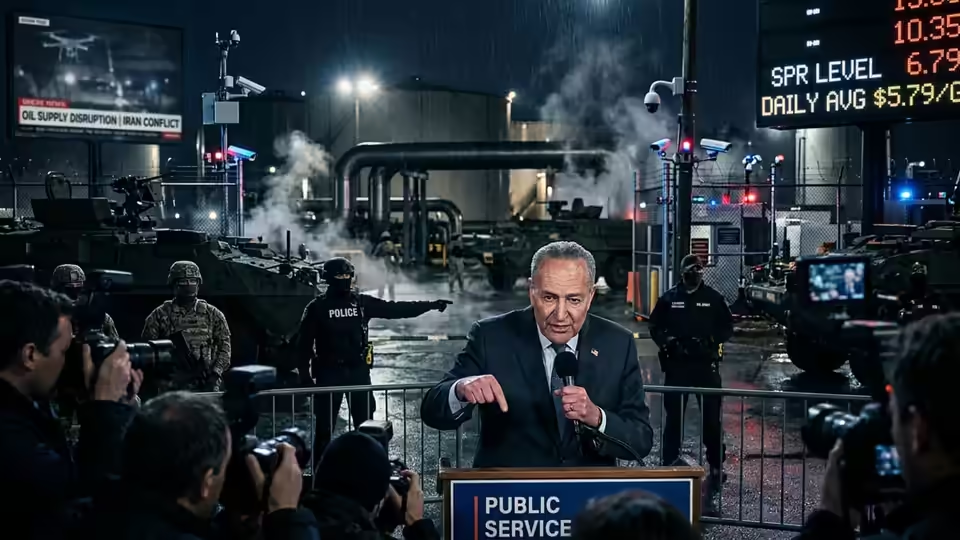
Trump Uses 'Plan C' Loophole to Keep Tariffs High Despite Court Losses
The Trump administration isn't backing down on its trade strategy, even after a string of losses in the Supreme Court and lower federal courts. While news outlets called the May 7 ruling a major defeat for the White House, a new court stay on May 12 changed the game. It allows the government to keep collecting 10% interim tariffs while the appeal plays out. By pivoting from broad emergency declarations to targeted Section 301 probes, the administration is trying to build a legal wall around its trade barriers. For the average American, it means the price relief they expected from those court wins has been put on ice.
The Trump administration is dodging high-profile court losses by using legal stays and Section 301 probes. This keeps the 10% global tariffs active and helps the government avoid paying out billions in court-ordered refunds.
On May 12, 2026, a federal appeals panel gave the Trump administration a major lifeline. They granted a stay on a lower court ruling that had briefly threatened to tear down the White House’s newest trade barriers. This stay means that even though the U.S. Court of International Trade (CIT) called the 10% interim tariffs illegal on May 7, the government won't stop collecting them. They'll keep taking those duties from importers while the case moves through the appeals process. For businesses, it creates a permanent state of limbo that the administration's using to force supply chains away from major trading partners.
The money involved is massive. It all goes back to the revenue from the 'Liberation Day' tariffs of April 2025. After the Supreme Court ruled on February 20, 2026, that the International Economic Emergency Powers Act (IEEPA) couldn't be used for worldwide levies, the administration was ordered to refund billions to U.S. companies. President Trump's public frustration with Justices Amy Coney Barrett and Neil Gorsuch really comes down to this mandated refund. He sees it as handing federal money back to corporations he thinks are disloyal for taking him to court in the first place.
[IEEPA] is a 1977 federal law that lets the president regulate international commerce after declaring a national emergency to deal with an 'unusual and extraordinary threat' from outside the U.S.
“The May 12 stay ensures the 10% global tariff remains an active cost for importers, effectively nullifying the May 7 'defeat' for the duration of the appeal.”
To make sure future tariffs don't get slapped down by judges the same way, the administration is now moving to Section 301 of the Trade Act of 1974. This is 'Plan C.' Unlike the broad emergency powers they used in 2025, Section 301 lets them run targeted investigations into trade practices they call 'unreasonable' or 'discriminatory.' With two new probes into China and other partners starting this month, the White House is building a record that’s historically much harder for courts to overturn. It’s a tactical shift. The administration has clearly learned that broad emergency declarations are legally flimsy, but sector-specific investigations provide a much sturdier floor.
[Section 301] is a part of the Trade Act of 1974 that allows the U.S. to impose sanctions on countries that break trade deals or engage in acts that are 'unjustifiable' and hurt American commerce.
The White House says these moves protect U.S. workers, but the real winners are specific domestic industrial sectors. The losers? Retail giants and regular shoppers. According to the Council on Foreign Relations (CFR), the 10% interim tariff targets billions in annual imports: it's effectively a national sales tax on foreign parts. Meanwhile, the companies fighting for those billion-dollar refunds are mostly large multinationals that have seen their profit margins get squeezed by these shifting duty rates since early 2025.
This cycle of 'tariff, ruling, and pivot' has become the pulse of current economic policy. It's the third time since the start of 2026 that the White House has cycled through a different legal authority to get what it wants. First it was IEEPA, then Section 122, and now Section 301. All for the same protectionist goal. And here's the kicker: it’s not even clear if the administration's legal team thinks these theories will survive the Supreme Court. They might just be trying to keep the revenue flowing during years of slow-moving litigation.
For regular people, this legal 'whack-a-mole' just means higher prices at the checkout counter. When a court strikes down a tariff, retailers don't usually lower their prices right away. They're too worried about the cost of compliance or the risk that the tariff will just come back through a stay or a new probe. The May 12 stay proves them right. It ensures that the 10% surcharge stays baked into the cost of goods for the foreseeable future, regardless of the judicial 'defeats' that made headlines last week.
Summary
The Trump administration isn't backing down on its trade strategy, even after a string of losses in the Supreme Court and lower federal courts. While news outlets called the May 7 ruling a major defeat for the White House, a new court stay on May 12 changed the game. It allows the government to keep collecting 10% interim tariffs while the appeal plays out. By pivoting from broad emergency declarations to targeted Section 301 probes, the administration is trying to build a legal wall around its trade barriers. For the average American, it means the price relief they expected from those court wins has been put on ice.
⚡ Key Facts
- The Supreme Court ruled in February 2026 against Trump's emergency tariffs imposed under the International Economic Emergency Powers Act (IEEPA).
- The Trump administration is pivoting to Section 301 of the 1971 Trade Act as a 'Plan C' for tariff authority.
- Trump publicly criticized Supreme Court Justices Barrett and Gorsuch for their votes in the February decision.
Trump Uses 'Plan C' Loophole to Keep Tariffs High Despite Court Losses
Connections in this story
- Multinational corporations reliant on low-tariff global supply chains
- Advocates for judicial supremacy and limited executive power
- Political opponents of the Trump administration's trade platform
- Specific economic arguments used by proponents of tariffs regarding national security or supply chain resilience.
- The actual legal arguments presented by the administration in the Supreme Court case.
- Specific data on trade deficits or foreign trade practices that Section 301 is traditionally used to address.
The article frames Trump's trade policy not as a strategic economic platform, but as a personal, emotionally driven power struggle against the judiciary.
See how the story connects.
Select any actor or numbered connection, then inspect the evidence before drawing a conclusion.
The Conversation US, Inc. → The Conversation
Parent company
Follow the public record
Source Trail
Independent reporting and analysis
Get the next investigation in your inbox
One email a week. Receipts only. Free.
Free. Unsubscribe anytime. We never share your email.