Trump Plan: Seize Iranian Oil Hubs to Lower US Fuel Prices
As US-Israel-Iran hostilities escalate, Donald Trump is proposing a direct seizure of Kharg Island. This 'energy dominance' strategy aims to stabilize domestic fertilizer and fuel costs, signaling a massive shift from sanctions to direct resource capture.
Trump is threatening to seize Iranian oil assets to offset the fallout of a messy war and high fuel prices. While he talks about 'taking the oil' to make money, his administration is quietly extending emergency shipping waivers to keep the domestic market from falling apart.
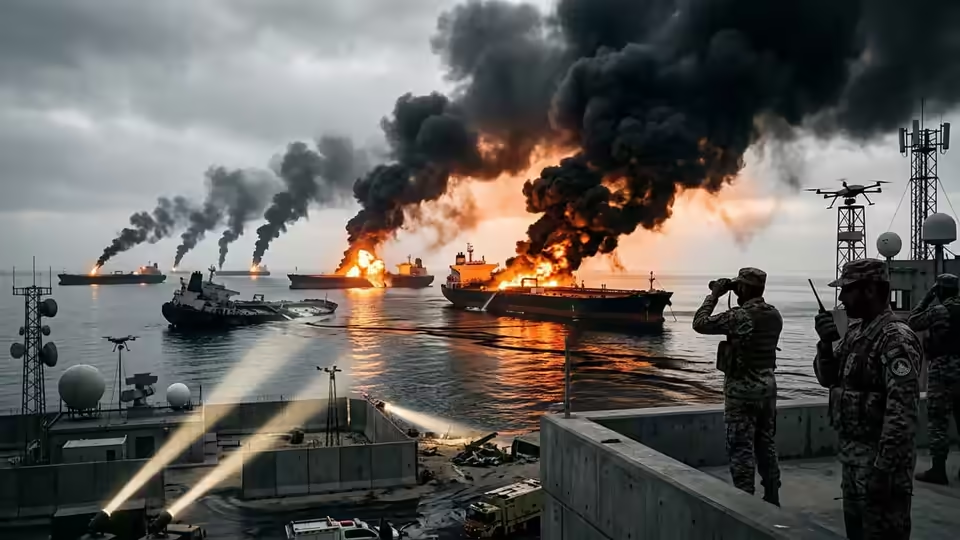
On March 30, 2026, President Donald Trump turned up the heat on the U.S.-Iran conflict. He didn't just suggest more sanctions. He said the United States should directly seize Iranian oil assets. 'I’d take the oil, I’d keep the oil,' Trump said, specifically calling out Kharg Island. That facility handles about 90% of Iran’s crude exports. While outlets like Middle East Eye call this 'imperialistLoaded Language pillageLoaded Language,' the immediate spark is a broken energy market. According to Axios and Bloomberg, oil prices hit multi-week highs in late April 2026. The Strait of Hormuz is basically closed to commercial ships, and the world is looking at a massive supply vacuum.
The administration's focus on Iranian oil isn't just tough talk. It's a response to massive economic pressure at home. On April 24, 2026, the White House announced they're extending the Jones Act waiver for another 90 days. This lets non-U.S. flagged ships carry oil and fertilizer between American ports. It's a move to stop local shortages caused by the war. Without these waivers, fuel prices would likely skyrocket right before the mid-term elections. For those who don't know: the Jones Act is a 1920 law that usually requires goods moved between U.S. ports to be on ships built, owned, and run by Americans. Right now, we just don't have enough of them.
The money involved is staggering. Iran is sitting on roughly 208 billion barrels of proven oil. Trump claims that taking it would 'bring plenty of money,' but the logistics are a total nightmare. This isn't 1953, when the CIA helped topple Prime Minister Mohammad Mosaddegh to protect what eventually became BP for a million-dollar budget. A modern seizure of Kharg Island would require a long-term military occupation of a target that's already in range of Iranian missiles. And the administration hasn't said if they'd sell the oil on the open market or use it to fill the U.S. Strategic Petroleum Reserve, which has been swinging wildly during this 2026 conflict.
“The White House extension of the Jones Act waiver on April 24, 2026, signals that the administration is bracing for at least 90 more days of energy market instability.”
What is missing from the 'pillageLoaded Language' narrative is the role of American energy companies. Under the 'energy dominance' plan, the U.S. has hit record exports. Taking Iranian crude off the board actually helps American exporters by keeping global prices high. But there is a catch. The high cost of shipping and the constant risk of strikes on Saudi or Emirati ports make the whole world less stable. Iranian officials have already shot back, saying their nation 'is not Venezuela.' That is a reference to when the U.S. seized Citgo assets in 2019. While the U.S. points to human rights and proxy wars as the reason for military action, the real focus is the 21 million barrels of oil that transit the Strait of Hormuz every day.
We can't yet confirm if the Pentagon has a real plan for how to 'seize and sell' Iranian crude. Usually, the U.S. uses the Office of Foreign Assets Control, or OFAC, to freeze bank accounts. Physically offloading a foreign tanker for profit is a different animal. If the administration moves from threats to action, it'll be the first time in the 21st century a major power tried to fund a war by annexing a sovereign state's primary resource. For now, the 90-day Jones Act waiver is a temporary bandage. But as that June 2026 expiration date gets closer, the pressure to either reopen the Strait or 'take the oil' is going to hit a breaking point.
The 'Energy Dominance' framework is all about pumping more at home and using oil as a diplomatic hammer. According to the EIA, the U.S. is producing over 13 million barrels a day. But it doesn't matter how much we pump if the domestic economy is still sensitive to $100 oil triggered by the Hormuz blockade. The conflict has essentially weaponized the global supply chain. In the end, it's the American consumer who is footing the bill for an open-ended military commitment in the Persian Gulf.
So, what's the play? Watch the S&P 500 Energy sector and the language coming out of the UN. If the U.S. starts auctioning off Iranian assets to pay for domestic infrastructure or military bills, it will trigger a massive legal crisis. For the average person, this all hits at the pump: every week the Strait stays a mess, it adds about 15 to 25 cents to a gallon of gas. It doesn't really matter how much oil is 'taken' if the shipping lanes are still a war zone.
Summary
After two months of direct fighting between U.S.-Israeli forces and Iran, Donald Trump is floating a radical plan: just take the oil. He's specifically eyeing Kharg Island. This isn't just a tweak to sanctions. It is a major escalation of his 'energy dominance' strategy. Critics point to the long history of Western meddling in the region, but the real driver here is the cost of fuel and fertilizer at home. The administration just pushed a 90-day Jones Act waiver to keep prices from spiraling while the Strait of Hormuz remains a war zone. This report breaks down the money behind the talk and the context you won't find in the headlines.
⚡ Key Facts
- President Trump made declarations about 'taking' and 'keeping' Iranian oil during the current conflict.
- Trump threatened to destroy Iran's oil and energy infrastructure.
- The US and UK overthrew Iranian Prime Minister Mohammad Mosaddegh in 1953 following oil nationalization.
- The US voted against a 1952 UN General Assembly resolution declaring self-determination a human right.
Trump Plan: Seize Iranian Oil Hubs to Lower US Fuel Prices
Network of Influence
- The Iranian government (framed as a victim and defender of sovereignty)
- Anti-Western geopolitical interests (Russia, China)
- Critics of US foreign policy seeking historical justification for modern conflicts
- The article omits the geopolitical reasons for US-Iran tensions, such as the Iranian nuclear program and regional proxy conflicts.
- It presents rhetorical threats as established policy without clarifying the legal distinctions between sanctions and literal 'theft'.
- There is no mention of the internal human rights record of the Iranian government or its own resource management.
The article frames current US-Iran tensions as a continuation of a century-long, inherent pattern of American 'imperialist pillaging' of the Global South, centering a victim-oppressor dynamic.
See how the story connects.
Select any actor or numbered connection, then inspect the evidence before drawing a conclusion.
Fadaat Media Ltd Owns Middle East Eye
Follow the public record
Source Trail
Independent reporting and analysis
Get the next investigation in your inbox
One email a week. Receipts only. Free.
Free. Unsubscribe anytime. We never share your email.