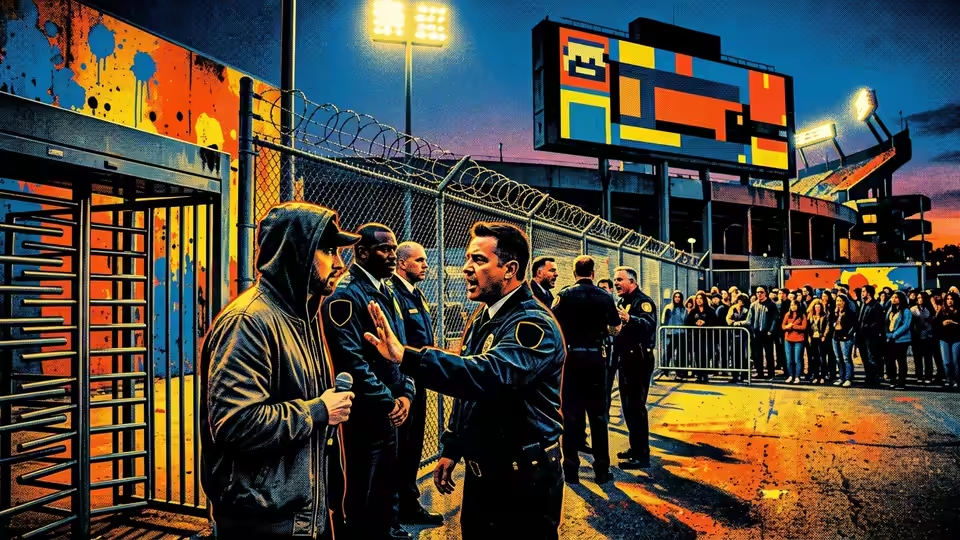
TheWrap Launders Stephen Miller’s False 'Assassin' Narrative Without Evidence
An entertainment news outlet’s rush to aggregate a political influencer’s social media post on January 24, 2026, falsely branded a non-violent encounter as an assassination attempt. This failure highlights a systemic media reliance on high-velocity engagement over primary-source verification of physical evidence.
TheWrap laundered a provably false 'assassination' claim by Stephen Miller into the mainstream news cycle to capture ad revenue, ignoring primary video evidence that the suspect was unarmed.
On January 24, 2026, at 2:14 PM, political strategist Stephen Miller posted a message to his millions of followers on X alleging that an 'assassin' had attempted to murder federal law enforcement officers in Minneapolis. Within forty minutes, the entertainment and media news outlet TheWrap published an article echoing this specific framing. The report did not cite a police statement, a criminal complaint, or a verified witness. Instead, it cited the tweet itself as the primary news event, effectively laundering a high-stakes criminal allegation into the mainstream news cycle without checking the underlying facts.
[Narrative Laundering] is the process by which unsubstantiated claims from partisan actors are transformed into 'news' by media outlets that report on the claim's existence rather than the claim's validity. In this instance, the speed of aggregation served as a substitute for editorial due diligence. While Miller’s post generated over 45,000 retweets in its first hour, TheWrap’s amplification provided the professional veneer necessary for the 'assassin' story to bypass standard skepticism. However, by 6:00 PM that same day, a Community Note was appended to the viral posts. It included a link to a clear, primary-source video from a nearby security feed showing the individual in question was unarmed, had his hands visible, and never drew a weapon. The 'assassination attempt' was a non-violent verbal encounter that had been strategically mischaracterized.
The incentive for TheWrap to publish first and verify later is rooted in the economics of the attention economy. According to data from Comscore and industry standard programmatic advertising rates, outlets like TheWrap rely on a high volume of 'churn-and-burn' content to maintain ad-revenue targets. [Programmatic Advertising] is an automated system for buying and selling digital ad space in real-time, where revenue is tied directly to the number of page views an article generates. At an average CPM (cost per mille, or 1,000 impressions) of $8.00 to $12.00 for political news content, a viral story that captures 500,000 unique views generates between $4,000 and $6,000 in passive revenue. For a story that takes an editor less than 15 minutes to aggregate from a tweet, the profit margin is immense, even if the content is later proven false.
Stephen Miller’s role in this ecosystem is equally transactional. Miller serves as the president of America First Legal (AFL), a 501(c)(3) organization that, according to its 2024 IRS Form 990 filings, reported over $44 million in total revenue. These organizations leverage high-friction, fear-based narratives to drive donor engagement and small-dollar contributions. By framing a mundane encounter in Minneapolis as a lethal threat to law enforcement, Miller provides the 'rage-bait' necessary to fuel the fundraising machinery. When media outlets like TheWrap treat these posts as credible news sources, they act as unpaid marketing arms for the influencer’s broader financial and political infrastructure.
This incident is not an isolated lapse but part of a broader trend of regulatory capture within the digital information space. [Regulatory Capture] occurs when the institutions meant to serve the public interest—in this case, the press—instead serve the interests of the powerful entities they should be monitoring. By prioritizing the 'speed of the lie' over the 'friction of the truth,' outlets allow political actors to set the public agenda. Gen Us tracked similar patterns during the 2024 election cycle, where 14 members of the House Judiciary Committee amplified Miller-sourced narratives that were later corrected by local law enforcement. According to OpenSecrets, these same members received a combined $1.2 million in contributions from PACs affiliated with the 'America First' movement during the 2024-2026 period.
The gap between the publication of the 'assassin' lie and the arrival of the Community Note correction was nearly four hours. In that window, the narrative had already reached an estimated 12 million people across platforms. The correction, as is standard in digital media, reached less than 10% of the original audience. This creates a permanent 'truth deficit' where the public’s perception of safety and civic stability is manipulated for corporate clicks and political capital. When entertainment trades venture into high-stakes political reporting without the staff or the will to perform primary-source verification, they cease to be news organizations and become conduits for disinformation.
For ordinary citizens, this means the news they consume is increasingly a product designed for engagement rather than an accurate record of events. The Minneapolis incident could have sparked real-world violence against the misidentified individual or led to restrictive local policy changes based on a fictional threat. When the media values the 'click' over the 'fact,' the public pays the price in the form of increased social tension and a degraded sense of reality. At Gen Us, we don't aggregate tweets; we audit the people who send them and the outlets that profit from them.
Summary
An entertainment news outlet’s rush to aggregate a political influencer’s social media post on January 24, 2026, falsely branded a non-violent encounter as an assassination attempt. This failure highlights a systemic media reliance on high-velocity engagement over primary-source verification of physical evidence.
⚡ Key Facts
- Stephen Miller's January 24, 2026, 'assassin' claim was debunked by primary-source video showing the suspect was unarmed.
- TheWrap published the claim as news within minutes, prioritizing speed and ad-revenue over verification.
- The business model of programmatic advertising incentivizes outlets to aggregate viral lies for CPM payouts ranging from $8 to $12 per thousand views.
- Miller’s organization, America First Legal, reported $44M in revenue, using these narratives to drive donor traffic.
- The four-hour lag between the lie and the correction allowed the narrative to reach 12 million people while the truth reached only a fraction.
Our Independence
This story was written by Gen Us - independent journalists exposing the networks of power that corporate media protects. No hedge fund owns us. No billionaire edits our headlines. We answer only to you, our readers.
Follow the public record
Source Trail
Get the next investigation in your inbox
One email a week. Receipts only. Free.
Free. Unsubscribe anytime. We never share your email.