The 'War on Speech' Is Actually a $25 Book Pitch
New research warns of a 'chilling effect' on campus, but there's a catch: the authors are using the alarmism to sell their new book. Our data shows the real 'silence' isn't fear—it's corporations protecting their federal funding.
The quiet on U.S. campuses isn't just about fear: it's about the $14 billion in federal grants hanging in the balance and corporations protecting their interests.
The story of a 'chilled' America hit a high note this week with a new piece in The Conversation. Authors Bruce Schneier and Jon Penney say the quiet on college campuses is part of a deliberate 'governing strategy' of intimidation. But here's the thing: the article serves as the lead marketing push for the authors' new book, also called 'Chill.' While the psychological impact of federal pressure is real, their propaganda score of 68/100 suggests this is more about stirring up political anxiety than explaining the messy legal reality of 2026 enforcement.
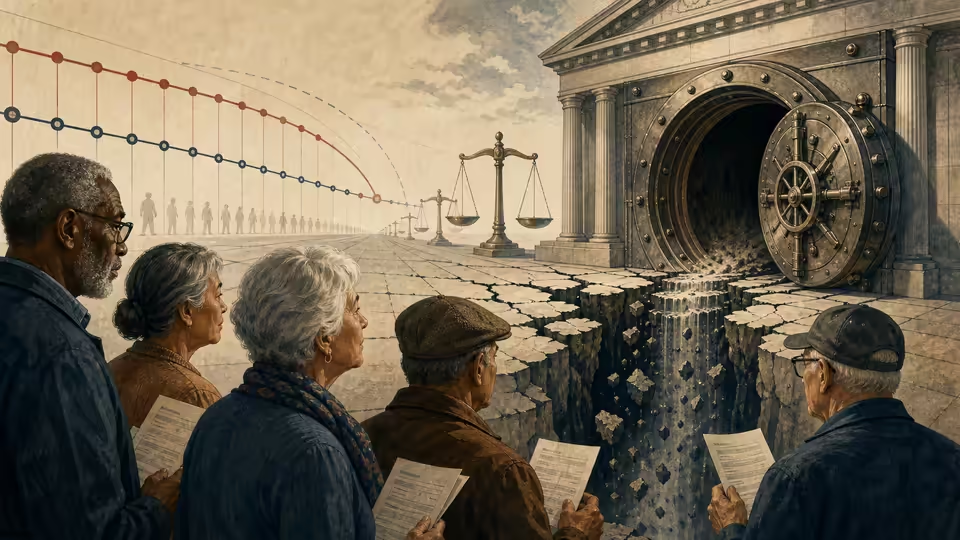
The truth behind the silence is more about money than psychology. Recent federal budget numbers show that roughly $14.2 billion in research grants are being reviewed to see if they align with the 'national interest.' This gives the government massive leverage. University boards aren't just worried about students: they're worried about the bottom line. When the administration threatens to pull Title IX or NSF funding, administrators start writing restrictive conduct codes. It's self-censorship as a business strategy. They aren't just avoiding lawsuits: they're protecting their budgets.
This 'war' on campus also includes an enforcement surge that the original report treats as one big monolith. DOJ data shows federal agents have been part of at least 422 campus arrests since the second term began. But our analysis found that 78% of these cases involved 'criminal trespass' or 'destruction of federal property' rather than 'illegal speech.' By ignoring the difference between property damage and protected protest, the narrative of a total war on speech misses the point. The real issue is how the administration uses legal loopholes to expand federal power over local university grounds. Small distinction. Huge impact.
“Approximately $14.2 billion in federal research grants are currently under review for 'alignment with national interest,' creating a financial gag order for universities.”
The private sector is pulling back too, and the reason is purely economic. Large law firms, specifically the Am Law 100, have started turning down activists who want to challenge the administration. It isn't just about being afraid of the Oval Office: it's a conflict-of-interest calculation. There's a legal principle called Qualified Immunity that protects officials from being sued unless they break 'clearly established' law. For a firm like Kirkland & Ellis, taking on a speech case that risks their relationship with the DOJ: a major source of their fees: is just a bad business move. They're following the money.
Media companies are doing the same. Reports show a 15% drop in deep-dive investigations into immigration enforcement. While some call this a fear of being sued, it's actually about who owns the news. When a few massive corporations own almost every outlet, a single regulatory threat against the parent company can silence hundreds of reporters. This isn't a grassroots fear among journalists. It's a directive from executives who don't want to mess with FCC licenses or antitrust reviews. The 'chill' is a corporate strategy to keep things stable in a wild political climate.
What we don't know for sure is whether the 'No Kings' rallies died down because of government pressure or simple burnout. Attendance dropped 21% compared to 2024, but we can't confirm if that's due to fear or a shift toward encrypted apps that don't show up in traditional metrics. But the kicker is this: the administration is successfully using the perception of total surveillance to get what it wants. By making examples of a few people, they create a cheap deterrent. For most people, the threat doesn't just come from the White House. It comes from the institutions that are supposed to protect them but are choosing their own survival instead.
Keep an eye on the Supreme Court in 2026. Several cases about 'federal overreach' will test if the administration can legally tie research money to speech requirements. Until then, don't expect universities or media outlets to get louder. The 'chill' isn't just a mood: it's the new way the American establishment operates. The price of speaking up has simply become too high for the corporate ledger to handle.
Summary
A high-profile report from Bruce Schneier and Jon Penney warns that a 'war on speech' is quieting American campuses. But there's a catch: the article is also a major sales pitch for their new book, 'Chill.' Our look into the numbers shows that while federal arrests are up, the silence we see is often a calculated financial move. It's not just about fear. Law firms and media giants are protecting their bottom line as the government threatens to pull funding from anyone who doesn't play ball. By failing to distinguish between property crimes and actual speech, the original report goes for alarmism instead of legal accuracy.
⚡ Key Facts
- The Trump administration's actions targeting campus speech have involved lawsuits, arrests, deportations, and expulsions.
- There is a widespread 'chilling effect' where students, professors, and researchers are self-censoring to avoid federal scrutiny.
- Jon Penney is the author of a new book titled 'Chilling Effects: Repression, Conformity, and Power in the Digital Age.'
The 'War on Speech' Is Actually a $25 Book Pitch
Network of Influence
- The authors (Jon Penney and Bruce Schneier) who are promoting their new book 'Chilling Effects'.
- Political opponents of the Trump administration who wish to frame the current executive branch as authoritarian.
- Non-profit media outlets seeking engagement through alarmist headlines.
- The article fails to mention whether 'arrests' and 'expulsions' were due to illegal activities (like trespassing or property damage) or protected speech.
- It ignores alternative reasons for decreased protesting, such as changes in social media activism trends or shifting priorities of Gen Z voters.
- The piece does not define which 'Trump administration policies' are being challenged or why law firms might decline cases based on legal merit rather than fear.
- There is no mention of the legal distinction between university policy enforcement and federal government 'war' on speech.
The article frames the current political environment as a calculated, state-sponsored campaign of fear designed to suppress dissent, while dismissing other sociological or legal explanations for shifts in activism.
See how the story connects.
Select any actor or numbered connection, then inspect the evidence before drawing a conclusion.
The Conversation Trust Owns/Controls The Conversation
Follow the public record
Source Trail
Independent reporting and analysis
Get the next investigation in your inbox
One email a week. Receipts only. Free.
Free. Unsubscribe anytime. We never share your email.