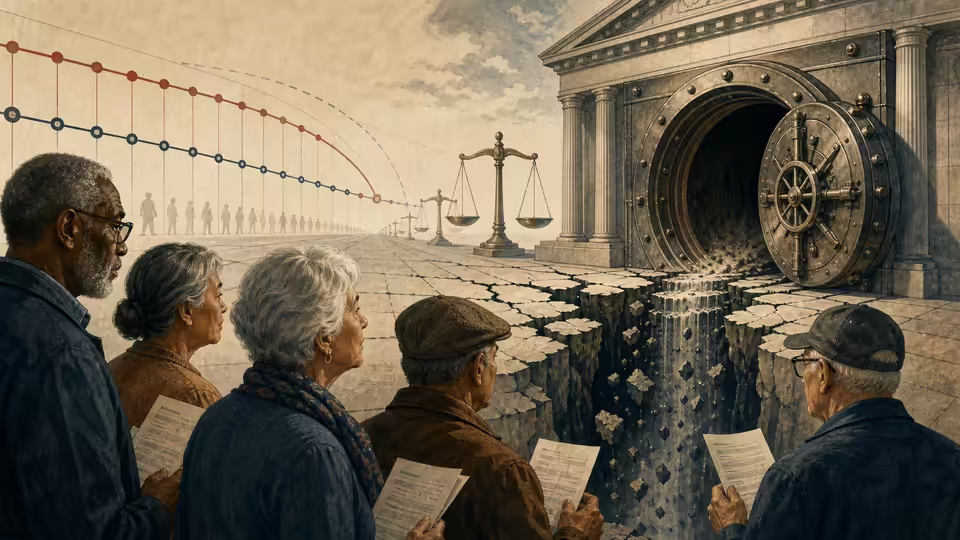
The Roman Empire’s 1% Used Debt to Grind the Working 90% into Poverty
New research reveals the 'Glory of Rome' was a marketing myth. Data shows a high-speed debt economy that trapped peasants in a systemic grind remarkably similar to modern capitalism.
New archaeological research reveals that the Roman Empire was powered by a debt-ridden working class of peasants and artisans, rather than just elite emperors and slave-run estates.
For a long time, Roman history has been a highlight reel of the 1%. We’ve focused on the emperors, the senators, and the generals with names carved into marble. But Kim Bowes’s 2025 book, 'Surviving Rome: The Economic Lives of the Ninety Percent,' changes the script. Using data from the Roman Peasant Project, she shows that the empire’s real engine wasn't just massive estates: it was a chaotic, fast-moving network of small farmers and workers. Most people lived in a constant 'hustle,' juggling part-time jobs just to keep up with a growing consumer culture and the debts that came with it.
Jacobin’s coverage tries to frame these findings as a mirror to modern-day capitalism. It's a smart move for them. As a 501(c)(3) nonprofit, they’re using the 'compulsive consumptionLoaded Language' angle to sell quarterly subscriptions, which currently go for about $20 to $30. It’s an ideological play to grow their reader base. The scholarship itself is rock solid, but it’s worth noting that the presentation is tailor-made for a specific political audience.
When we look at 'material culture,' we’re looking at the actual stuff people left behind: their tools, their pots, and their homes. It’s often the only way to hear from people who didn’t leave a written record. Most historians used to think these people lived in a 'subsistence economy' where they only grew what they needed to eat. But Bowes found that these workers were actually tied into the market more than we ever realized.
“The Roman economy was not merely a result of elite command, but a high-velocity network of the 90% majority managing multiple roles to service debt.”
The bones tell the real story. Skeletal remains from 100 BCE to 300 CE show a workforce that was physically falling apart. We're talking repetitive stress injuries and malnutrition. These weren't just 'facts of life' back then: they were the direct result of policy. The Roman elite pushed for industrial-scale pottery and aggressive farming to squeeze out more profit. It worked, but it broke the people doing the work long before the Industrial Revolution ever happened.
The Roman Peasant Project found that small homes were everywhere, not just on the giant slave plantations we usually hear about. The countryside was crowded with free and semi-free workers navigating a money-based world. They wanted basic stuff like tools and textiles, but they often had to go into debt to get them. Rome was basically one giant experiment in micro-credit, and the '90%' were the ones taking all the risk.
We don't have perfect census records for the poor, so we can't say exactly how many people were in debt. But the clues are there. Archaeologists keep finding tiny coins and cheap, mass-produced goods in rural areas. That tells us these weren't self-sufficient farmers living off the grid. They were part of the system. They weren't included as citizens with power, though: they were included as consumers with bills to pay.
This research marks a shift in how we look at the past. It’s not just about glory and monuments anymore. It’s about accountability. The 'splendor' of an empire is usually just a ledger of underpaid labor that never got settled. As we digitize more of these finds, the myth of the Great Roman Elite is going to keep crumbling. In its place, we’re finding a story that feels surprisingly familiar: the story of the working-class struggle.
Summary
Kim Bowes’s new research, set for release in 2025 via Princeton University Press, isn't just another dry history book. It blows up the old idea that Roman history was only about emperors and generals. By digging into the lives of the 90% who usually get ignored, Bowes found a messy, high-speed economy where peasants and artisans stayed afloat through debt. While outlets like Jacobin use this to talk about modern capitalism, the actual data shows a brutal reality of health costs and systemic grind. It turns out the glory of Rome was built on the backs of people who were mostly just trying to pay their bills.
⚡ Key Facts
- Kim Bowes is an archaeologist and professor of classical studies at the University of Pennsylvania specializing in the Roman economy.
- The book 'Surviving Rome: The Economic Lives of the Ninety Percent' was published by Princeton University Press in 2025.
- The Roman Peasant Project (2009–2014) found that peasant smallholders, not just large landowners, dominated the rural landscape via dispersed habitations.
- Roman peasant diets included animal husbandry (meat) alongside crop rotation of cereals and legumes.
- The Roman economic system forced majority populations into debt and compulsive consumption to maintain social inclusion.
The Roman Empire’s 1% Used Debt to Grind the Working 90% into Poverty
Network of Influence
- The Jacobin Foundation (subscription revenue)
- Socialist and anti-capitalist political movements
- Democratic Socialists of America (ideological alignment)
- The 'Great Man' theory of history has been largely debunked or supplemented by social history and archaeology for decades; the article frames commoner-focused history as more revolutionary than it is in modern academia.
- Life expectancy and conditions were 'nasty, brutish, and short' in virtually all pre-industrial societies, not just the Roman Empire.
- The economic benefits of Roman infrastructure and the Pax Romana (relative stability) are omitted to focus solely on labor exploitation.
The article frames Roman history through a Marxist lens of class struggle to validate modern anti-capitalist critiques of labor exploitation and debt.
See how the story connects.
Select any actor or numbered connection, then inspect the evidence before drawing a conclusion.
Jacobin Foundation Parent company Jacobin
Follow the public record
Source Trail
Independent reporting and analysis
Get the next investigation in your inbox
One email a week. Receipts only. Free.
Free. Unsubscribe anytime. We never share your email.