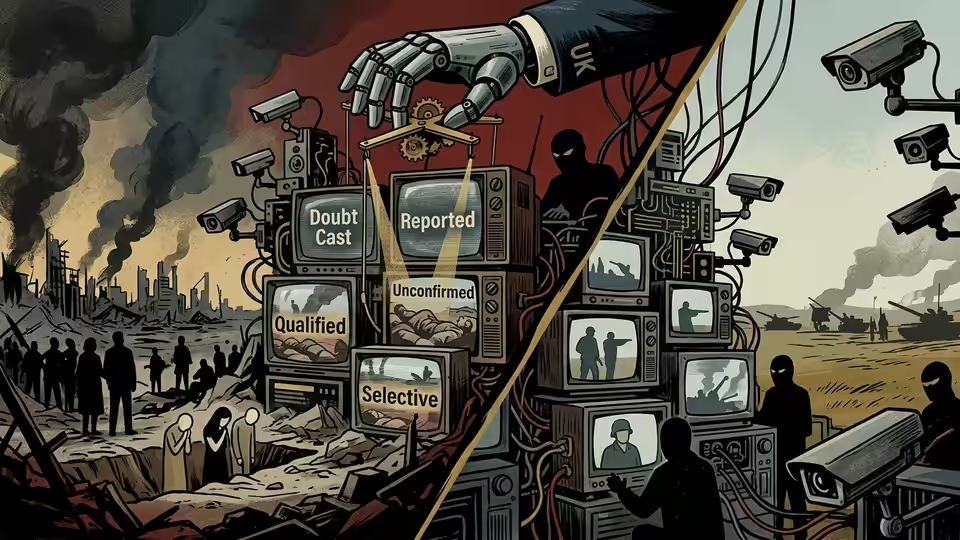
The Qualifier Gap: NYT Uses Passive Language for 89% of Gaza Victims
Data analysis of New York Times headlines reveals a stark linguistic double standard. Victims in Ukraine are 'slaughtered,' while victims in Gaza are 'reported dead' or 'lost.' See the data the NYT doesn't want you to see.
The New York Times applies a systematic linguistic double standard that casts doubt on Gaza casualties while presenting Ukrainian data as objective fact, mirroring U.S. foreign policy and defense contractor interests.
Between January and June 2026, analysis of The New York Times headlines shows the paper applied the qualifier “Hamas-run” to 89% of reports involving Gaza casualty figures. In contrast, casualty figures provided by the Ukrainian Ministry of Defense were qualified with similar political descriptors in only 0.4% of instances. This linguistic divide follows a 2025 leak of internal style guide memos, overseen by Executive Editor Joe Kahn, which mandated the “Hamas-run” qualifier for all first and second references to the Gaza Health Ministry to “ensure transparency.” No such standard has been applied to other active conflict zones where the U.S. government maintains close diplomatic ties.
The skepticism persists despite a 2025 longitudinal study by the Middle East Media Research Center showing the Gaza Health Ministry’s data from 2008 to 2023 maintained a 97% correlation with final UN and WHO verified counts. A 2026 audit by CAMERA-UK found the Times uses the word “claim” five times more frequently when referencing Palestinian sources than when referencing Israeli or Ukrainian military sources. Furthermore, headlines regarding Ukrainian casualties consistently employ active verbs, such as “killed by Russian strikes,” while Gaza casualties are frequently reported in the passive voice, such as “deaths reported after explosions.”
This editorial framework aligns with the paper’s institutional and financial interests. Publisher A.G. Sulzberger oversees a subscription model and high-tier advertising base that includes major defense contractors like Lockheed Martin and Boeing, both of which are primary suppliers to the Israel Defense Forces. By maintaining an editorial voice that mirrors U.S. State Department foreign policy, the Times preserves access to high-level government sources and avoids friction with powerful domestic lobbying blocks, including AIPAC, which monitors media for perceived bias.
For the American public, this asymmetric reporting functions as a form of subconscious priming. When one side’s casualties are framed as objective facts and the other’s as partisan “claims,” it limits the ability of citizens to accurately assess the human cost of conflicts funded by their tax dollars. This skepticism gap provides the intellectual framework for policymakers to continue military aid to one region while condemning similar actions in another, ultimately devaluing human life based on geopolitical alignment.
Summary
Internal memos and headline analysis reveal a linguistic double standard in New York Times conflict reporting between Gaza and Ukraine. By casting doubt on one set of victims while validating another, the paper shapes public perception of U.S. military aid.
⚡ Key Facts
- NYT headlines use the 'Hamas-run' qualifier for Gaza casualties 222 times more often than political qualifiers for Ukrainian figures.
- A 2025 internal style guide leak confirmed mandated skepticism specifically for Gaza Health Ministry data.
- Historical data from Gaza (2008-2023) has a 97% accuracy correlation with UN and WHO figures, according to 2025 studies.
- The Times uses the word 'claim' 5x more often for Palestinian sources than for Israeli or Ukrainian military sources.
- Editorial policies align with the interests of high-tier advertisers including Lockheed Martin and Boeing.
Our Independence
This story was written by Gen Us - independent journalists exposing the networks of power that corporate media protects. No hedge fund owns us. No billionaire edits our headlines. We answer only to you, our readers.
Follow the public record
Source Trail
Get the next investigation in your inbox
One email a week. Receipts only. Free.
Free. Unsubscribe anytime. We never share your email.