The Pentagon Killed 193 People Without Evidence of Drugs or Terror
General Donovan’s 'Joint Task Force' has turned the Pacific into a 'kinetic' business model for drone contractors, leaving 193 dead and zero proof of criminal activity.
The U.S. military’s killed 193 people in a new drone-heavy drug war that trades arrests for executions. It’s a move that bypasses the legal system, lines the pockets of defense contractors, and leaves the public with zero proof of the crimes.
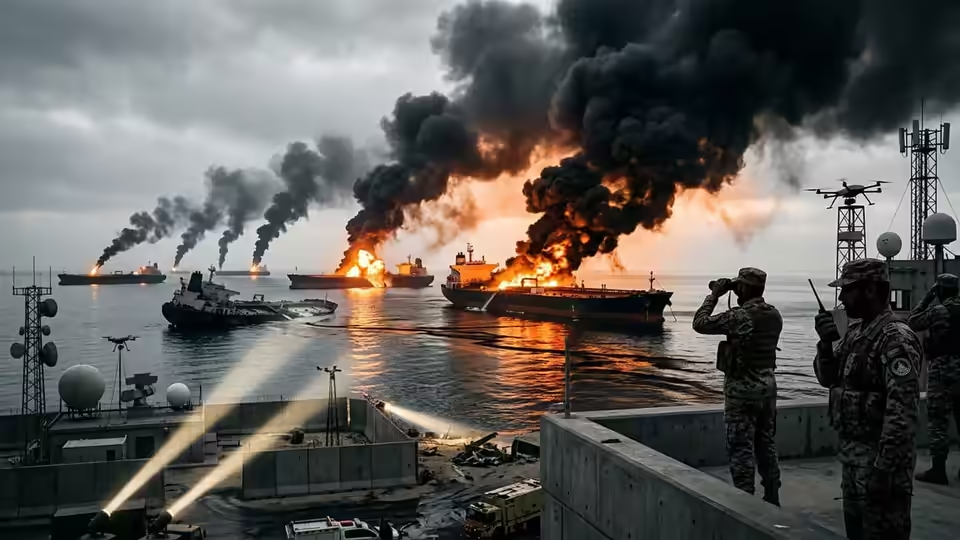
The U.S. military isn't just patrolling drug routes anymore. It’s conducting executions. On May 8, 2026, SOUTHCOM Commander Gen. Francis L. Donovan directed another 'lethal kinetic strikeLoaded Language' against a boat in the Eastern Pacific. Two men died. A third was pulled from the water by the Coast Guard. Outlets like Fox News are happy to parrot the military’s 'narco-terrorist' label, but it’s a loaded term. The Pentagon hasn't actually provided the public with any proof to back it up. In military speak, a 'kinetic strikeLoaded Language' means using active force, like a missile or a drone, to blow something up instead of just stopping it.
Since Joint Task Force Southern Spear kicked off in September 2025, the toll has reached at least 193 people, according to AP data. This isn't the Coast Guard’s old 'board and seize' playbook. It's a total overhaul. Just look at the first week of May 2026. On Monday, a strikeLoaded Language in the Caribbean killed two. Tuesday, three more died in the Eastern Pacific. Then came Friday’s strikeLoaded Language with another two dead. And despite all the blood, the military hasn't shown a single gram of cocaine or named the specific 'Designated Terrorist Organizations' these people were supposedly working for.
There's a lot of money moving behind this new strategy. By calling the War on Drugs a counter-terrorism operation, SOUTHCOM gets access to much looser funding. Their 2026 budget is sitting at nearly $1.2 billion, and more of that cash is going straight to surveillance contractors. Big players like General Dynamics and smaller drone firms are cleaning up. Demand for the MQ-9 Reaper, a drone that lets pilots kill from thousands of miles away, has skyrocketed since Donovan took over.
“The AP reports that these strikes have killed at least 193 people in total since the campaign began last September.”
General Francis L. Donovan didn't hide his intentions. During his January 15, 2026, Senate confirmation, he pushed hard for 'lethalLoaded Language solutions' to kill cartel operations before they ever get near U.S. waters. But there's a dark side to that logic. Critics say it turns the Eastern Pacific into a zone where the U.S. is judge, jury, and executioner. They're using the term 'Narco-Terrorism' to swap civil law for military engagement. It’s a convenient label that lets them shoot first and skip the courtroom.
The kicker is that we don't know what 'intelligence' is actually triggering these hits. For the May 8 strikeLoaded Language, SOUTHCOM just said it was a 'known trafficking route.' But those same routes are full of fishermen and migrants. Without drug seizures or public trials for survivors, the logic is totally circular. They’re terrorists because we shot them, and we shot them because they’re terrorists. The Coast Guard is usually stuck playing janitor, cleaning up the wreckage and bodies left behind by drone munitions.
This escalation works out well for Washington. Politically, it lets the administration look 'tough' on fentanyl during an election year without dealing with the mess of a real trial. Financially, it keeps the defense industry humming. For the families of the 193 people killed since September, there’s no way to fight back. Because the U.S. calls this a 'non-international armed conflict,' they claim the laws of war apply. That means they don't have to worry about human rights law or due process.
As Southern Spear keeps rolling, keep an eye out for 'collateral damage.' That’s just military jargon for dead civilians. This 'kill-first' policy is a dangerous precedent that won't stay confined to the Eastern Pacific for long. If the military can execute people based on secret intel today, who’s next? At this point, it isn't even about the drugs. It's about perfecting the art of the remote-controlled execution.
Summary
A U.S. military strike in the Eastern Pacific on May 8, 2026, left two dead and one survivor, the latest body count in General Francis L. Donovan’s 'Joint Task Force Southern Spear.' Since September 2025, the campaign’s killed 193 people. The Pentagon calls them 'narco-terrorists,' but they haven't shown any evidence of drugs or terror links. It's a move away from the law and toward a 'kinetic' business model that’s great for drone contractors but leaves legal oversight in the dust.
⚡ Key Facts
- The U.S. military conducted a lethal kinetic strike on a suspected drug-trafficking vessel in the Eastern Pacific on Friday, May 8, 2026.
- Two individuals were killed in the strike and one survived.
- The operation was directed by SOUTHCOM commander Gen. Francis L. Donovan.
- The U.S. military has conducted multiple similar strikes recently, including actions in the Caribbean and Eastern Pacific earlier the same week.
- The campaign has killed at least 193 people since it began.
The Pentagon Killed 193 People Without Evidence of Drugs or Terror
Network of Influence
- U.S. Southern Command (SOUTHCOM) for demonstrating operational effectiveness and justifying budget allocations.
- Political figures advocating for a 'war on drugs' and military intervention in drug trafficking.
- Defense contractors who provide the technology for 'kinetic strikes'.
- Lack of independent verification of the 'terrorist' designation or evidence of drugs on board.
- Legal justification for the use of lethal force against suspected smugglers in international or foreign waters instead of apprehension and trial.
- The specific names of the 'Designated Terrorist Organizations' involved are not provided.
- Information on whether the 'strike' involved drones, missiles, or manned aircraft.
The article frames extrajudicial lethal military action against drug smugglers as a necessary and justified defensive measure against 'narco-terrorists' by uncritically echoing military press releases.
See how the story connects.
Select any actor or numbered connection, then inspect the evidence before drawing a conclusion.
Fox Corporation Owns Fox News
Follow the public record
Source Trail
Independent reporting and analysis
Get the next investigation in your inbox
One email a week. Receipts only. Free.
Free. Unsubscribe anytime. We never share your email.