The Hormuz Fear-Machine: Who Profits From $117B Doomsday Theories?
A viral analysis predicts global collapse if the Strait of Hormuz closes. We look at the military math and the financial sectors betting on your terror.
A total blockade of the Strait of Hormuz would cause massive industrial pain, but the 'civilizational collapse' narrative ignores the multi-billion dollar military and infrastructure safeguards designed to prevent it.
About 20.5 million barrels of oil move through the Strait of Hormuz every single day. That’s 20% of what the entire world consumes, worth a staggering $117 billion in daily trade. Craig Tindale’s '12-order cascade' theory isn't wrong about our dependency; modern life is basically built on hydrocarbons. If the flow stops, the polyester supply chain—driven by things like Paraxylene and Monoethylene Glycol—hits a brick wall. But here’s the kicker: the original report frames the system as a 'brittleLoaded Language hierarchy' without mentioning the U.S. Fifth Fleet. Headquartered in Bahrain with a $15 billion annual budget, their entire job is to make sure those waters stay open.
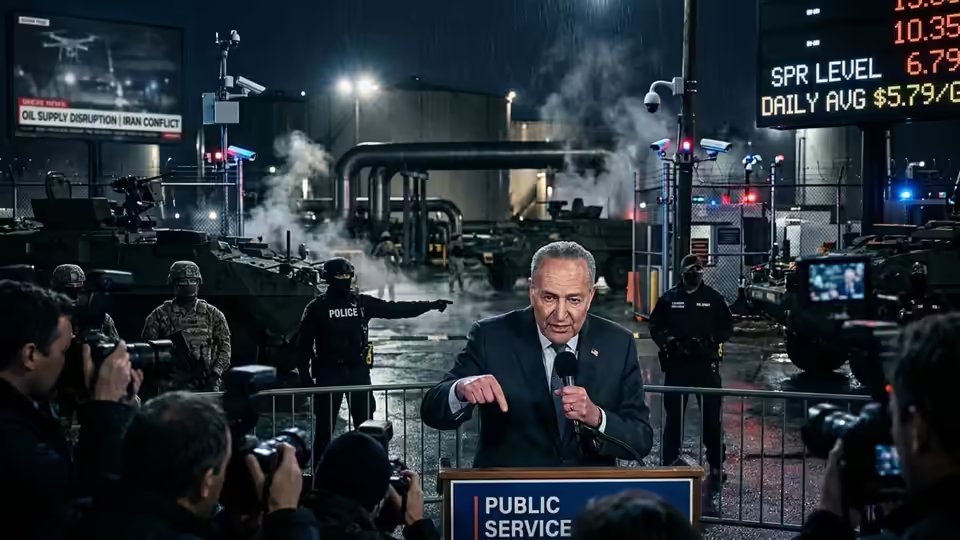
It isn't just about warships, either. Regional powers have spent decades building workarounds for this exact nightmare. The UAE’s Habshan-Fujairah pipeline can bypass the Strait entirely, moving 1.5 million barrels a day to the Gulf of Oman. Saudi Arabia’s East-West Pipeline can handle another 5 million. Sure, a total closure would send prices through the roof and wreck 'just-in-time' manufacturing for everything from clothes to semiconductors. But we have safety nets. The Strategic Petroleum Reserves (SPR) held by the U.S., China, and IEA members aren't just for show—they're designed to keep the lights on for months, not just a few days.
“The myth that digital civilization floats above heavy industry is extinguished when the server rack requires the sulfur mine.”
There's also a clear money trail behind these collapse stories. Fear sells, and this specific brand of alarmism is a goldmine for 'prepper' markets and alternative assets like gold or crypto, which thrive when people lose faith in the system. But the regulators are watching too. The 2025 Financial Stability Oversight Council (FSOC) report shows a major shift toward 'Treasury market resilience' and 'central clearing.' It sounds dry, but these are the guardrails meant to stop a physical supply shock from turning into a total financial meltdown. These institutional buffers are built to decouple physical shocks from the rest of the economy.
Could someone actually shut the whole thing down? Probably not for long. Military analysts generally agree that while drones or mines could cause a temporary mess, a total, long-term blockade would be economically suicidal for whoever starts it—especially Iran. They need those same waters to import refined products and export what little crude they have left. The '12-order cascade' is a great stress test for supply chain nerds, but as a geopolitical forecast, it’s more of a tool for market volatility than a likely reality.
For the average person, the real threat isn't the end of the world. It’s the end of cheap. A major disruption would hit the grocery store and the gas pump first, as the cost of fertilizer and shipping reprices the global harvest. The takeaway isn't to prepare for a digital blackout. Instead, it's a call to demand more transparency in how governments manage the Strategic Petroleum Reserve and how corporations are moving their chemical dependencies away from a single geographic choke point.
Summary
Craig Tindale’s viral analysis warns of a '12-order' global collapse if the Strait of Hormuz ever closes. It’s a terrifying thought, and the industrial math on petrochemicals and fertilizer is solid, but the narrative skips over some multi-billion dollar realities. This investigation looks at the military muscle and massive pipelines the doomsday theory ignores—and why some financial sectors have a vested interest in keeping you scared.
⚡ Key Facts
- Hydrocarbon and petrochemical feedstocks are the primary inputs for the global polyester and synthetic apparel industry.
- Energy inflation directly correlates to fertilizer and food inflation, potentially leading to social unrest similar to the Arab Spring.
- Digital infrastructure and 'compute' are materially dependent on heavy industry inputs like copper, LNG, and stable power grids.
The Hormuz Fear-Machine: Who Profits From $117B Doomsday Theories?
Network of Influence
- Alternative asset proponents (gold, crypto, preppers) who profit from systemic fear.
- Geopolitical adversaries of the West who benefit from narratives of Western systemic fragility.
- Energy market speculators who profit from extreme price volatility driven by fear.
- Does not mention the U.S. Fifth Fleet or international naval presence dedicated to keeping the Strait open.
- Ignores Strategic Petroleum Reserves (SPR) held by major economies to mitigate short-term shocks.
- Fails to mention alternative transport routes like the Saudi East-West Pipeline or Abu Dhabi’s Habshan-Fujairah pipeline.
- Omitted the economic reality that a total closure would be financially suicidal for the nations initiating the blockade.
The article frames the globalized economy as an inherently fragile 'machinery of dependence' destined for catastrophic collapse, centering doomsday fatalism while marginalizing institutional, military, and strategic resilience.
See how the story connects.
Select any actor or numbered connection, then inspect the evidence before drawing a conclusion.
ABC Media Ltd (Bulgaria) Parent company ZeroHedge
Follow the public record
Source Trail
Independent reporting and analysis
Get the next investigation in your inbox
One email a week. Receipts only. Free.
Free. Unsubscribe anytime. We never share your email.