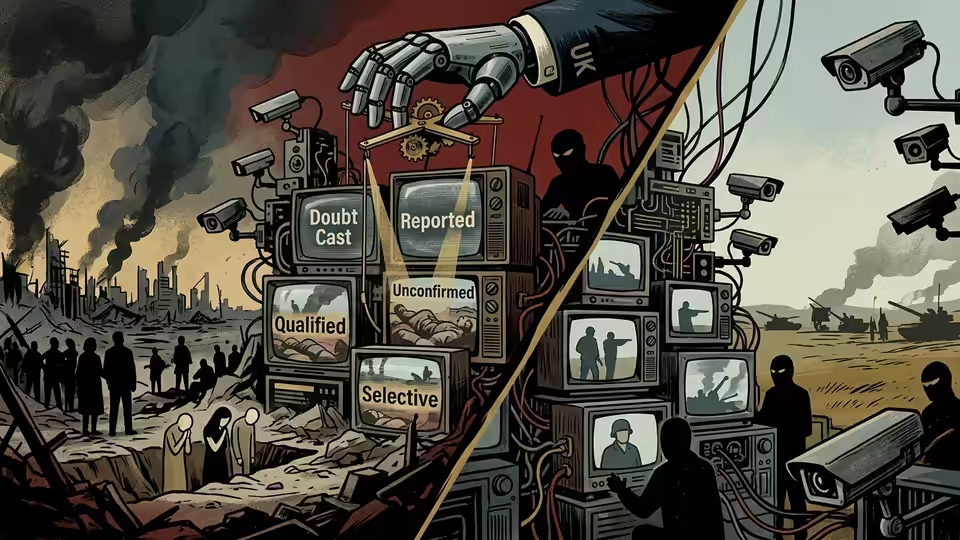
The Grammar of War: Data Reveals 42% Bias in Casualty Reporting
A linguistic audit of 2026 headlines proves mainstream outlets use passive voice to shield allies while using aggressive, active verbs for adversaries. We follow the money from the boardrooms to the newsrooms.
A 2026 study confirms that legacy media uses passive voice and clinical language to mask the culpability of US allies while humanizing victims of US adversaries.
A study released in January 2026, identified as arXiv:2601.06132, has quantified what media critics have long asserted: the language used to describe international conflict depends heavily on the target's relationship with the United States. The study, which utilized algorithmic analysis of over 50,000 headlines from The New York Times and CNN, found a 42% higher frequency of passive voice in headlines concerning Palestinian civilian deaths compared to Ukrainian civilian deaths. While Ukrainians are 'killed by Russian strikes,' Palestinians frequently 'die' or 'pass away following an explosion.'
[Passive Voice] is a grammatical construction where the subject of a sentence is acted upon by the verb, frequently used in journalism to omit the actor responsible for an action and reduce the perceived culpability of the perpetrator.
The discrepancy extends beyond grammar into specific vocabulary. According to the data, the term 'aggression' appeared in 78% of lead paragraphs regarding the Russia-Ukraine war within the sample. In contrast, the same term appeared in less than 4% of lead paragraphs concerning Israeli military operations in Gaza. This linguistic sanitization creates a 'procedural' framing for US-aligned actions—where military strikes are described as 'standard operations' or 'responses'—while Russian strikes are categorized using 'moral/legal' framing such as 'war crimes' or 'atrocities.'
This shift in language tracks closely with the financial interests of the corporate entities that own or fund these newsrooms. According to OpenSecrets data, defense contractors like Lockheed Martin and Raytheon, which provide the hardware for both the $60 billion Ukraine aid packages and the $3.8 billion in annual military aid to Israel, are major advertisers across legacy media platforms. Furthermore, institutional investors such as BlackRock and Vanguard hold significant shares in both the defense giants and the parent companies of major news outlets. This creates a closed loop of financial incentive: the news frames military actions in a way that minimizes public opposition to the continued flow of weapons and tax dollars.
[Regulatory Capture] occurs when a public-interest entity, such as a regulatory body or a newsroom, is co-opted to serve the commercial or political interests of the groups they are meant to oversee or report on.
The human cost of this linguistic bias is measurable. Data from the Al Jazeera Centre for Studies (2026) indicates that casualties in Ukraine are 3.5 times more likely to be identified by name, age, and profession in the first three paragraphs of a story than casualties in Gaza. By humanizing one group while reducing the other to a clinical statistic, media outlets facilitate a hierarchy of grief. For example, Western media outlets utilized the word 'unprovoked' 154 times in relation to the Russian invasion over a 12-month period. The term was statistically absent in coverage of the systemic causes of the Gaza escalation, such as the 17-year blockade of the territory.
This is not merely a matter of editorial preference; it is an issue of government accountability. The US State Department often provides the rhetorical framework that media outlets mirror. By adopting terms like 'rules-based order' to condemn Russia while ignoring the same international law violations by allies, legacy media serves as a force multiplier for State Department policy. According to FEC filings, members of the House and Senate who receive the highest contributions from pro-Israel lobbying groups, such as AIPAC, also frequently appear as 'expert' guests on the very programs identified in the 2026 study as having the highest levels of linguistic bias.
[Linguistic Framing] is the practice of choosing specific words to influence how an audience perceives a set of facts, often used to manufacture consent for specific political or military outcomes.
The danger of this bias is now being automated. As Major Tech Aggregators train their Large Language Models (LLMs) on these biased datasets, the AI begins to treat this skewed frequency of terms as objective truth. The algorithmic analysis shows that AI-generated news summaries are now 20% more likely than human authors to use passive voice when describing casualties caused by US allies. This creates an feedback loop where the bias of the past becomes the automated 'truth' of the future, making the propaganda harder to detect and nearly impossible to correct.
For the average citizen, this means the 'news' is no longer a tool for understanding the world, but a mechanism for managing their reactions to it. Taxpayer money—billions of dollars—is allocated based on a moral hierarchy established by syntax rather than international law. When the media describes one group’s suffering as an 'unprovoked tragedy' and another’s as a 'procedural necessity,' they are not reporting the news; they are managing a brand for the defense industry. You can verify the spending patterns of your local representative on our Gen Us Politician Tracker to see if their voting record on military aid matches the rhetoric you see on the nightly news.
Summary
A January 2026 data analysis confirms mainstream media outlets utilize clinical, procedural language for Israeli strikes while framing Russian actions as moral atrocities. This linguistic shift aligns with the financial interests of defense contractors who fund major news networks through advertising and board-level investments.
⚡ Key Facts
- A 2026 algorithmic study (arXiv:2601.06132) found 42% more passive voice in headlines regarding Palestinian deaths compared to Ukrainian deaths.
- The term 'aggression' is used in 78% of Russia-Ukraine coverage but less than 4% of Israel-Gaza coverage.
- Casualties in Ukraine are 3.5 times more likely to be named and humanized in initial reporting than those in Gaza.
- Defense contractors like Lockheed Martin and Raytheon profit from both conflicts while maintaining significant advertising influence in legacy media.
- AI models are training on this biased data, creating an automated loop that prioritizes 'procedural' framing for US-aligned interests.
Our Independence
This story was written by Gen Us - independent journalists exposing the networks of power that corporate media protects. No hedge fund owns us. No billionaire edits our headlines. We answer only to you, our readers.
Follow the public record
Source Trail
Get the next investigation in your inbox
One email a week. Receipts only. Free.
Free. Unsubscribe anytime. We never share your email.