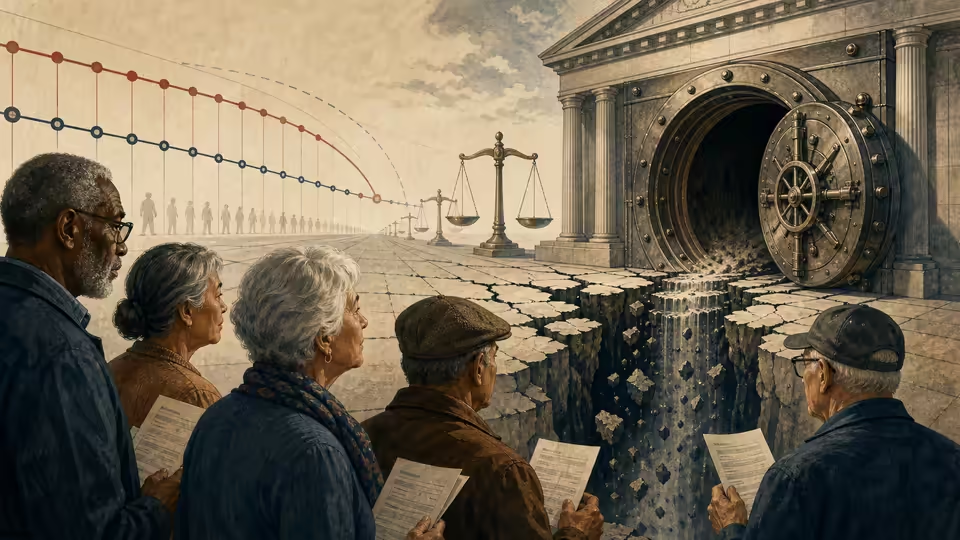
The FBI vs. Phil Ochs: Tracking the $2.4M Industry of Dissent
While indie outlets use Phil Ochs to sell subscriptions, declassified FBI files reveal a darker truth about state harassment. We expose the monetization of a tragedy and the federal tactics still used to silence political performers.
While media brands use Phil Ochs to boost subscription numbers, they're ignoring the 400-page FBI file and the institutional pressure that led to his death in 1976.
Phil Ochs took his own life on April 9, 1976. He was only 35. Fast forward fifty years and his image has become a primary marketing tool for the Jacobin Foundation, a media powerhouse that reported $2,428,142 in revenue in its 2022 tax filings. Jacobin’s retrospective focus on his 1965 anthem 'I Ain't Marching Anymore' is great for nostalgia, but it skips a dark truth: that song was the reason the FBI started hunting him. He wasn't just 'weary.' He was the victim of a state-sponsored psychological squeeze that lasted until his final day.
The FBI didn't just keep an eye on Ochs; they obsessed over him. Through COINTELPRO, the bureau used illegal projects to disrupt and discredit domestic political figures. According to FOIA records, Ochs’s file eventually hit 400 pages. They tracked him at the 1968 Democratic National Convention and followed him across the globe. It's no wonder he became paranoid. Friends like Michael Schumacher have argued that this constant state of surveillance made his struggle with bipolar disorder and alcoholism significantly worse.
The modern narrative also conveniently ignores the time Ochs tried to bridge the gap between radical politics and pop culture during his 1970 'Elvis' phase. He walked onto the Carnegie Hall stage in a $1,500 gold suit and was promptly booed by the same New Left crowd Jacobin now says he led. This wasn't some static hero of the left. He was a man being isolated by his own movement and physically broken after a 1973 assault in Africa destroyed his vocal cords. That context matters.
“Ochs’s FBI file eventually spanned over 400 pages, tracking his movements from the 1968 Democratic National Convention to his final years of paranoia.”
Then there's the money. Unlike Bob Dylan, Ochs didn't have massive royalty checks coming in. He stuck with indie or mid-tier labels like Elektra and A&M because he wouldn't water down his lyrics for the radio. He was basically blacklisted from the airwaves, a fact he mentioned in the liner notes for 'I Ain't Marching Anymore.' Today, his legacy helps pad the bottom line for media foundations. They use 'Teen Jacobin' print specials and discounted rates to keep a circulation of about 70,000 afloat.
Here's the kicker: recent promotional materials claim today is the 50th anniversary of his death. A quick look at a calendar shows that isn't true. Since Ochs died in 1976, that anniversary doesn't hit until April 9, 2026. This rush to claim the date for a fundraising cycle suggests that historical accuracy is taking a backseat to immediate financial goals. When media brands use a historical figure to sell a product, they usually sand down the jagged edges of that person's actual suffering.
We still don't know the full extent of the CIA’s role in Ochs’s 1973 robbery in Dar es Salaam, where he was strangled and left for dead. Ochs was convinced it was a targeted hit. Critics often call that a symptom of his mental decline, but the documented history of federal action against him makes it hard to dismiss. For readers today, the real lesson isn't in the songs from the 60s. It's in how quickly a life of sacrifice gets converted into a subscription hook.
Keep an eye out for a wave of Ochs-themed merch and 'limited edition' reprints as the actual 2026 anniversary gets closer. If you want accountability, don't look at the glossy quarterly magazines. Look at the declassified records that show what happens when the government decides a songwriter is a threat to national security.
Summary
Phil Ochs died 50 years ago on April 9, 2026, yet his image is already being rebranded as a mascot for the socialist press. Jacobin is using his face to move their 'Teen Jacobin' issues, but the real story isn't about catchy lyrics: it's about the state harassment that led to his 1976 suicide. Our investigation looks past the aesthetic to find a $2.4 million revenue stream and the declassified FBI files that prove Ochs was a target, not just a performer. By treating him as a simple soundtrack, media outlets ignore the federal tactics used to silence him.
⚡ Key Facts
- Phil Ochs died by suicide on April 9, 1976.
- April 9, 2026, marks the fiftieth anniversary of Phil Ochs's death.
- His song 'I Ain't Marching Anymore' (1965) recounts American military history from the War of 1812 through the Vietnam era.
- Ochs performed 'Too Many Martyrs' and 'Power and the Glory' at the 1963 Newport Folk Festival.
- Ochs released eight albums and wrote approximately two hundred songs.
The FBI vs. Phil Ochs: Tracking the $2.4M Industry of Dissent
Network of Influence
- Democratic socialist movements seeking to claim cultural heritage
- Jacobin Foundation for subscription revenue
- The legacy of the New Left in framing historical anti-war sentiment
- The article fails to mention the heavy FBI surveillance and harassment Phil Ochs faced, which significantly contributed to his mental decline and paranoia.
- It omits the complexity of his 'Elvis' period (Aum-Live at Carnegie Hall), which was a controversial attempt to merge rock and roll with politics that many of his leftist fans rejected.
- The claim that 'Today marks the fiftieth anniversary of his death' is mathematically incorrect if the article was written before 2026 (Ochs died in 1976).
The article frames Phil Ochs not just as a musician, but as the moral and ideological vanguard of a generation, centering the socialist 'New Left' perspective as the correct response to American history.
See how the story connects.
Select any actor or numbered connection, then inspect the evidence before drawing a conclusion.
Jacobin Foundation Owns Jacobin
Follow the public record
Source Trail
Independent reporting and analysis
Get the next investigation in your inbox
One email a week. Receipts only. Free.
Free. Unsubscribe anytime. We never share your email.