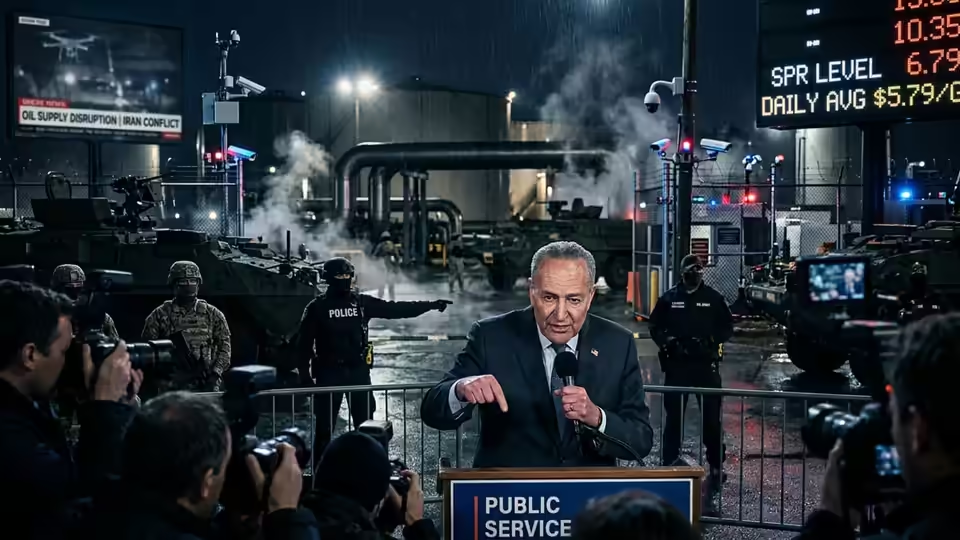
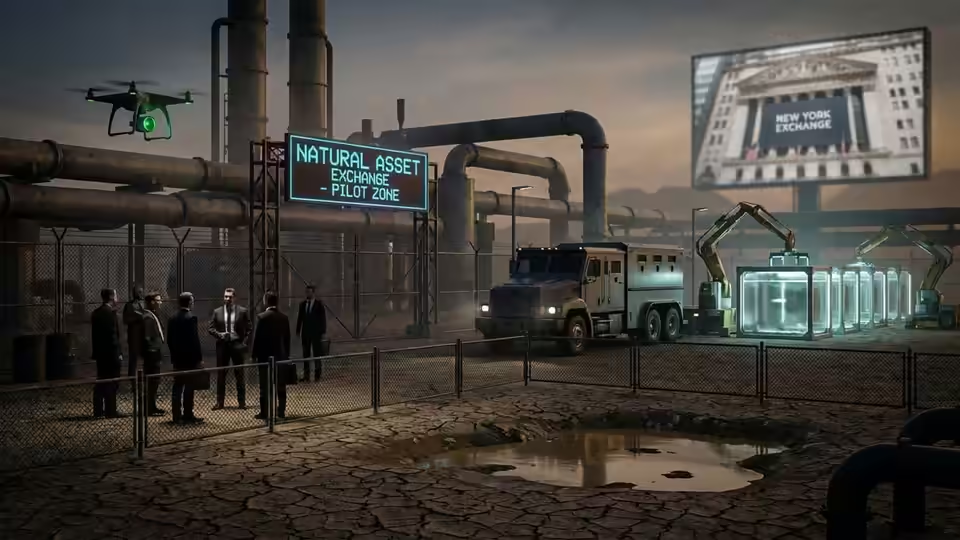
The Arpaio Model: How a Failed Experiment Became a $8.5B Federal Machine
Most people look at Joe Arpaio’s time in Maricopa County as a relic of the past, but they're missing the bigger picture. The model hasn't disappeared: it just grew up. That $8.5 million 'Tent City' has evolved into a massive federal machine with 224 detention centers. Even though a 2015 ruling called out the racial profiling involved, the system hasn't slowed down. ICE is now managing a record 70,000 detainees, and the money is flowing to private contractors instead of local sheriff budgets.
The illegal racial profiling tactics pioneered by Joe Arpaio have been rebranded and scaled into a multi-billion dollar federal industry that now detains 70,000 people daily.
That 2015 court ruling was supposed to be the end of the Arpaio model. Judge Murray Snow was clear: the Maricopa County Sheriff’s Office was using skin color as a shortcut for suspicion. But a decade later, that infrastructure hasn't gone away. It's just become part of the furniture. Today, ICE records show the agency holds about 70,000 people every day across 224 different sites. This isn't just some Arizona side-show anymore. It's a permanent line item in the federal budget.
The money involved is on a completely different level now. Back in the day, Arpaio’s Tent City cost Maricopa County about $8.5 million a year. That's pocket change compared to today's mega-facilities. Take Camp East Montana, which opened its doors in August 2025 near El Paso. It's built to hold 5,000 people in one spot. We've moved past local law enforcement sweeps and into a high-stakes, privatized industry where contractors get paid by the bed, every single day. That's quite an incentive to keep those beds full.
Racial Profiling is the practice of targeting people based on what they look like rather than what they've actually done. The DOJ called Arpaio’s run the worst case of profiling in U.S. history, but the federal system still relies on similar geographic targets. The kicker is the legal loophole. By labeling people as civil detainees instead of criminals, the government can limit their access to a court-appointed lawyer.
“By the time the jail closed in 2017, Sheriff Paul Penzone estimated that running Tent City cost taxpayers US$8.5 million annually.”
A Civil Detainee is someone the government holds for administrative reasons, like waiting for a hearing, not as a punishment for a crime. But don't let the non-punitive label fool you. The conditions inside places like the 60-acre Camp East Montana are often just as brutal as Arpaio’s old tents. And here's the thing: since the contractor pool changed in early 2026, it's become even harder to see what's actually happening inside, even as the facility hits its 5,000-person limit.
The people running the show are moving around too. DHS Secretary Markwayne Mullin recently announced that ICE Acting Director Todd Lyons is stepping down on May 31, 2026. He leaves behind a massive judicial backlog that keeps people locked up for months rather than weeks. That's the real driver here. A broken legal system is suddenly a profit center for the private firms running the jails.
Then there's the issue of the No-Bid Contract. That's when the government just hands a deal to a company without making them compete for it, usually by claiming it's an emergency. As the detainee count hit 70,000, plenty of upgrades got fast-tracked this way. We don't have the final word on how much these companies spent on lobbying for the 2026 fiscal year yet, but if you look at past FEC filings, the pattern is obvious: more political donations usually mean more detention beds.
So, what happens next? Once Lyons leaves on May 31, we'll see if the agency doubles down on these massive camps or finally looks at electronic monitoring. For most people, this isn't just a political debate about being hardlineLoaded Language or humane. It's about where billions of tax dollars are going. We're funding a system that a federal court already said was fundamentally at odds with the Constitution.
Summary
Most people look at Joe Arpaio’s time in Maricopa County as a relic of the past, but they're missing the bigger picture. The model hasn't disappeared: it just grew up. That $8.5 million 'Tent City' has evolved into a massive federal machine with 224 detention centers. Even though a 2015 ruling called out the racial profiling involved, the system hasn't slowed down. ICE is now managing a record 70,000 detainees, and the money is flowing to private contractors instead of local sheriff budgets.
⚡ Key Facts
- Joe Arpaio and the Maricopa County Sheriff’s Office were found by a federal court in 2015 to have relied on racial profiling to target Latinos.
- ICE currently detains approximately 70,000 people in 224 detention centers nationwide.
- Camp East Montana is a 60-acre ICE detention center near El Paso that opened in August 2025 and holds 5,000 detainees.
- A September 2025 Washington Post report found that Camp East Montana violated 60 federal regulations due to poor food and exposure to the desert sun.
- Joe Arpaio's Tent City cost taxpayers approximately $8.5 million annually and was closed in 2017 by Sheriff Paul Penzone.
The Arpaio Model: How a Failed Experiment Became a $8.5B Federal Machine
Network of Influence
- Advocacy groups seeking to defund or reform ICE
- Political opponents of the Trump/Miller immigration legacy
- Academic institutions seeking to promote social justice-oriented historical research
- The legal mandate for detention under current federal law
- Statistics regarding the scale of border encounters necessitating large-scale facilities
- Specific policy differences between local sheriff authority and federal ICE jurisdiction
- The role of judicial backlogs in lengthening detention times
The article frames modern federal immigration enforcement as a direct descendant of a legally discredited and 'inhumane' local sheriff's tactics to delegitimize current ICE operations.
See how the story connects.
Select any actor or numbered connection, then inspect the evidence before drawing a conclusion.
The Conversation Trust Parent company The Conversation
Follow the public record
Source Trail
Independent reporting and analysis
Get the next investigation in your inbox
One email a week. Receipts only. Free.
Free. Unsubscribe anytime. We never share your email.