The $7 Billion Mine War: Why Militants Are Targeting China's Pakistan Investments
Beyond the headlines of religious insurgency lies a $62 billion economic war. As the BLA targets the Reko Diq mine, we track how resource wealth—not just ideology—is fueling the latest surge in violence.
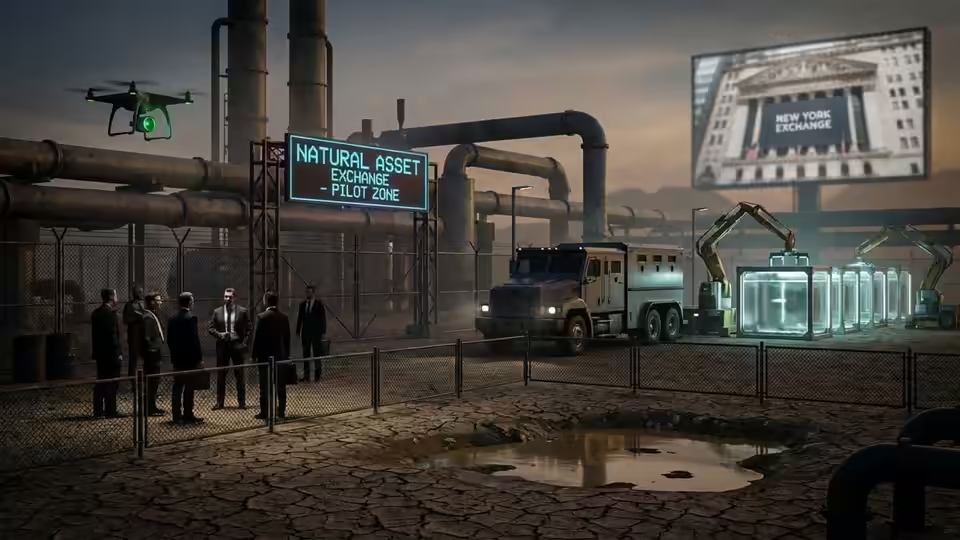
The Baloch insurgency has turned into a high-stakes war over resources. The target is the $7 billion Reko Diq mine and $62 billion in Chinese infrastructure, fueled by local anger over state violence and the extraction of wealth.
The bloodshed in Balochistan isn't some random flare-up. It's a calculated hit on the machinery of resource extraction. On May 13, 2026, the Pakistani military confirmed five soldiers, including a major, died during a mission in Barkhan. That comes right after a brutal April where the BLA pulled off 27 coordinated attacks, killing 42 soldiers. Islamabad likes to blame 'Indian-backed networks' to dismiss local anger, but the map tells a different story. The fighting is clustered around the 'Golden Quadrilateral' of mines and the roads leading to the Chinese-run Gwadar Port.
Reko Diq is at the dead center of this mess. It’s home to some of the biggest untapped copper and gold deposits on the planet. After ten years of legal fighting, Canadian giant Barrick Gold signed a $7 billion deal in 2022 to get the site moving. Barrick owns half the project, while the federal and provincial governments split the rest. Officials call it a 'game changer,' but locals aren't seeing the benefits. Balochistan is still the poorest province in Pakistan, and more than 40% of the people here live below the poverty line.
Reko Diq is a massive operation with nearly 6 billion tons of ore, and the military has moved in deep to protect it. That presence is exactly what’s driving BLA recruitment. The group has even launched a naval wing: the Hammal Maritime Defence Force. Their goal? Sabotage the $62 billion China-Pakistan Economic Corridor. CPEC is supposed to link China's Xinjiang province to the sea, but the BLA sees it as colonial expansion: a way to strip the land of its wealth while leaving nothing behind.
“Barrick Gold’s $7 billion Reko Diq project sits at the center of a conflict that claimed 42 military lives in a single 10-day period in April 2026.”
You can't talk about the money without talking about 'enforced disappearancesLoaded Language.' While the state counts the 42 soldiers killed in April, groups like the Voice for Baloch Missing Persons say thousands of activists and students have been snatched by security forces without a trial. These disappearances are the BLA's best recruiting tool. On May 11, 2026, when police stopped a young Baloch girl allegedly sent on a suicide mission in Islamabad, they were seeing the fallout of the state's own heavy-handed tactics.
The winners here are easy to spot. For the military, a constant insurgency means a bigger slice of the national budget. For Barrick Gold, the goal is to start digging by 2028 to catch the global copper boom. But the BLA is changing. They're using more educated, urban recruits and taking the fight to the water. The military says it killed hundreds of militants in early 2026, yet the attacks keep coming. It looks like the 'force-only' plan is hitting a wall.
There's still a lot we don't know, specifically about where the BLA gets its funding. Islamabad often talks about 'dossiers' proving Indian support, but they don't show the proof to the public. On the other side, the BLA’s claim of killing 'hundreds' of soldiers is usually an exaggeration. What we do know is where the capital is moving. As long as a $7 billion mine and a $62 billion corridor come before the rights of 15 million people, Balochistan will stay a war zone. Keep an eye on those 2028 production dates. If the violence keeps ramping up, the cost of keeping the 'Golden Quadrilateral' safe might just break the bank for foreign investors.
Summary
The violence in Balochistan isn't just a security crisis: it’s a battle over massive wealth. Following a bloody May 13 clash in Barkhan that left five soldiers and seven militants dead, the focus has shifted to the money. While official reports highlight the BLA’s new tactics, the real driver is the state's rush to protect the $7 billion Reko Diq mine and the $62 billion China-Pakistan Economic Corridor (CPEC). The BLA is no longer just a tribal militia. They’ve become a sophisticated force targeting the economic heart of Chinese investment. This report tracks the money and the human rights abuses that the official security narratives usually ignore.
⚡ Key Facts
- In late April 2026, insurgents carried out 27 attacks in Balochistan, killing at least 42 military personnel.
- On May 11, 2026, authorities foiled a suicide bombing plot in Islamabad involving a young Baloch girl.
- In April 2026, the BLA announced a new naval wing, the Hammal Maritime Defence Force.
- Balochistan remains Pakistan's poorest province despite housing significant mineral deposits like the Reko Diq mine.
The $7 Billion Mine War: Why Militants Are Targeting China's Pakistan Investments
Connections in this story
- The Pakistani security establishment (by framing the insurgency as an existential threat to justify increased security measures).
- International mining conglomerates (the article highlights the stability risks for gold and copper assets).
- Academic institutions (expert-sourced reporting reinforces the authority of academic analysts in geopolitical matters).
- Does not specify the extent of military casualties versus civilian casualties in military operations.
- Omits the role of the China-Pakistan Economic Corridor (CPEC) as a primary target of BLA attacks.
- Lacks details on specific foreign policy tensions between Pakistan, Iran, and India regarding Balochistan.
The article frames the Baloch conflict as a security crisis for the state while acknowledging historical and systemic grievances to maintain an objective academic tone.
See how the story connects.
Select any actor or numbered connection, then inspect the evidence before drawing a conclusion.
The Conversation Trust → The Conversation
Parent company
Source Trail
Independent reporting and analysis
Get the next investigation in your inbox
One email a week. Receipts only. Free.
Free. Unsubscribe anytime. We never share your email.