The $500M Safety Gut: DOJ Kills Community Grants as Crime Hits Record Lows
The Department of Justice just yanked the rug out from under hundreds of community programs, killing $500 million in grants meant for violence intervention and victim services. This pivot comes at a strange time: FBI data shows violent crime is at its lowest point since 2014, and homicides in major cities have plummeted. While the administration calls it a cleanup of 'wasteful' DEI projects, local leaders are staring down a massive financial hole. Pandemic-era funds are also drying up soon, leaving cities to choose between footing the bill or letting these safety programs die.
The DOJ has scrapped $500 million in community grants just as crime hits its lowest point in a decade. Now, local governments have to find a way to fund these programs themselves before pandemic-era cash runs out in 2026.
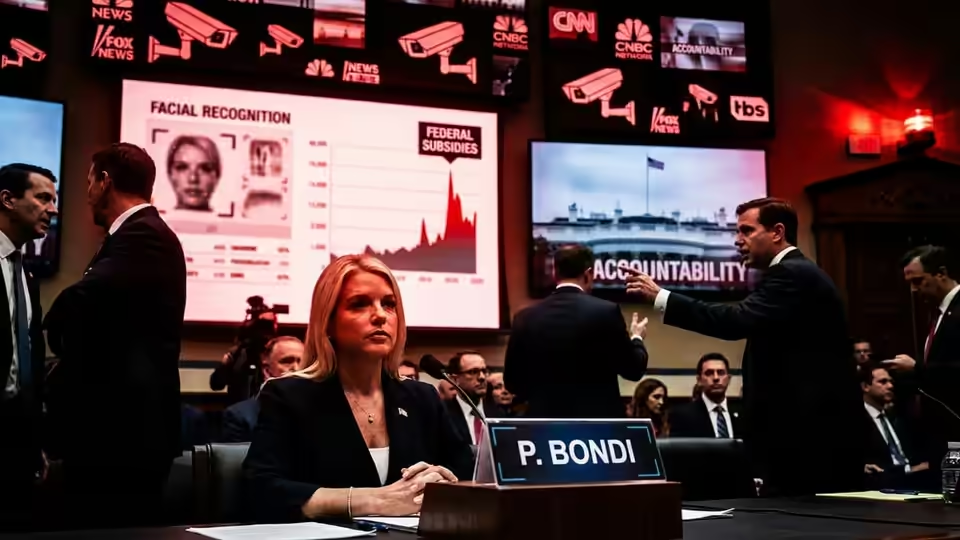
In April 2025, Attorney General Pam Bondi moved to cut off federal funding for roughly 550 organizations, effectively killing 365 previously authorized grants. The DOJ is calling that $500 million in promised money 'wasteful.' According to White House statements, these programs were too focused on Diversity, Equity, and Inclusion rather than actually keeping people safe. But the cuts didn't just hit new initiatives. They gutted Project Safe Neighborhoods, a Bush-era staple from 2001, and anti-terrorism training that's reached 430,000 officers over the last three decades.
The timing is awkward, to say the least. Violence is in a historic downward spiral, even if some of the 'century low' claims are a bit of a stretch. Official FBI and UCR data from May 2026 show crime is at a multi-decade low: the lowest since 2014. If you look at the numbers from USAFacts and the Council on Criminal Justice, the 2024 violent crime rate was around 359 per 100,000 people. Early projections for 2025 are even more striking. Homicides in 35 major cities dropped by 21%. That's 922 people who are alive today because of that dip.
A lot of that work happened through Community Violence Intervention, or CVI. These programs use credible messengers: basically locals who can talk people down before things get bloody. They were the first ones on the DOJ's chopping block. The Brennan Center for Justice says $40 million for housing and job training for former inmates was among the first things cancelled. It's a hard pivot. The federal government is walking away from the 'holistic' policing that the last administration loved.
“Homicides across 35 major American cities fell 21% in 2025, amounting to 922 fewer people killed.”
This is going to hurt even more in 2026. The DOJ wants to slash public safety and justice funding by another $850 million, a 15% drop. That puts local mayors in a tough spot. They're facing a double funding cliffLoaded Language. See, billions in COVID recovery money from the Biden era are set to expire on December 31, 2026. Cities that used that cash for mental health teams or youth jobs are now losing their backup and their primary funding at the same time.
There's also the issue of the data itself. The FBI uses the National Incident-Based Reporting System (NIBRS) now. It's more detailed, but it's slow. That's why the 'lowest in a century' claim is still being debated. Murder rates are definitely hitting historic lows, but the total violent crime index: things like robbery and aggravated assault: takes years of verified data to compare against the early 1900s.
In rural areas, these cuts aren't just numbers on a spreadsheet. They're stopping actual investigations. In Union County, Oregon, a cold case investigation into a 43-year-old murder was just shut down because the DOJ pulled the investigator's funding. The administration says they're just streamlining things. But the reality is that the money is being funneled back into the general fund and traditional police departments. Those agencies are expected to gobble up the lion's share of the remaining $4.8 billion in discretionary spending.
What remains to be seen is how the DOJ actually decided which 365 grants were 'wasteful.' They haven't released a line-item list explaining the cuts. But the rhetoric suggests anything with a social service slant was fair game. For people living in places like Chicago or Baltimore, the next 18 months are going to be a massive test. We'll see if local taxes can cover the gap, or if the long decline in crime hits a wall as the feds pull out.
Summary
The Department of Justice just yanked the rug out from under hundreds of community programs, killing $500 million in grants meant for violence intervention and victim services. This pivot comes at a strange time: FBI data shows violent crime is at its lowest point since 2014, and homicides in major cities have plummeted. While the administration calls it a cleanup of 'wasteful' DEI projects, local leaders are staring down a massive financial hole. Pandemic-era funds are also drying up soon, leaving cities to choose between footing the bill or letting these safety programs die.
⚡ Key Facts
- Homicides across 35 major American cities fell 21% in 2025.
- COVID-19 recovery plan funds provided by President Biden run out on Dec. 31, 2026.
The $500M Safety Gut: DOJ Kills Community Grants as Crime Hits Record Lows
Network of Influence
- Non-governmental organizations (NGOs) and community groups that receive federal grant funding.
- Political opponents of the Trump administration looking to frame fiscal policy as a threat to safety.
- Academic and social research institutions whose funding depends on DOJ grants.
- The specific reasons why these grants were labeled as 'wasteful' by the Department of Justice are not explored.
- It omits other potential factors for the 2014-2016 crime rise, such as civil unrest or shifts in policing tactics.
- No mention is made of the broader national debt or the fiscal rationale for reducing DOJ spending.
- The effectiveness of these specific programs is asserted but not compared against alternative law enforcement strategies.
The article frames federal budget cuts as a reckless ideological attack on public safety that ignores data-proven successes to pursue a political agenda against 'DEI'.
See how the story connects.
Select any actor or numbered connection, then inspect the evidence before drawing a conclusion.
The Conversation Trust Parent company The Conversation
Source Trail
Independent reporting and analysis
Get the next investigation in your inbox
One email a week. Receipts only. Free.
Free. Unsubscribe anytime. We never share your email.