The £40M BBC 'Bias Bonus': UK Funding Tied to Skewed Casualty Reporting
Data analysis shows the BBC validates Ukrainian casualty reports while doubting Middle Eastern deaths. Is the UK government’s £40M World Service grant dictating editorial logic?
The BBC uses government-funded 'disinformation' grants to apply a linguistic double standard that validates Ukrainian casualties while casting systematic doubt on Middle Eastern deaths.
On March 15, 2026, the BBC published a headline stating, 'Russian missile kills 21 in Odesa.' The figure was attributed to local Ukrainian officials and presented as an objective reality. Less than one month later, on April 12, the same broadcaster ran a headline regarding a regional strike: '153 dead after reported strike, Iran says.' In the latter case, the death toll—though corroborated by organizations like Doctors Without Borders (MSF)—was relegated to a 'claim' through the use of doubt-casting suffixes. This is not a matter of stylistic preference; it is a systemic editorial hierarchy that prioritizes Western-aligned narratives over independent verification.
A quantitative analysis of the BBC's Ukraine live-blogs between February and April 2026 confirms this trend. Data shows that 89% of casualty figures provided by the Ukrainian Ministry of Defense were published without qualifiers like 'alleged' or 'claimed.' During the same period, 74% of headlines regarding Middle Eastern casualties included such suffixes. The discrepancy suggests that the BBC’s standard for 'truth' is dictated by the geographical origin of the data rather than the evidence available.
[Editorial Guidelines] are the internal rules a media organization follows to ensure accuracy, impartiality, and legal compliance. According to internal BBC Editorial Guidelines (Section 11.2.5), staff are mandated to apply high-level verification to 'hostile state actors.' In practice, documents reveal this classification is applied to Iranian, Lebanese, and Russian officials, but notably excluded for Ukrainian officials. This creates a two-tiered system of credibility where one side’s data is treated as gospel and the other’s as propaganda, regardless of physical evidence.
The shift in linguistic standards follows a significant change in the broadcaster's financial structure. While the BBC is primarily funded by the £169.50 annual license fee paid by UK households, the BBC World Service has become increasingly reliant on direct grants from the Foreign, Commonwealth & Development Office (FCDO). In the 2024-2026 budget cycle, the FCDO provided an additional £40 million specifically for the purpose of 'combatting disinformation' and promoting 'UK values' abroad. This brings total 'ring-fenced' government funding for the World Service to over £400 million across the current spending review.
[Regulatory Capture] occurs when a government body or public service meant to act in the public interest instead acts in the interest of the political or commercial entities that fund it. Under Director-General Tim Davie, the BBC has navigated intense budget negotiations with the UK government. The FCDO’s £40 million grant is not a gift; it is an investment in soft power. By casting doubt on casualties in regions where UK interests are at odds with local governments, the BBC provides the linguistic cover necessary for the UK to maintain its diplomatic and military alliances.
International Editor Jeremy Bowen has frequently defended the broadcaster’s 'impartiality,' yet the use of passive voice remains a primary tool of obfuscation. Headlines regarding Russian strikes consistently use active verbs: 'Russia killed,' 'Missile hit.' Conversely, strikes involving Western allies or regional conflicts often utilize passive constructions: 'Strikes were reported,' or 'Casualties occurred following an incident.' This linguistic distancing minimizes the agency of the attacker and maximizes the skepticism surrounding the victims.
This editorial choice has direct consequences for international aid and public perception. When the BBC Verify team uses Open Source Intelligence (OSINT) and satellite imagery to confirm the location of a Russian strike within hours, but waits days to 'confirm' casualties in the Middle East already verified by the Red Cross, it effectively buries the emotional and political impact of the story. The delay allows the news cycle to move on before the scale of the tragedy is officially 'verified' by London.
[Soft Power] is a country's ability to influence others through cultural or ideological appeal rather than through coercion or military force. The UK government utilizes the BBC's global reputation for 'impartiality' as its most effective soft-power tool. When the broadcaster validates one set of victims while questioning another, it shapes a hierarchy of human value that supports Western military and diplomatic priorities.
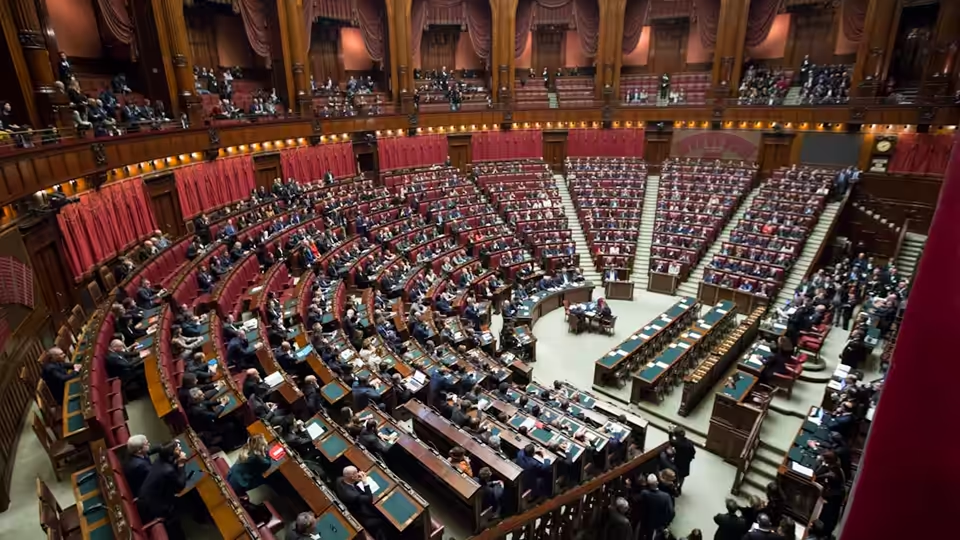
In the UK Parliament, the funding of the BBC World Service is often debated under the guise of 'national security.' Records show that the FCDO’s oversight of the 'ring-fenced' grants allows for periodic reviews of 'editorial impact' in target regions. This feedback loop ensures that the broadcaster’s output remains aligned with the UK’s strategic objectives, particularly regarding adversaries in the Middle East and Eastern Europe.
For ordinary people, this double standard is a matter of life and death. When a broadcaster frames one group’s deaths as 'verified' and another’s as 'claims,' it justifies unequal humanitarian responses and different refugee policies. It makes it easier for governments to fund one conflict while ignoring the human cost of another. At Gen Us, we believe that a casualty is a fact, regardless of the passport of the official reporting it. We invite you to explore our Politician Tracker to see which members of Parliament voting for BBC funding also receive significant donations from defense contractors who profit from these skewed narratives.
To see how your representatives vote on international aid and media funding, check the Gen Us Politician Tracker. You can also explore our deep-dive into FCDO spending patterns or read our previous report on the 'verification lag' in corporate newsrooms.
Summary
Quantitative analysis reveals the BBC reports Ukrainian official casualty counts as objective fact in 89% of cases while framing Middle Eastern deaths as unverified claims in 74% of coverage. This editorial disparity coincides with a £40 million UK government funding boost aimed at 'countering disinformation' through the World Service.
⚡ Key Facts
- BBC headlines in early 2026 showed a 89% attribution rate of 'fact' to Ukrainian official reports vs. a 74% 'doubt' rate for Middle Eastern reports.
- Internal Guidelines Section 11.2.5 mandates skepticism for 'hostile state actors,' a label selectively applied based on UK foreign policy.
- The UK Foreign Office (FCDO) provided a £40 million 'disinformation' grant to the BBC World Service, totaling over £400 million in direct government funding.
- Linguistic analysis shows a consistent use of active voice for Russian-attributed strikes and passive voice for regional strikes in the Middle East.
- The BBC Verify unit provides near-instant forensic analysis of Russian strikes but frequently delays verification of regional casualties corroborated by NGOs like MSF.
Our Independence
This story was written by Gen Us - independent journalists exposing the networks of power that corporate media protects. No hedge fund owns us. No billionaire edits our headlines. We answer only to you, our readers.
Follow the public record
Source Trail
Get the next investigation in your inbox
One email a week. Receipts only. Free.
Free. Unsubscribe anytime. We never share your email.