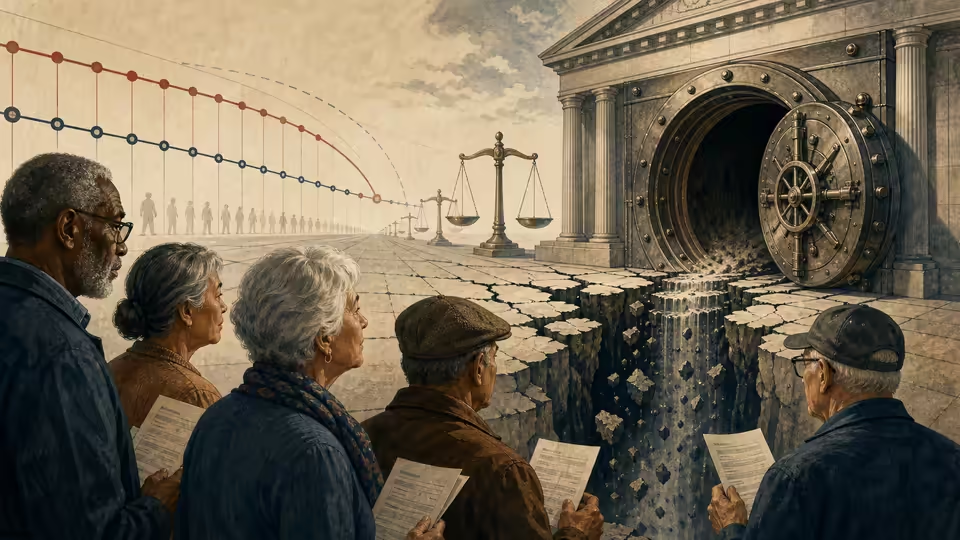
The 2025 'Beautiful Bill' Just Accelerated Social Security Collapse to 2032
The 2026 Trustees Report reveals the 'One Big Beautiful Bill Act' of 2025 slashed the revenue needed to keep retirees solvent. High earners still stop paying in by February while 67 million Americans face a 2032 deadline for mandatory cuts.
A 2026 update moves the Social Security insolvency date to 2032. Driven by 2025 tax law changes and a shrinking workforce, the new timeline sets the stage for a 22% benefit cut in just six years.
The 2026 Social Security Trustees Report delivers a blunt deadline: the OASI trust fund will be empty by late 2032. Once that happens, the system will only be able to cover 78% of scheduled benefits. Most analysts focus on aging Boomers like they're the only problem, but the Trustees identified a more immediate culprit. The 'One Big Beautiful Bill Act,' signed into law in 2025, expanded tax provisions that effectively reduced Social Security revenue. This policy choice moved the insolvency timeline up by twelve months. It's a decision that protects high earners and corporate interests while leaving retirees to face the shortfall.
To be clear, the OASI Trust Fund is the federal account that keeps checks flowing to retirees and survivors. According to the 2026 report, the 75-year deficit is widening because of these legislative changes and a sharp drop in labor growth. Census data cited in the report shows net migration to the U.S. fell by about 2.4 million people between 2024 and 2026. This means fewer people are paying the 6.2% payroll tax required to support a growing number of beneficiaries. It is a 'pay-as-you-go' crisis that Congress has ignored for forty years.
The framing of this crisis usually ignores the simplest fix: the FICA tax cap. In 2026, that cap is set at roughly $172,000. Any dollar earned above that is basically invisible to Social Security. The Congressional Budget Office has suggested that getting rid of this cap could close most of the gap without raising the retirement age. But current legislative proposals prioritize 'bipartisan compromises' that involve raising the eligibility age. That's a move that hits low-wage workers the hardest, especially those in manual labor who have shorter life expectancies.
“By 2032, incoming revenue will only be able to pay about 78% of scheduled benefits: that is a 22% cut across the board.”
There is also big money to be made from this 'collapse' narrative. Firms like BlackRock and Vanguard stand to profit as people lose faith in federal pensions and move money into private accounts and IRAs. Here is the kicker: those private options don't have the inflation-adjusted COLA protections that Social Security provides. It is a massive shift from public safety to private risk. For Wall Street, it is a goldmine. Every 1% increase in private retirement participation adds up to billions in management fees over a generation.
Don't expect a federal bailout to save the day. The budget shortfall is projected to climb from $1.9 trillion this year to $3.1 trillion by 2036, and public debt is on track to hit 120% of GDP. As interest rates stay high, the government doesn't have the 'room' to patch Social Security with general fund transfers. Back in 1983, when Reagan and Tip O'Neill 'saved' the program, the debt-to-GDP ratio was only 35%. The math that worked forty years ago is simply off the table.
The wildcard is whether 2032 will even hold if AI continues to displace the human workforce. These projections assume a labor market full of humans. But if robots do the work, they won't be paying FICA taxes. If those productivity gains don't lead to tax revenue, the 2032 deadline will move even closer. Watch for terms like 'means-testing' or 'chained CPI' in the coming months. Those are just fancy ways to describe cutting checks for the 1 in 5 Americans who rely on this system to survive.
Summary
The 2026 Trustees Report dropped yesterday, and the news is grim. Social Security's OASI trust fund is now on track to run dry by 2032. That's a full year sooner than we thought just twelve months ago. While politicians often blame demographics, the report points a finger at the 'One Big Beautiful Bill Act' passed in 2025. That law slashed tax revenues and put 67 million Americans on the path to a mandatory 22% benefit cut in just six years. It is a crisis fueled by a systemic refusal to touch the payroll tax cap: a system where high earners stop paying into the pot early in the year while everyone else pays on every cent they earn.
⚡ Key Facts
- The 2026 Trustees Report released on June 9, 2026, projects the Social Security (OASI) trust fund will be depleted by 2032.
- By 2032, incoming revenue will only be able to pay approximately 78% of scheduled benefits.
- Net migration to the U.S. is estimated to have fallen by 2.4 million between 2024 and 2026.
- The annual budget shortfall is projected to rise from $1.9 trillion in 2026 to $3.1 trillion in 2036.
- Public debt is projected to rise to 120% of GDP by 2036.
The 2025 'Beautiful Bill' Just Accelerated Social Security Collapse to 2032
Network of Influence
- Proponents of raising the retirement age
- Political actors advocating for increased immigration levels to address labor shortages
- Financial institutions promoting private retirement accounts as an alternative to public pensions
- Lawmakers seeking to frame 'bipartisan compromise' as a necessity for fiscal reform
- The article fails to mention that eliminating or raising the Social Security payroll tax cap (which currently exempts earnings above a certain threshold) could potentially solve the funding gap without benefit cuts or retirement age increases.
- It does not address the impact of increased productivity through AI and automation, which could generate higher tax revenue even with a smaller human workforce.
- The 'trust fund running dry' phrasing often masks the fact that Social Security is a pay-as-you-go system that would still receive 78% of its funding through ongoing payroll taxes even if reserves are depleted.
The narrative frames the Social Security shortfall as an inevitable demographic crisis that can only be solved through immigration or painful bipartisan compromises like tax hikes and age increases, while omitting more progressive taxation solutions.
See how the story connects.
Select any actor or numbered connection, then inspect the evidence before drawing a conclusion.
The Conversation Trust Owns The Conversation
Follow the public record
Source Trail
Independent reporting and analysis
Get the next investigation in your inbox
One email a week. Receipts only. Free.
Free. Unsubscribe anytime. We never share your email.