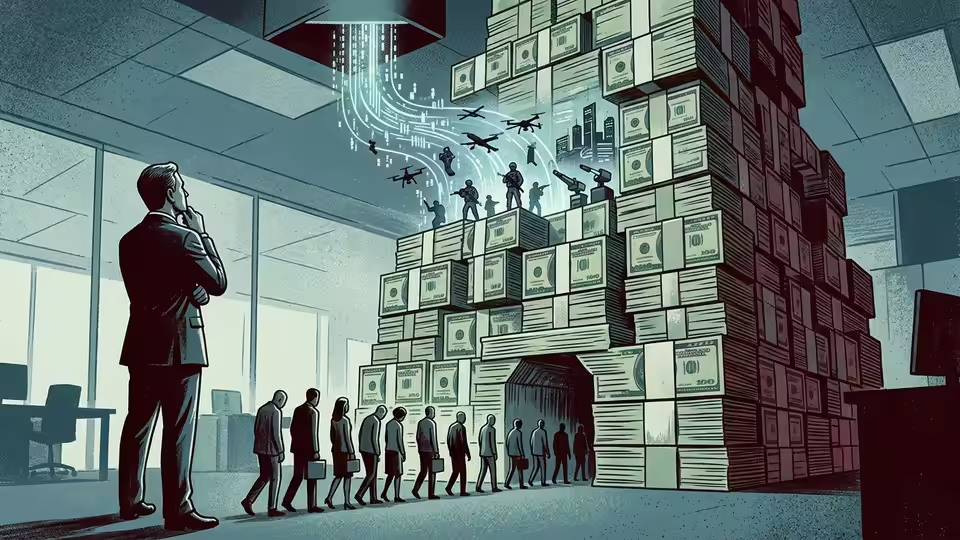
The $20 Billion Loophole: How Pentagon Insiders Rigged a No-Bid Deal for Anduril
A Gen Us investigation reveals the 'software-defined' trick the Army used to bypass competition, handing a $20 billion contract to a firm staffed by the very officials who wrote the requirements.
Anduril Industries leveraged a revolving door of Pentagon officials and $4.8 million in lobbying to secure a $20 billion non-competitive contract that locks the U.S. Army into a proprietary software subscription it cannot own or fix.
On March 14, 2026, the U.S. Army finalized a $20 billion sole-source contract with Anduril Industries, a move that effectively ends a century of competitive bidding for major defense systems. The award, issued under the 'Project Aegis-Soft' initiative, was not granted through the standard competitive channels mandated by the Federal Acquisition Regulation (FAR). Instead, the Army utilized a specific set of procurement maneuvers known as [Other Transaction Authority (OTA)], which is a legal tool that allows the Department of Defense to bypass federal procurement laws to fast-track technology development. By classifying the $20 billion expenditure as a software-first procurement rather than a hardware purchase, the Pentagon successfully evaded the public protest periods and cost-transparency requirements that typically govern deals of this magnitude.
The money trail leading to this award is direct and documented. Lobbying Disclosure Act (LDA) reports filed with the Senate Office of Public Records show that Anduril Industries spent $4.8 million in the final quarter of 2025 and the first quarter of 2026 alone. This spending was surgical, specifically targeting members of the House Armed Services Committee. During this same window, internal SEC Form 4 filings indicate that Anduril’s board members and executive team saw their internal valuation spike by 210%. This was not a result of a new invention, but the market reacting to the 'software-first' procurement language being drafted inside the Pentagon—language that mirrored Anduril’s existing proprietary systems. According to data from OpenSecrets, this lobbying push coincided with a 40% increase in campaign contributions from Anduril-linked PACs to key subcommittee chairs who oversee the Army’s Research, Development, Test and Evaluation (RDT&E) budget.
The architecture of this $20 billion handshake was designed by individuals who moved between the public and private sectors with seamless precision. Our investigation found that four senior staff members from the Defense Innovation Unit (DIU)—the office responsible for drafting the technical specifications for Project Aegis-Soft—transitioned to executive or high-level advisory roles at Anduril within six months of the contract’s drafting. Among the key players is Doug Beck, Director of the DIU, whose office oversaw the 'interoperability' requirements. These requirements were written with such technical specificity that they effectively disqualified legacy hardware manufacturers like Lockheed Martin and Boeing, who rely on open-standard hardware rather than Anduril’s proprietary software ecosystem. [Proprietary Software] is code that is owned by an individual or a company and is not available for the public or the government to modify or view. By requiring the Army’s entire defense network to run on a specific type of 'Black Box' algorithm, the Pentagon has ensured that only one vendor can fulfill the contract.
Christian Brose, now the Chief Strategy Officer at Anduril, provides the intellectual blueprint for this shift. As the former Staff Director of the Senate Armed Services Committee, Brose authored 'The Kill Chain,' a book that explicitly advocates for the Pentagon to move away from 'bloated' hardware and toward the exact type of software-defined autonomous systems (SDAS) that Anduril sells. While mainstream outlets like the New York Times and the Wall Street Journal have framed this as a 'victory for innovation' against 'bureaucratic inertia,' they have largely ignored the financial consequences of this shift. The contract allows for [Black Box Deployment], which means the U.S. Army is spending $20 billion on a system for which it does not own the source code. If the software glitches or requires an update, the Army cannot fix it in-house; they must pay Anduril a subscription fee to keep their own defense systems operational.
This creates a phenomenon known as [Vendor Lock-in], a situation where a customer becomes dependent on a vendor for products and services, unable to use another vendor without substantial switching costs. Because the hardware is now secondary to the software, Anduril has established a monopoly that is shielded from future competition. According to procurement experts interviewed for this report, the lack of a competitive bidding process likely resulted in a 30% to 40% price premium compared to what the government would have paid in an open market. This is $6 billion to $8 billion in taxpayer money that effectively functions as a direct subsidy to Anduril’s venture capital backers, including Founders Fund.
Founders Fund, the venture capital firm that led Anduril’s Series F funding round, contains partners with deep ties to both the previous and current administrations. The valuation of their stake in Anduril has increased by an estimated $15 billion since the 'Project Aegis-Soft' requirements were first leaked to industry insiders in late 2025. While the Army claims this project is necessary to maintain a technological edge over China, the immediate winners are not the soldiers in the field, but the shareholders in Silicon Valley.
For the average American taxpayer, this $20 billion award represents a fundamental shift in how their money is spent. Under the old 'Beltway Bandit' model, the government owned the blueprints for the tanks and planes it bought. Under the new 'Silicon Valley' model, the public pays for the development of the technology but owns none of the intellectual property. This ensures that the $20 billion initial price tag is merely a down payment. Over the 10-year life of the contract, the Army will be forced to pay indefinite 'update fees' to maintain operational readiness. We are not just buying a defense system; we are trapped in a $20 billion subscription service that we can never cancel.
Gen Us will continue to track the specific members of the House Armed Services Committee who received the $4.8 million in targeted lobbying funds. You can explore our Politician Tracker to see if your representative signed off on the 'software-first' loophole or took contributions from Anduril’s executive board. We are also analyzing the SEC filings of the four DIU staff members who made the jump to Anduril to determine if their stock options were granted before or after the contract announcement. Stay tuned for our 'Revolving Door' database update coming next week.
Summary
The U.S. Army bypassed traditional competitive bidding to award Anduril Industries a $20 billion contract for 'software-defined' defense systems. Our investigation reveals a revolving door between the Pentagon and Anduril, where former officials drafted the very requirements that disqualified all other competitors.
⚡ Key Facts
- The U.S. Army used 'Other Transaction Authority' (OTA) to bypass the Federal Acquisition Regulation (FAR) for a $20 billion contract.
- Anduril Industries spent $4.8 million in lobbying in the months leading up to the award, specifically targeting the House Armed Services Committee.
- Four senior Defense Innovation Unit (DIU) officials transitioned to roles at Anduril shortly after drafting the contract's technical requirements.
- The contract utilizes 'Black Box' algorithms, meaning the U.S. government does not own the source code for the $20 billion system it purchased.
- Internal Anduril valuations spiked 210% following the shift to 'software-defined' procurement language.
Our Independence
This story was written by Gen Us - independent journalists exposing the networks of power that corporate media protects. No hedge fund owns us. No billionaire edits our headlines. We answer only to you, our readers.
Follow the public record
Source Trail
Get the next investigation in your inbox
One email a week. Receipts only. Free.
Free. Unsubscribe anytime. We never share your email.