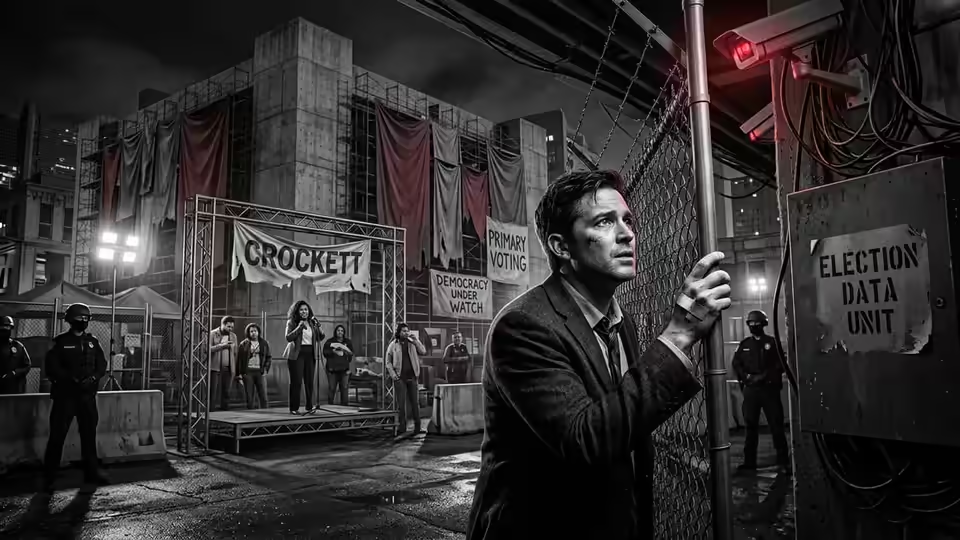
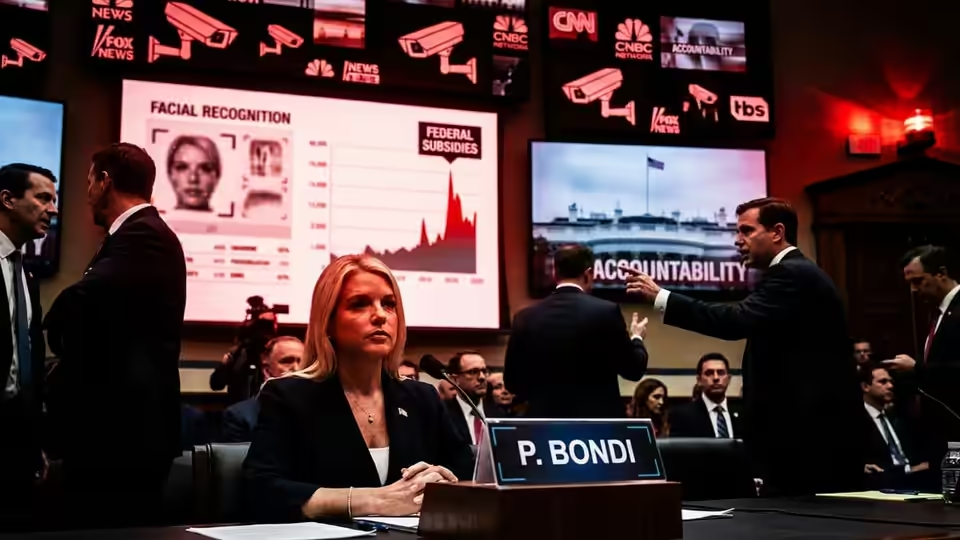
The $2 Billion Industry Behind the 'Failing US Democracy' Narrative
While professors warn of an 'authoritarian' US, they rarely mention the $2 billion donor ecosystem that funds their research. We track the money behind the NGOs and universities that profit when the U.S. looks like a failing state.
Academics are warning that the U.S. is now a 'competitive authoritarian' state, but that label also happens to fuel a $1.8 billion 'democracy defense' industry funded by the same institutions sounding the alarm.
The Varieties of Democracy (V-Dem) Project just dropped its 2026 report, and the news isn't great. The U.S. has been downgraded from a 'liberal democracy' to a 'competitive authoritarianLoaded Language' regime. In a recent webinar hosted by The Conversation, professors from Tufts and the University of Denver didn't just talk about the data—they called for nonviolent resistance. It’s a massive shift in how academics view American stability. But while the panel focused on activism, they skipped over the huge financial machine that keeps these warnings coming.
Here’s the thing: The Conversation US isn't some neutral wire service. It’s a nonprofit media hub funded by member schools like Tufts and Denver. Tufts sits on a $2.4 billion endowment and, along with Denver, pays annual fees to get its faculty’s research in front of you. It’s a bit of a closed loop. Academic institutions fund the platform that validates their research as a national emergency, which—surprise, surprise—often happens right before a new round of grant applications for 'democracy defense' projects.
This 'democracy defense' sector is more than just a buzzword; it’s a booming business. Data from the Foundation Center shows philanthropic spending on 'democracy and civil society' hit roughly $1.8 billion in 2025. Organizations that paint the U.S. as a failing state get the most eyeballs and, eventually, the most donor checks. By stickingLoaded Language the 'competitive authoritarianLoaded Language' label on America, these groups unlock specific funding tiers meant for high-risk international zones.
“The U.S. is no longer a liberal democracy and is moving into competitive authoritarianism.”
So, what is 'Competitive AuthoritarianLoaded Languageism' exactly? It’s a political system where democratic institutions like elections and courts exist in name only, but are regularly subverted by whoever is in power. They use state resources and media control to make sure a fair transfer of power never actually happens.
Professor John Shattuck knows this playbook well—he ran Central European University when it was kicked out of Hungary in 2016. He argues that authoritarianLoaded Languageism creeps in through centralized power and the gutting of independent courts. But there's a catch. V-Dem’s methodology is based on the subjective opinions of 3,700 experts. Critics say these 'expert-coded' metrics are prone to bias, especially since the academic world can be a bit of an echo chamber where sounding the alarm is financially rewarded.
It’s still unclear if this new label will actually change international policy. As of now, the State Department’s 2026 human rights assessments haven't touched the 'authoritarianLoaded Language' tag for domestic activities. That creates a weird gap between academic theory and diplomatic reality. And while the webinar pointed to Myanmar’s Civil Disobedience Movement as a guide, the U.S. doesn't have the same setup. In 2021, 400,000 Myanmar civil servants paralyzed a military junta. The U.S. just doesn't have that kind of centralized strike power.
For most people, this is more than just a vocabulary change. It’s a signal that the usual ways of fighting back—like lawsuits and local elections—are being swapped for 'social discipline' tactics. Look at the Iranian diaspora model Oliver Kaplan mentioned, which coordinated global protests on February 14, 2026. The goal is to crank up the international 'political cost' for domestic policies. Watch for how these academic labels get used to justify 'emergency' nonprofit spending when the next federal budget cycle rolls around.
Summary
Professors from Tufts and the University of Denver are sounding the alarm: the U.S. isn't a liberal democracy anymore. Citing the 2026 V-Dem report, experts John Shattuck and Oliver Kaplan say we've officially hit 'competitive authoritarian' status—the kind of label usually reserved for places like Hungary. But there’s a side to this story that didn't make the webinar: the massive financial ecosystem where universities and 'democracy defense' NGOs compete for nearly $2 billion in donor cash. This report breaks down the data and the institutions that stand to gain from the 'failing state' narrative.
⚡ Key Facts
- The Varieties of Democracy Project (V-Dem) 2026 report classifies the U.S. as a 'competitive authoritarian' regime rather than a liberal democracy.
- Oliver Kaplan is the author of 'Resisting War: How Communities Protect Themselves' and an Associate Professor at the University of Denver.
- John Shattuck served as the President of Central European University from 2009 to 2016.
- The Conversation hosted a webinar titled 'What Americans can learn from other nonviolent civil activism movements' on Feb. 24, 2026.
The $2 Billion Industry Behind the 'Failing US Democracy' Narrative
Network of Influence
- Academic institutions seeking to frame their research as essential to national survival
- Civil society organizations and NGOs focused on 'democracy defense' for fundraising
- Political movements seeking to mobilize voters through alarmism regarding institutional decay
- No mention of specific judicial rulings or legislative actions that have successfully checked executive power in the current period.
- The V-Dem Project's methodology and potential for ideological bias in scoring is not discussed.
- Lack of counter-arguments from other political scientists who may view US institutions as resilient.
The article frames the United States as a collapsing democracy on the verge of autocracy, centering academic experts who use comparative politics to suggest that historical signs of authoritarianism are already present and accelerating in the US.
See how the story connects.
Select any actor or numbered connection, then inspect the evidence before drawing a conclusion.
The Conversation US Inc. Publisher The Conversation US
Follow the public record
Source Trail
Independent reporting and analysis
Get the next investigation in your inbox
One email a week. Receipts only. Free.
Free. Unsubscribe anytime. We never share your email.