The $1.76 Billion BLM Windfall: How Your Outrage Became a Tech Commodity
While 26 million Americans marched for reform, tech giants and publishers turned the movement into a $1.76 billion revenue stream. We follow the money from the streets to the spreadsheets to show why your 'digital identity' is more profitable than actual policy change.
Anton Jäger’s 'Hyperpolitics' argues that our digital outrage is loud but toothless. Despite a $1.76 billion donation surge following the 2020 protests, federal policy remains stalled while tech platforms and publishers continue to profit from the engagement economy.
The arrival of Anton Jäger’s 'Hyperpolitics: Extreme PoliticizationLoaded Language Without Political Consequences' on February 10, 2026, feels like a grim milestone for the post-2020 era. Jäger’s point is simple but stinging: our political lives are more intense than ever, yet we’ve never been less effective at actually changing things. It’s a reality that even corporate boardrooms have started to bank on. A February 26, 2026, report from the Harvard Business Review, 'Rethinking Strategy in a HyperpoliticalLoaded Language World,' basically coaches CEOs on how to perform the right political rituals to avoid a boycott while keeping their lobbying machines running exactly as they always have.
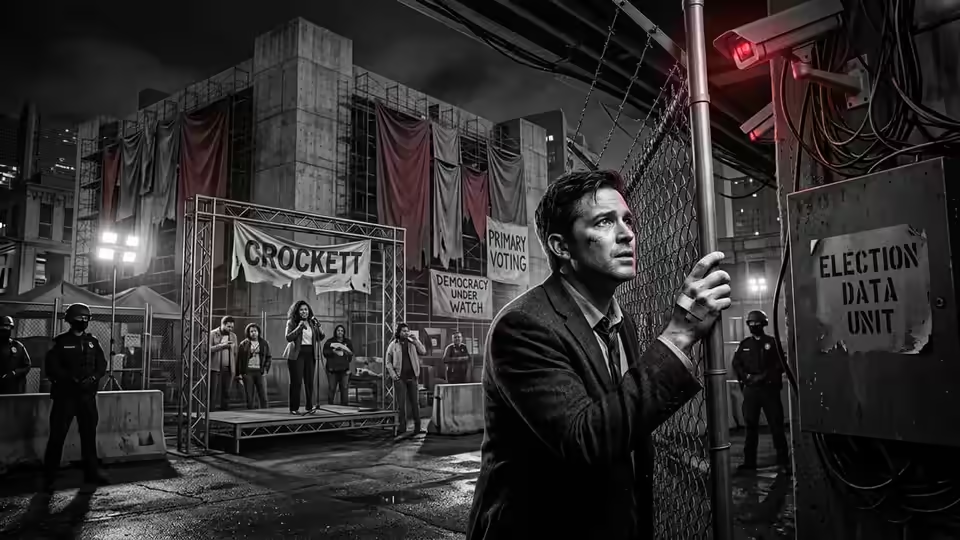
If you want to understand why the radical energy of a film like Ari Aster’s 'Eddington' doesn't seem to translate into actual policy, you've got to follow the money. Jäger and the writers at Jacobin often keep these figures in the margins, but they’re massive. Data from OpenSecrets and the Associated Press shows that BLM-related groups alone raised over $90 million in 2020, part of a staggering $1.76 billion surge in donations to racial justice. And yet, the George Floyd Justice in Policing Act is still stuck. But don’t let the 'total failure' narrative fool you—the Brennan Center for Justice points out that 30 states actually passed oversight or use-of-force reforms by 2022. It’s a messy, incremental reality that a grand theory of failure misses.
So, what does 'hyperpolitics' actually look like? It’s a world where everyone has a political take, but the organizations that used to do the heavy lifting—unions, local parties, civic clubs—have mostly collapsed. In their place, we have 'Algorithmic Radicalization.' This is how tech giants like Meta and Alphabet keep you engaged: their engines prioritize high-arousal, divisive content because it keeps you on the site longer. It doesn't matter if the post actually helps your cause. It just has to make you feel something. In this loop, 'feeling' political becomes a substitute for doing the work, and big tech cashes the check.
“The $1.76 billion surge in donations to racial justice causes in 2020 highlights a massive mobilization of capital that failed to translate into federal legislative reform.”
The financial machinery behind the discourse is just as telling. Jacobin, for instance, reported about $5.1 million in revenue in its 2022 tax filings. Its partner, Verso Books, is the biggest radical publisher in the English-speaking world. There’s a clear market for the idea that modern activism is just a hollow 'neoliberalLoaded Language' symptom; it’s a narrative that drives subscriptions and book sales. Their critique of 'clicktivism' is backed by data, sure, but their proposed solution—a return to industrial-era organizing—doesn’t quite account for the gig economy of 2026. It’s a lot harder to build a union when your coworkers are just avatars on an app.
We also have to be precise with the numbers to avoid the exact kind of hyperbole Jäger warns against. According to Mapping Police Violence, police killed 1,232 people in 2023. That’s the highest number since 2013 and a 7% increase from the year before. These are the 'material facts' that haven’t changed, and they show why slogans like 'Defund' never quite hit the ledger. In fact, an NBC News analysis of 50 major cities found that police budgets actually went up by an average of 4.4% in the year after the 2020 protests. The noise didn't follow the money.
The big question is whether this 'hyperpoliticalLoaded Language' moment is a permanent trap or just a phase. Jäger thinks we’re stuck, but there’s a pulse elsewhere. The Bureau of Labor Statistics reported that 451,000 workers were involved in major strikes in 2023. That’s real institutional power being clawed back in places far away from the social media 'discourse cycle.' For the rest of us, the lesson isn't just that the internet is a distraction. It's that the $1.76 billion spent on 'consciousness' might have been better used as seed money for actual infrastructure.
As we move further into 2026, keep an eye on whether that energy finally moves back into tangible spaces—unions, school boards, and local councils. Or, it might just stay a profitable commodity for the platforms and publishers who benefit from the noise. The consequences aren't missing because they're impossible to achieve. They're missing because the current economy of outrage finds it much more profitable to keep us talking than to let us win.
Summary
In 2020, as many as 26 million Americans took to the streets for Black Lives Matter. It was the largest movement in U.S. history, yet federal police reform has barely moved an inch. Anton Jäger’s new book, 'Hyperpolitics,' argues we've traded real power for loud digital identities. But while Jäger focuses on the sociology, the real story might be the money: $1.76 billion was raised for these causes, even as tech platforms and publishers found a way to turn our collective outrage into a profitable, if powerless, commodity.
⚡ Key Facts
- Anton Jäger's book 'Hyperpolitics: Extreme Politicization Without Political Consequences' was published by Verso in 2026.
- The film 'Eddington' (2025), directed by Ari Aster, features a scene regarding a high school student's 'newfound racial consciousness' during the 2020 protests.
- Black Lives Matter demonstrations in 2020 amounted to the largest protest movement in US history.
- The rate of police killings has slightly increased since 2020.
- Anton Jäger argues that Western societies have moved from mass politics to post-politics, then antipolitics, and finally hyperpolitics.
The $1.76 Billion BLM Windfall: How Your Outrage Became a Tech Commodity
Network of Influence
- Verso Books (the publisher of the book being reviewed)
- The Jacobin Foundation (seeking print subscriptions)
- Socialist political organizations seeking a return to 'mass politics' structures over spontaneous protest
- The article fails to mention specific local-level legislative reforms or state-level police funding changes that occurred post-2020.
- It ignores the role of algorithmic social media incentives in creating 'hyperpolitics', focusing instead on macroeconomic 'devolution'.
- The claim regarding 'increased police killings' lacks citation or adjustment for population and crime rate shifts during the pandemic.
The article frames modern political activism as a hollow, performative symptom of neoliberal decline that lacks the structural power of 20th-century mass labor movements.
See how the story connects.
Select any actor or numbered connection, then inspect the evidence before drawing a conclusion.
Jacobin Foundation Parent company Jacobin
Follow the public record
Source Trail
Independent reporting and analysis
Get the next investigation in your inbox
One email a week. Receipts only. Free.
Free. Unsubscribe anytime. We never share your email.