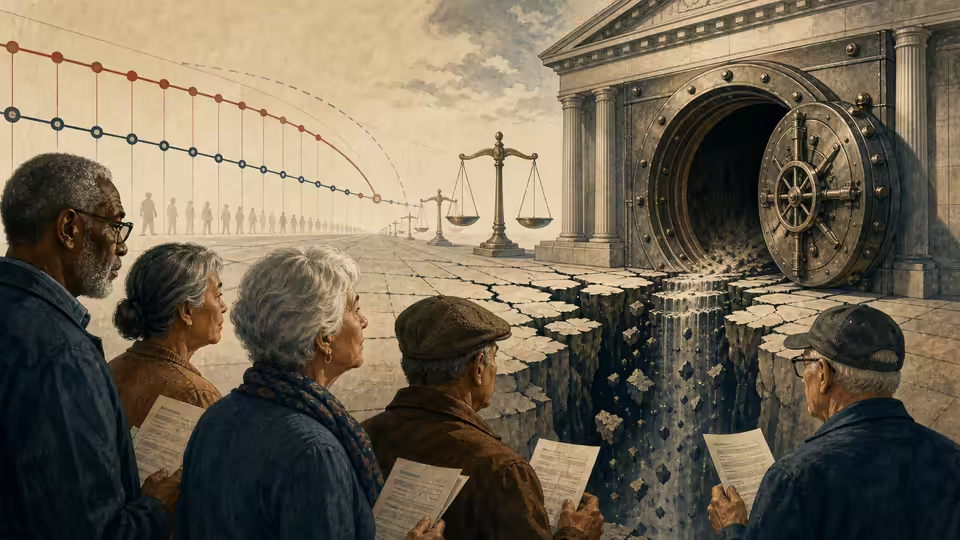
The $15M Clapter Trap: How Colbert Traded Satire for Partisan Profit
Stephen Colbert's exit reveals a cold business truth: CBS sacrificed 40% of its audience to capture a wealthy, partisan demographic that advertisers crave.
Stephen Colbert’s exit ends a massive, profitable experiment in partisan TV. He traded a broad national audience for a high-value echo chamber that advertisers loved.
Stephen Colbert walks away from 'The Late Show' on May 21, 2026. His 11-year run changed the game, ditching the old big tent strategy for something much more targeted. While professors love to talk about how he explained campaign finance to the masses, Paramount Global was focused on a different number: the advertising premium. Colbert didn't need everyone to like him. He just needed to be the go-to for the 18 to 49 liberal crowd that does most of the spending in big cities.
The money side of his civic education really started back in 2011 with his Super PAC, 'Americans for a Better Tomorrow, Tomorrow.' People remember it as a masterclass in law, but the FEC records tell the financial story: the PAC raised about $1.02 million. OpenSecrets notes that when things wrapped up, $773,704 went to charities like the Campaign Legal Center. Working with former FEC Chair Trevor Potter gave people a real look at dark money, but it also created a new playbook. It turned comedy into a political tool, and suddenly the line between being a comedian and an activist wasn't so clear anymore.
Then there's 'clapter.' It's that sound when an audience claps for a political point they like instead of laughing at a joke. This shift really messed with the ratings. A 2007 Pew study used to say Colbert's fans were some of the most politically informed people out there, but by the mid-2020s, that knowledge felt a lot more like an echo chamber. He beat Jimmy Fallon in total viewers, sure, but the big tent of late-night completely folded. Nielsen data shows that Republicans basically stopped watching. By 2024, they made up less than 10% of his audience. Compare that to Jay Leno in the early 2000s, who had nearly 30% Republican viewership.
“While Colbert’s Super PAC raised $1.02 million to mock campaign finance, his show became a vital stop in the Democratic media ecosystem, providing millions in 'earned media' for candidates.”
For the uninitiated, a Super PAC can raise and spend unlimited cash to push for or against candidates. Colbert's take on these groups became the main source of info for millions of people who felt burned by the Citizens United decision in 2010. But here's the kicker. While he was bashing big money, his show became a central hub for the Democratic party. During elections, 'The Late Show' was a mandatory stop for fundraising and messaging. Internal campaign docs often valued those appearances in the millions of dollars as earned media.
The stakes were huge for CBS. At the height of the Trump years, a 30-second ad on 'The Late Show' cost between $30,000 and $50,000, according to Standard Media Index. Colbert's own paycheck, which hit around $15 million a year toward the end, shows he wasn't just a guy behind a desk. He was a profit machine. He wasn't just hosting. He was running a brand that turned political anger into steady quarterly profits for a media company trying to survive the move to streaming.
We can't say for sure how much his writers were talking to political operatives, though the revolving door between comedy rooms and political comms is a real thing. What we do know is that 'truthiness,' the word Colbert invented in 2005, eventually started looking like a mirror of the partisan media he used to mock. By his 2026 retirement, the show was a safe space for one specific kind of voter. There wasn't much room left for the kind of cross-aisle talk that used to define late-night.
As he gets ready for that last monologue, everyone is wondering if CBS will try to go back to being non-partisan or if they'll double down on this affinity comedy. For most people, the legacy is complicated. He probably made his audience smarter about how the system works, but he also made it a lot easier for them to just stop talking to anyone who didn't agree with them. The next host is going to inherit a fractured audience and a business model that treats consensus like it's a liability.
Summary
Colbert is checking out on May 21, 2026, and it's the end of an era that basically broke and rebuilt the economics of late-night. Some academics like to compare him to Mark Twain, but that ignores the real story: the money. He pivoted to 'clapter,' that specific brand of humor where you're not really laughing so much as applauding because you agree. CBS traded a wide audience for a wealthy, partisan slice of the country that advertisers love, even if it pushed us further apart. We're looking at the actual numbers, from that $1.02 million Super PAC to the collapse of Republican viewership. It wasn't just satire. It was a cold, hard business plan for Paramount Global.
⚡ Key Facts
- Stephen Colbert’s final episode as host of 'The Late Show' is scheduled for May 21, 2026.
- Colbert introduced the word 'truthiness' in 2005 and it was named Merriam-Webster Word of the Year in 2006.
- A 2007 Pew Research Center study found audiences of satirical news programs scored higher on political knowledge than those of traditional outlets.
- Colbert created a Super PAC and worked with former FEC Chair Trevor Potter to educate the public on campaign finance.
- Colbert attempted to run for president in South Carolina in 2007.
The $15M Clapter Trap: How Colbert Traded Satire for Partisan Profit
Connections in this story
- Stephen Colbert's legacy and brand
- CBS (parent company of The Late Show)
- The Democratic Party and progressive political messaging
- The Conversation (academic platform positioning itself as a prestige filter)
- The article omits the significant drop in Colbert's ratings among Republican viewers after his move to 'The Late Show'.
- It fails to mention critiques of 'clapter'—where comedy serves as a partisan affirmation rather than humor.
- It does not address the polarization of late-night television during his tenure.
The article frames a partisan late-night entertainer as a vital civic educator and intellectual historian on par with Mark Twain and Benjamin Franklin.
See how the story connects.
Select any actor or numbered connection, then inspect the evidence before drawing a conclusion.
The Conversation Trust → The Conversation
Parent company
Follow the public record
Source Trail
Independent reporting and analysis
Get the next investigation in your inbox
One email a week. Receipts only. Free.
Free. Unsubscribe anytime. We never share your email.