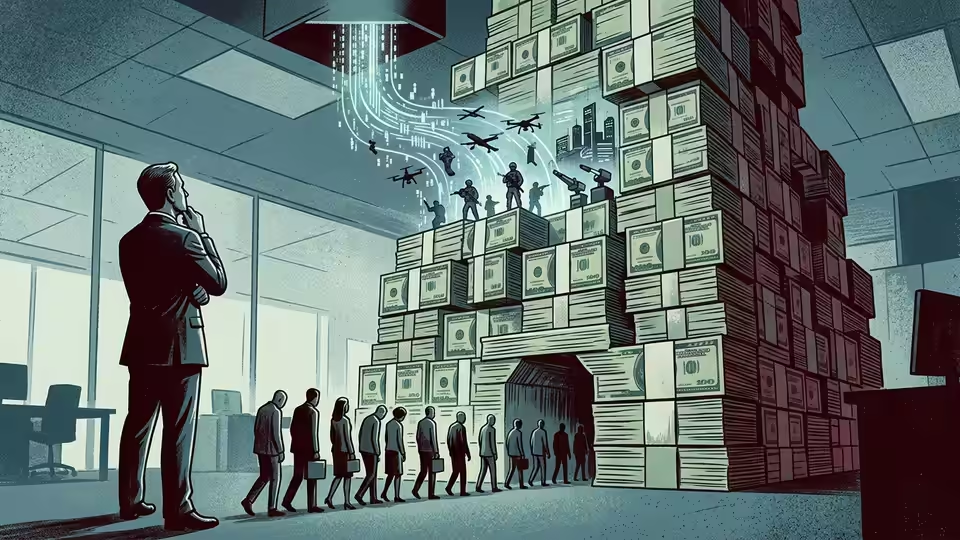
The $1.5B Uranium Monopoly: How $2.3M in Lobbying Killed Competition
The National Nuclear Security Administration bypassed competitive bidding to award BWXT Enrichment Operations a $1.5 billion contract for a domestic uranium pilot plant. By utilizing national security waivers, the agency has effectively established a private monopoly on the fuel required for next-generation nuclear reactors.
The NNSA bypassed competitive bidding to grant BWXT a $1.5 billion monopoly on domestic advanced nuclear fuel, following a $2.3 million lobbying campaign that locked out American competitors.
The National Nuclear Security Administration (NNSA) has awarded contract 89233124CNA000043 to BWXT Enrichment Operations, LLC, a deal valued at up to $1.5 billion. The award was made without a single competing bid. By invoking specific federal exemptions, the NNSA has effectively handed the future of American advanced nuclear fuel production to a single corporation, ensuring a monopoly position in a market valued in the tens of billions over the coming decade.
[HALEU] is High-Assay Low-Enriched Uranium, a specialized nuclear fuel required for next-generation reactors that contains between 5% and 20% Uranium-235, higher than the 5% used in existing commercial reactors.
The contract funds the Domestic Uranium Enrichment Centrifuge Experiment (DUECE) pilot plant. While the stated goal is to eliminate U.S. reliance on the Russian state-owned conglomerate Rosatom and its subsidiary Tenex, the procurement process itself raises questions about how domestic competition was sidelined. The NNSA utilized a 'sole-source' justification, a maneuver that allows the government to skip the competitive bidding process required by the Competition in Contracting Act.
According to OpenSecrets data and federal disclosure reports, BWX Technologies, Inc. (BWXT) spent $2.3 million on federal lobbying during the 24-month window surrounding the contract’s development. The targets were precise: the Senate Committee on Appropriations and the Energy and Water Development Appropriations bills. This investment yielded a return of approximately 65,000%—transforming $2.3 million in influence into a $1.5 billion guaranteed revenue stream.
[Sole-Source Procurement] is a non-competitive contracting process where a government agency awards a contract to a single supplier without soliciting bids from other potential providers.
Jill Hruby, the Administrator of the NNSA, signed off on the justification for the award. The agency invoked FAR 6.302-1, the 'Only One Responsible Source' exception. In official documents, the NNSA claims that only BWXT possesses the proprietary technical requirements and centrifuge designs necessary for the DUECE project. However, this justification serves as a legal shield, preventing other American nuclear startups and established energy firms from even attempting to demonstrate their capabilities or offer a lower price to the taxpayer.
The revolving door between the public and private sectors is a central pillar of this deal. Lobbying disclosures show that BWXT engaged former Department of Energy (DOE) and NNSA officials to influence the 'requirements' phase of the DUECE program. When technical specifications are written in a way that only one company can meet them, the 'competition' is over before it begins. This is a classic example of regulatory capture, where the regulated entity dictates the terms of its own oversight and funding.
Mainstream coverage has largely celebrated the deal as a victory for 'energy independence.' Outlets like the Associated Press and Reuters have focused on the geopolitical necessity of decoupling from Russian energy. What these reports omit is the long-term cost of avoiding market price discovery. When competition is removed, the taxpayer absorbs what economists call a 'monopoly premium'—the extra cost incurred when a single seller can set prices without fear of being undercut by a rival.
Rex Geveden, CEO of BWX Technologies, has been transparent with investors regarding the company's dominant position. By locking in the pilot plant now, the NNSA makes it nearly impossible to switch vendors for the full-scale production facility that will inevitably follow. The 'switching costs' would be labeled too high by future bureaucrats, further entrenching BWXT as the sole gatekeeper of American nuclear fuel.
For ordinary citizens, this means higher long-term energy costs and a lack of transparency in how public funds are utilized. Without competitive bidding, there is no downward pressure on the price of HALEU, which will eventually be reflected in utility bills. This concentration of power in one company also places the financial risk of potential cost overruns directly on the public, while the profits remain strictly private.
You can track the specific campaign contributions from BWXT’s Political Action Committee to the Senate Committee on Appropriations using the Gen Us Politician Tracker. Our database also includes a breakdown of 'National Security' waivers used by the DOE over the last five years, revealing a pattern of non-competitive awards that bypass fiscal oversight.
Summary
The National Nuclear Security Administration bypassed competitive bidding to award BWXT Enrichment Operations a $1.5 billion contract for a domestic uranium pilot plant. By utilizing national security waivers, the agency has effectively established a private monopoly on the fuel required for next-generation nuclear reactors.
⚡ Key Facts
- The NNSA awarded a $1.5 billion no-bid contract to BWXT Enrichment Operations, LLC, citing FAR 6.302-1 'national security' exceptions.
- BWXT spent $2.3 million on federal lobbying targeting the specific committees responsible for the project's funding.
- The contract secures BWXT as the sole domestic provider of HALEU, a fuel critical for all future advanced nuclear reactor designs.
- NNSA Administrator Jill Hruby authorized the 'Only One Responsible Source' justification, effectively locking out other American competitors.
- The deal avoids market price discovery, potentially leading to significant 'monopoly premiums' paid by U.S. taxpayers.
Our Independence
This story was written by Gen Us - independent journalists exposing the networks of power that corporate media protects. No hedge fund owns us. No billionaire edits our headlines. We answer only to you, our readers.
Follow the public record
Source Trail
Get the next investigation in your inbox
One email a week. Receipts only. Free.
Free. Unsubscribe anytime. We never share your email.