The $1 Trillion Divorce: How Corporate Cash Pushed the Working Class to the GOP
New data reveals a 70-year collapse of the Democratic labor base. While pundits blame 'culture wars,' the numbers show a direct correlation between corporate donor addiction and a 26% drop in working-class support.
New 2026 data confirms the GOP has captured the working-class majority as Democrats prioritize corporate donors and the college-educated over labor-centric policy.
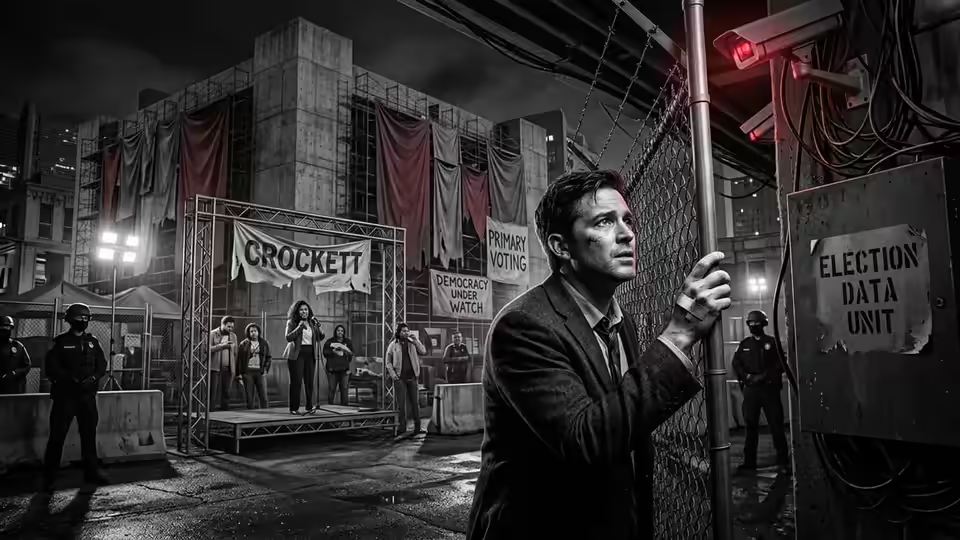
This isn't just a trend anymore. It's a full-blown realignment. Based on ANES data from June 2026, the 2020 and 2024 elections were the breaking point. The GOP now owns the majority of the self-identified working class. While cable news fixates on woke rhetoric and cultural gripes, the hard numbers tell a story of a long-term economic divorce. Back in 1960, Democrats held 56% of this vote. Today? It's plummeted to 30%. The party didn't just change: it swapped labor power for a coalition of college grads and deep-pocketed donors.
Don't buy the myth that the working class is disappearing. Even as more people get degrees, the chunk of voters who call themselves working class has stayed steady at 35% to 38% for seven decades. The group itself hasn't shrunk, but its makeup has. About 21% have degrees now, but only 5% are in a union. That’s a massive drop from the 1950s. And it didn't happen by accident. Both parties signed off on trade deals like NAFTA and China’s PNTR status, which basically gutted the Midwestern manufacturing base that used to be the Democrats' Blue Wall.
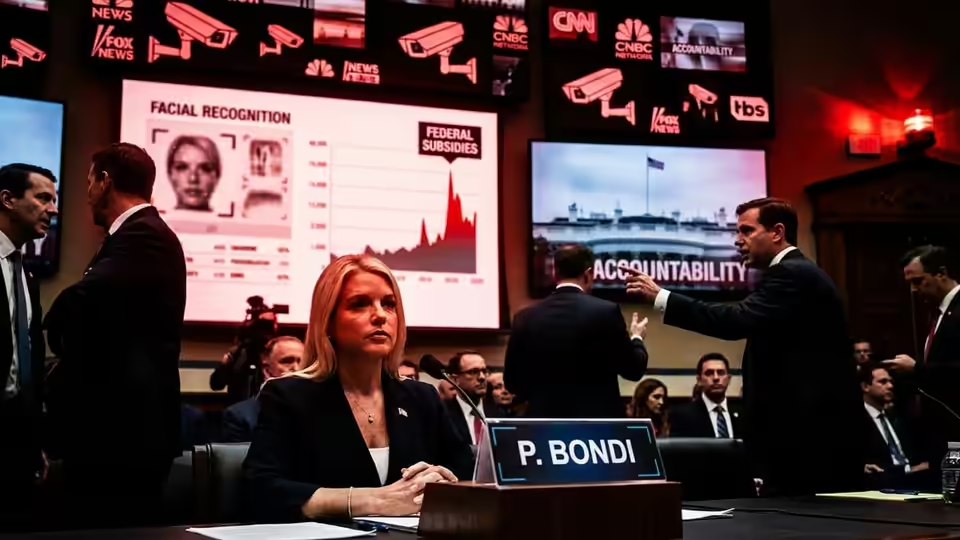
People call this Class Realignment. It's a fancy way of saying low-income voters are moving right while the wealthy move left. While politicians like Bernie Sanders scream about oligarchy, the DNC and its allies are still cashing checks from the very people who benefit from the status quo. In 2024, the legal and investment sectors dumped over $1.2 billion into federal races. Most of that cash is used to make sure the boat doesn't rock too much.
“The Democratic share of the working-class coalition plummeted from a 56% majority in 1960 to just 30% today.”
Here’s the kicker: who actually wins when we talk about this as a cultural fight? Corporate interests. If you treat class struggle as a debate over social values rather than a fight for better pay or trade protection, both parties can keep their donors happy without fixing structural rot. A June 2026 Washington Post analysis points to a trust gap in government. But it ignores how the $14.4 billion spent on the 2024 cycle mostly bought ads meant to stir up social outrage instead of explaining actual economic policy.
The Diploma Divide is now the biggest predictor of how someone will vote. It’s given Republicans an opening to claim the working class label without actually offering pro-labor stuff like a higher minimum wage. Instead, the GOP just points at Democrats as out-of-touch elites who care more about global markets than local stability. It works. Look at Maine, where guys like Graham Platner are trying to bring back class war talk but getting blocked by party moderates who don't want to scare off rich suburban donors.
Is this move to the GOP permanent? Hard to say. The GOP won the vote, but they didn't necessarily win the argument. Most working-class voters, regardless of party, still want to tax the rich and protect Social Security. But here's the thing: as long as Democratic leaders treat these voters as a demographic to be messaged to rather than a base to be fought for, this realignment isn't going anywhere.
Watch the internal fight coming to the Democratic party in late 2026. Progressives want a total reset: cost-of-living controls and a U-turn on corporate trade. Meanwhile, the moderate wing, backed by the biggest donors, will probably stick to affordability tweaks that don't upset the markets. For the 38% of Americans who keep the country running, this fight determines if they'll ever get a seat at the table again.
Summary
Data from the American National Election Studies (ANES) tells a 70-year story of a party losing its way. For the first time, a majority of the working class backed Republicans in both 2020 and 2024. While the size of this group hasn't really changed, the Democratic share of it has crashed from 56% in 1960 to just 30% now. Most pundits blame a culture war, but the real culprit is a series of policy bets, like NAFTA and deregulation, and a heavy addiction to corporate donor cash. By framing this as a worldview gap, the establishment lets corporate interests off the hook for a massive economic abandonment.
⚡ Key Facts
- For the first time in American National Election Studies (ANES) history, more self-identified working-class voters identified as Republican than Democrat in 2020 and 2024.
- The share of Americans who consider themselves working class has remained stable at roughly 35-38% for the past 70 years.
- The working-class share of the Democratic coalition has fallen from a peak of 56% in 1960 to approximately 30% today.
- 21% of those who identify as working class in 2024 have a college degree.
The $1 Trillion Divorce: How Corporate Cash Pushed the Working Class to the GOP
Network of Influence
- The Republican Party (by reinforcing a narrative of Democratic cultural elitism)
- Centrist Democrats (who use such arguments to push the party away from progressive economic populism)
- Corporate interests (by framing class struggle as a 'cultural' issue rather than an economic one)
- The role of Fox News and conservative media in shaping the 'worldview' of working-class voters over the mentioned 50-year period.
- The impact of specific trade policies like NAFTA, which many argue fundamentally damaged the Democratic brand in the Midwest.
- The racial diversity of the 'working class' is often glossed over in favor of a narrative centered on the white Midwestern voter.
- The influence of campaign finance and corporate lobbying on both parties' policy decisions.
The article frames the Democratic Party's failure as a cultural misunderstanding of a static, traditionalist working class rather than a result of specific economic outcomes or external propaganda.
See how the story connects.
Select any actor or numbered connection, then inspect the evidence before drawing a conclusion.
The Conversation US, Inc. Owns The Conversation (US)
Follow the public record
Source Trail
Independent reporting and analysis
Get the next investigation in your inbox
One email a week. Receipts only. Free.
Free. Unsubscribe anytime. We never share your email.