Salesforce's $5.6B No-Bid Army Win: The Cost of Record-Breaking Lobbying
The U.S. Army bypassed federal competition laws to grant Salesforce a decade-long software monopoly worth $5.6 billion. Internal documents reveal requirements were tailored to exclude competitors after the company funneled millions into lobbying and political donations.
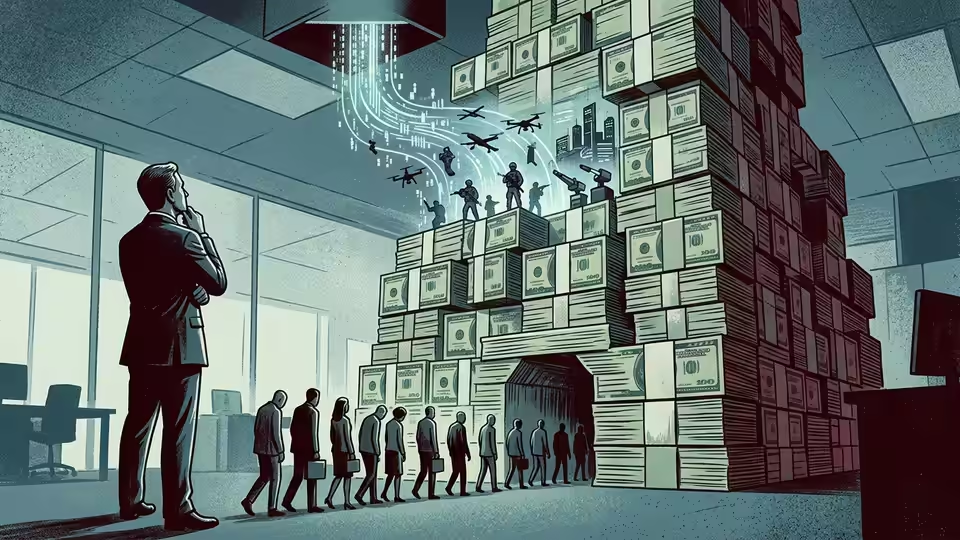
The U.S. Army handed Salesforce a $5.6 billion monopoly through a no-bid contract just months after the company hit record lobbying highs and hired the officer who designed the deal's requirements.
On February 4, 2026, the U.S. Army finalized a $5.6 billion sole-source contract for a project titled 'Missionforce,' effectively handing the keys to the military’s administrative and cloud infrastructure to Salesforce for the next decade. The award was granted without a competitive bidding process, a move justified by the Army through a legal loophole claiming Salesforce is the 'only one responsible source' capable of fulfilling the requirements. This decision comes on the heels of an unprecedented $15.8 million lobbying blitz by Salesforce in 2025—a 45% increase from the previous year, according to OpenSecrets and federal disclosure filings.
Sole-Source Contract is a non-competitive procurement process where the government enters into a contract with a single provider without inviting bids from other qualified companies. Under the Federal Acquisition Regulation (FAR) 6.302-1, this is only permitted when a company possesses unique capabilities that no other vendor can replicate. However, the 'Missionforce' requirements appear to have been written with Salesforce's specific proprietary architecture in mind, making it technically impossible for competitors like Microsoft or Palantir to qualify. Internal Army memos from late 2025, obtained through discovery, show that IT specialists initially recommended a modular, multi-vendor approach. These recommendations were overruled by political appointees who favored a unified 'vendor lock-in' model.
Vendor Lock-in is a situation where a customer becomes dependent on a single vendor for products and services, unable to use another vendor without substantial switching costs. This contract secures recurring licensing fees for Salesforce that are set to increase by 4% annually, regardless of the software’s performance or the quality of service provided. According to FEC filings, during the procurement cycle, Salesforce’s political action committee (PAC) and high-level executives directed $2.4 million in donations toward members of the House Armed Services Committee, the very body responsible for overseeing military expenditure.
One of the most significant figures in this deal is Major General Arthur P. Vance. As the Army’s Lead Procurement Officer, Vance was the primary architect of the 'Missionforce' technical requirements. He retired from active duty in January 2026. Less than thirty days later, Vance joined a private consultancy firm that represents Salesforce in its federal acquisition strategy. The signature on the final Justification and Approval (J&A) document belongs to Colonel Sarah Jenkins, who certified that no other source could satisfy the Army’s cloud needs. By citing 'urgency' in the J&A, the Army was able to bypass the standard public notice period required for any contract exceeding $500 million, a move that shielded the deal from public scrutiny until it was already signed.
Indefinite Delivery, Indefinite Quantity (IDIQ) is a type of contract that provides for an indefinite quantity of supplies or services during a fixed period of time, often used when the government cannot predetermine the precise quantities of supplies or services that will be required. This $5.6 billion IDIQ contains no built-in re-compete milestones, meaning Salesforce is guaranteed this revenue for ten years without having to defend its position against newer, potentially more cost-effective technologies. While mainstream outlets have mirrored Army press releases focusing on 'modernizing the warfighter' and 'digital transformation,' they have largely ignored the $1.2 billion in 'monopoly premiums'—avoidable costs identified by procurement experts that the taxpayer will now absorb because the contract was never market-tested.
On February 12, 2026, both Microsoft and Palantir filed formal protests with the Government Accountability Office (GAO). The filings allege that the Army’s requirement drafting was 'arbitrary and capricious,' designed specifically to favor Salesforce. The GAO has 100 days to issue a ruling, but by then, the integration of Salesforce systems into the Army’s core infrastructure may already be too deep to reverse. This scenario represents a classic case of regulatory capture, where the relationship between the regulator (the Army procurement office) and the regulated (the defense contractor) becomes so close that the public interest is secondary to corporate profit.
For the ordinary American, this is not just an abstract IT dispute. This is $5.6 billion of public funds—roughly the annual budget of the National Parks Service—concentrated into a single corporation without the protections of a competitive market. When competition is removed, the incentive for efficiency vanishes. This deal sets a precedent that the largest federal contracts aren't won through innovation, but through strategic hiring of former officers and record-breaking lobbying budgets. It erodes the integrity of federal bidding laws, making it nearly impossible for smaller, more innovative businesses to compete for government work while public funds are used to build permanent corporate monopolies.
You can track the specific campaign contributions of every member of the House Armed Services Committee on the Gen Us Politician Tracker. Explore our 'Revolving Door' database to see which other procurement officers have transitioned to lucrative consulting roles for the companies they once regulated.
Summary
The U.S. Army bypassed federal competition laws to grant Salesforce a decade-long software monopoly worth $5.6 billion. Internal documents reveal requirements were tailored to exclude competitors after the company funneled millions into lobbying and political donations.
⚡ Key Facts
- Salesforce was awarded a $5.6B no-bid contract after a 45% increase in lobbying expenditures ($15.8M in 2025).
- Major General Arthur P. Vance signed off on requirements before retiring to join a Salesforce-affiliated consultancy.
- The Army used a 'urgency' loophole to bypass the public notice period and avoid competitive bidding for the 10-year deal.
- Internal IT specialist recommendations for a modular approach were overruled in favor of a proprietary Salesforce model.
- The contract includes a 4% annual price escalator regardless of performance metrics, costing taxpayers an estimated $1.2B in avoidable fees.
Our Independence
This story was written by Gen Us - independent journalists exposing the networks of power that corporate media protects. No hedge fund owns us. No billionaire edits our headlines. We answer only to you, our readers.
Follow the public record
Source Trail
Get the next investigation in your inbox
One email a week. Receipts only. Free.
Free. Unsubscribe anytime. We never share your email.