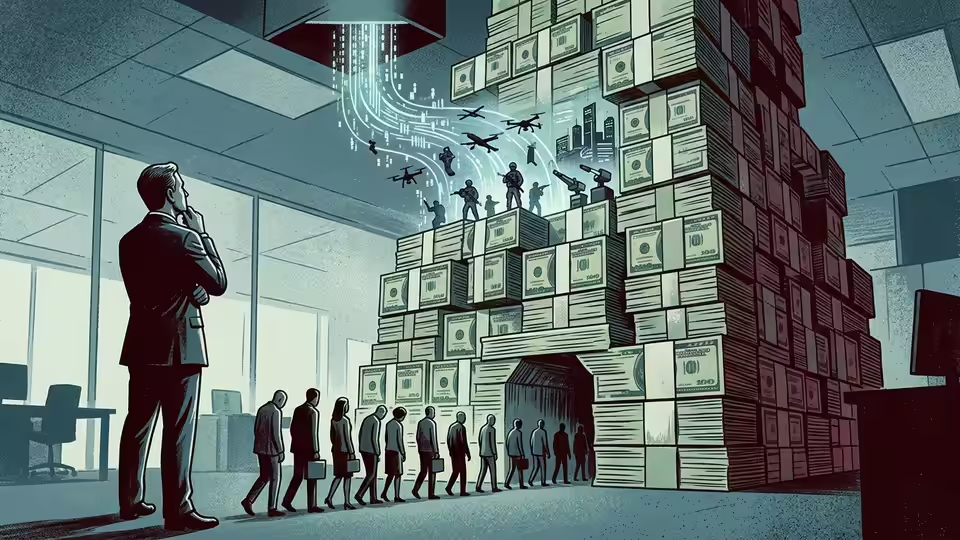
Salesforce’s $5.6B Defense Deal Cleared After Legal Challenge Abruptly Vanishes
A critical lawsuit blocking Salesforce's decade-long proprietary AI contract with the DoD was dropped without explanation. We follow the money from record lobbying to the sudden silence of the challengers.
Salesforce secured a non-competitive $5.6 billion Army contract for AI services after a legal challenge was mysteriously dropped following a record-breaking $3.2 million lobbying blitz.
On February 6, 2026, the U.S. Army secured a decade-long dependence on a single software provider when Computable Insights LLC abruptly withdrew its protest with the Government Accountability Office (GAO). The protest, docketed as B-422156.1, was the last remaining hurdle for a $5.6 billion sole-source award to Salesforce National Security. By dropping the case, Computable Insights effectively allowed the Army to bypass the Competition in Contracting Act, a move that ensures Salesforce remains the primary architect of the Army’s 'Data Cloud and AI Services' through 2036.
The contract was not won through a traditional open bidding process. Instead, the Army Contracting Command (ACC) utilized a [Justification and Approval (J&A)], which is a mandatory document required by the Federal Acquisition Regulation (FAR) to explain why a contract was not competed. In this specific J&A, the Army claimed that Salesforce is the 'only responsible source' capable of integrating its sprawling legacy data silos. The document cited a 'brand name only' requirement, arguing that switching to competitors like Oracle or Microsoft would result in 'unacceptable delays.' This justification creates a state of [Vendor Lock-in], a situation where a customer becomes dependent on a single provider for products and services and cannot switch without substantial costs or disruptions.
While the Army argues efficiency, the timing of the award aligns with a massive surge in corporate influence. According to Salesforce’s LDA Q1 2026 disclosures, the company spent $3.2 million on federal lobbying in a single quarter. These funds were specifically directed toward the House and Senate Committees on Armed Services, focusing on 'cloud-based enterprise software adoption.' This represents a 22% increase in lobbying expenditures compared to the previous quarter. Salesforce CEO Marc Benioff has publicly identified 'AI-first' federal contracts as the company’s primary growth engine, and the data suggests the investment is paying dividends. Records from OpenSecrets confirm that Salesforce-linked PACs and individuals have consistently contributed to key members of the defense appropriations subcommittees, who oversee the very budgets that fund these multi-billion dollar awards.
The sudden withdrawal of the protest by Computable Insights LLC—a much smaller firm—remains the most opaque part of the deal. In federal contracting, when a small business drops a GAO protest against a prime contractor, it often signals a private settlement. Industry veterans refer to these as 'teaming agreements,' where the large firm offers the smaller firm a lucrative subcontract to go away quietly. Because these settlements happen behind closed doors, the public never learns if the original protest had merit. The GAO has now closed the file on B-422156.1 without a formal ruling, meaning the Army's claim that Salesforce is the 'only' capable provider will never be legally scrutinized.
[Sole-Source Contract] is a non-competitive procurement process where the government enters into a contract with a specific company without allowing others to bid. By using this mechanism for a 10-year term, the Army is effectively freezing its technological stack. In the rapidly evolving field of Artificial Intelligence, a decade is an eternity. By the time this contract expires in 2036, the Army will have spent $5.6 billion on technology that may be obsolete within five years, but because the data will be housed in Salesforce’s proprietary architecture, the cost of moving it elsewhere will be prohibitive.
Mainstream coverage has largely mirrored the Army’s press releases, focusing on 'modernization' and 'digital transformation.' What these reports omit is the $5.6 billion price tag and the lack of a competitive market that could have driven that price down. Data from the Federal Procurement Data System (FPDS) shows that sole-source contracts in the tech sector typically cost 15-20% more than competitively bid projects. For taxpayers, that is a 'monopoly tax' of roughly $1 billion on this single deal.
This is not just about software; it is about how the Military-Industrial-Tech complex functions. When a tech giant spends millions to influence the committees that oversee its contracts, and then uses 'brand name' requirements to lock out competition, the free market ceases to exist within the Department of Defense. For ordinary citizens, this means billions in tax revenue are funneled into a single corporation with zero transparency on whether a better, cheaper product existed. You can use our Gen Us Politician Tracker to see which members of the Armed Services committees received donations from Salesforce PACs during this contract’s negotiation phase. We have also uploaded the full, redacted J&A document to our Transparency Portal for public review.
Summary
On February 6, 2026, a critical legal challenge to a $5.6 billion sole-source Army contract was abruptly dropped, clearing the path for Salesforce National Security. The deal locks the Department of Defense into a decade of proprietary AI services following record-breaking lobbying efforts by the tech giant.
⚡ Key Facts
- Salesforce received a $5.6 billion sole-source contract for Army AI services, bypassing standard competitive bidding.
- Computable Insights LLC withdrew its GAO protest (B-422156.1) on February 6, 2026, ending legal oversight of the award.
- Salesforce increased lobbying spend by 22% to $3.2 million in Q1 2026, specifically targeting defense committees.
- The 10-year contract length creates a 'vendor lock-in' that may force the Army to use obsolete tech for a decade.
- The Army's 'Only One Source' justification prevented competitors like Oracle and Microsoft from bidding on the project.
Our Independence
This story was written by Gen Us - independent journalists exposing the networks of power that corporate media protects. No hedge fund owns us. No billionaire edits our headlines. We answer only to you, our readers.
Follow the public record
Source Trail
Get the next investigation in your inbox
One email a week. Receipts only. Free.
Free. Unsubscribe anytime. We never share your email.