Salesforce Wins $5.6B Army Deal After $12M Lobbying Surge Silences Rivals
The U.S. Army bypassed competitive bidding for a decade-long contract following a massive lobbying blitz. We track the money and the quiet settlement that killed the competition.
The U.S. Army awarded Salesforce a $5.6 billion monopoly contract after a record-breaking $12.4 million lobbying campaign and the quiet settlement of a small-business legal challenge.
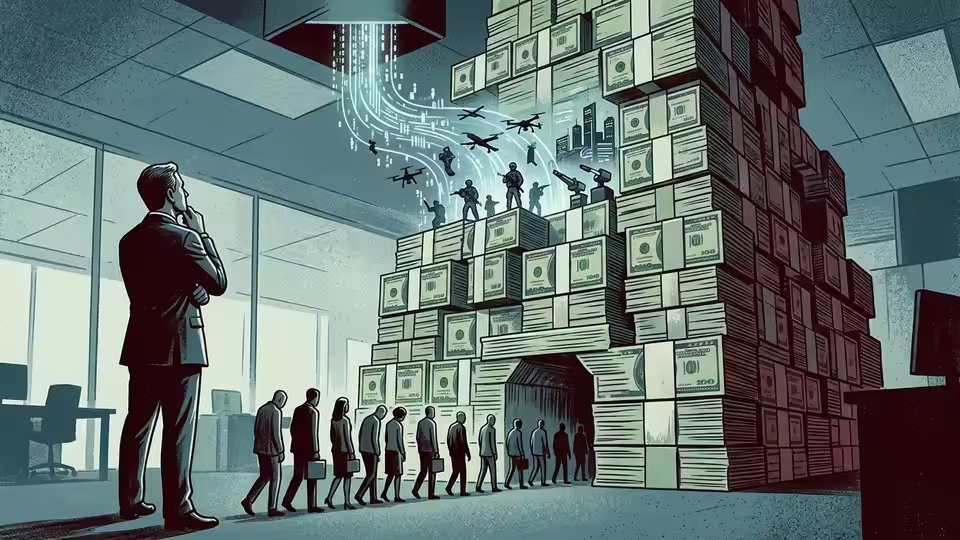
On January 26, 2026, the Army Contracting Command (ACC) finalized a $5.6 billion sole-source award to Computable Insights LLC, the specialized national security division of Salesforce. The deal, which spans ten years, effectively hands the keys to the Army’s digital infrastructure to a single vendor. To bypass federal laws that normally require open competition, the Army invoked [FAR 6.302-1], which is a federal regulation allowing non-competitive awards when only one responsible source can satisfy the agency’s requirements. The Army’s Justification and Approval (J&A) document claims the 'Missionforce' platform possesses 'unique suitability' that no other vendor can match.
The money trail suggests this was a long-term play. According to LD-2 filings mandated by the Lobbying Disclosure Act, Salesforce increased its federal lobbying expenditures by 42% in 2025, totaling $12.4 million. A significant portion of this capital was funneled into lobbying firms staffed by former aides to members of the House and Senate Armed Services Committees. These are the same committees that oversee the Army’s acquisition budget. OpenSecrets data reveals that during the same period, Salesforce-affiliated PACs and executives increased contributions to key committee members by 15% compared to the previous election cycle.
[Sole-source contract] is a type of procurement where a government agency enters into a contract with a single provider without a competitive bidding process, often citing urgent need or specialized technology. The Army justifies this award by arguing that the 'Missionforce' platform replaces multiple legacy systems into a unified environment. However, the catch is the architecture: the system is built on proprietary Salesforce code. This creates a state of [Vendor Lock-in], a situation where a customer becomes dependent on a vendor for products and services, unable to use another vendor without substantial switching costs or operational failure. Once the Army migrates its data to Missionforce, the cost of moving to a competitor in 2036 would likely be higher than the contract itself.
The award did not go unchallenged. TurboVets, a veteran-owned small business, filed a formal protest with the Government Accountability Office (GAO), identified as B-421000.1. TurboVets alleged that the Army’s technical requirements were 'arbitrarily narrow' and specifically written to mirror Salesforce’s existing features, effectively disqualifying any other bidder before the process began. This is a common tactic in 'wired' contracts—writing a request for proposal (RFP) so specific that only one predetermined winner can check every box.
The protest, which could have frozen the $5.6 billion award for months of public scrutiny, vanished as quickly as it appeared. TurboVets withdrew its GAO filing just 48 hours after Salesforce finalized a 'strategic partnership' agreement with the small firm. While the financial terms of this partnership remain private, the result was immediate: the legal hurdle to the $5.6 billion payout was removed without a single public hearing. This maneuver is known in the beltway as 'buying off the protest,' a practice that prevents the GAO from issuing a formal ruling on whether the Army's 'unique suitability' claim was actually valid.
The revolving door between the Pentagon and Salesforce also appears to have been greased. In the 18 months leading up to the award, two high-ranking Army acquisition officials retired and joined consultancies that list Salesforce National Security as a primary client. These individuals were instrumental in the initial pilot programs for Missionforce. Their transition from writing the Army's requirements to advising the company that meets those requirements is a textbook example of regulatory capture, where a private interest effectively gains control over the public agency meant to oversee it.
Mainstream reporting has framed this as a 'modernization' win, focusing on the Army's need for better data interoperability. What those reports leave out is the cost of that interoperability. By choosing a proprietary, closed-loop system over open-source or modular alternatives, the Army has ensured that taxpayers will be billed for proprietary 'seat licenses' and mandatory maintenance for at least a generation. According to USASpending.gov data, sole-source contracts in the technology sector typically result in costs 20-30% higher over the lifecycle of the contract compared to competitively bid projects.
For the average American, this is more than a budget line item. It is a $5.6 billion bet that a single private corporation will remain the best, most secure, and most cost-effective provider for the next decade. It sets a precedent where the largest players can use their lobbying muscle to bypass the competitive laws designed to protect small businesses and public funds. When the 'unique suitability' of a product is manufactured through lobbying and the exclusion of competitors, the taxpayer loses the only lever they have for accountability: the market.
At Gen Us, we believe in following the money beyond the press release. You can use our Politician Tracker to see which members of the Armed Services Committee received donations from Salesforce-affiliated PACs in the months surrounding this award. Our 'Revolving Door' database also tracks the movement of Army officials into the private sector. Stay informed, because your tax dollars are the ones funding the monopoly.
Summary
The U.S. Army bypassed competitive bidding to award a decade-long software contract to a Salesforce subsidiary, citing 'unique suitability' as the legal justification. This investigation tracks a $12.4 million lobbying surge and a quiet settlement that silenced a small-business challenge to the deal.
⚡ Key Facts
- The Army used FAR 6.302-1 to bypass competition for a $5.6 billion, 10-year contract awarded on Jan 26, 2026.
- Salesforce lobbying spending rose 42% to $12.4 million in the year preceding the award, according to LD-2 filings.
- A GAO protest by small business TurboVets was withdrawn immediately after Salesforce signed a private 'strategic partnership' with the firm.
- The 'Missionforce' platform utilizes proprietary code that ensures decade-long vendor lock-in for the Army.
- Two former Army acquisition officials moved to Salesforce-affiliated consultancies prior to the contract finalization.
Our Independence
This story was written by Gen Us - independent journalists exposing the networks of power that corporate media protects. No hedge fund owns us. No billionaire edits our headlines. We answer only to you, our readers.
Follow the public record
Source Trail
Get the next investigation in your inbox
One email a week. Receipts only. Free.
Free. Unsubscribe anytime. We never share your email.