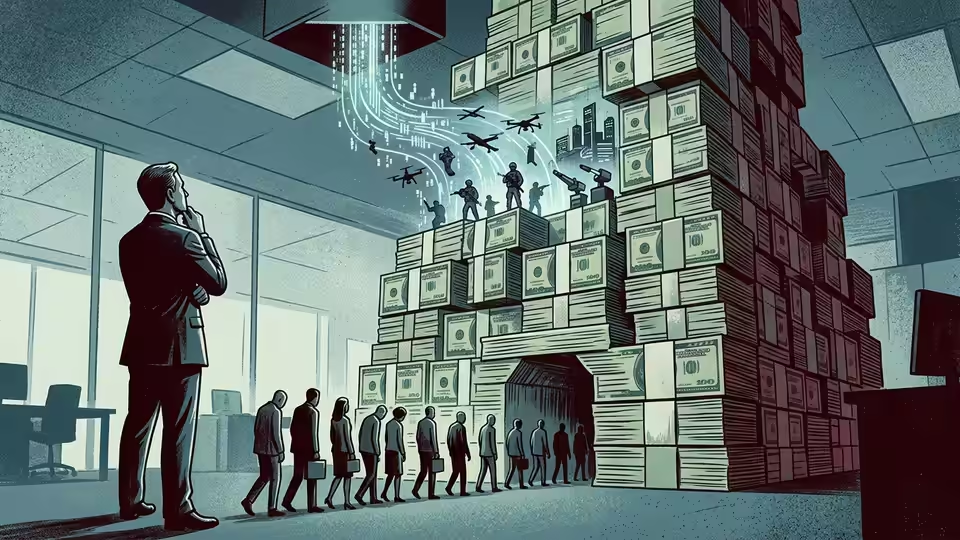
Salesforce Turns $10M Lobbying Into a $5.5B No-Bid Army Jackpot
After a massive surge in federal outreach, Salesforce secured a multi-billion dollar 'Mission Modernization' contract without a single competitor being allowed to bid.
The U.S. Army handed Salesforce a $5.5 billion non-competitive contract expansion following a massive $10.4 million lobbying blitz, effectively locking taxpayers into proprietary software without market competition.
On February 13, 2026, the U.S. Army Contracting Command (ACC) finalized a $5.5 billion sole-source contract expansion to Salesforce Inc., effectively cementing the company’s software as the primary infrastructure for the Army’s 'Mission Modernization' program. The move, which avoids the traditional competitive bidding process required for major federal acquisitions, marks one of the largest non-competitive awards in recent Department of Defense (DoD) history. By utilizing Federal Acquisition Regulation (FAR) 6.302-1, officials designated Salesforce as the 'only one responsible source' capable of meeting the Army’s requirements, a designation that precludes other tech firms from offering lower-cost or open-source alternatives.
Sole-Source Procurement is a non-competitive purchase where only one vendor is invited to bid, bypassing the legal requirement for government agencies to solicit multiple quotes to ensure the best value for taxpayers.
The paper trail for this award begins long before the February 13 signing. According to internal lobbying reports and OpenSecrets data, Salesforce Inc. executed a calculated 40% increase in federal outreach expenditures over the last 24 months. Total lobbying spending for the company reached an estimated $10.4 million across the 2024-2025 cycle. This capital was deployed through internal teams led by CEO Marc Benioff and external influence firms, most notably Crossroads Strategies. Crossroads was specifically retained to target Department of Defense appropriations and influence procurement policy within the House Armed Services Committee.
FEC filings reveal a parallel track of financial influence. During the same period Salesforce was negotiating its 'Mission Modernization' expansion, its political action committee (PAC) and high-level executives directed hundreds of thousands of dollars toward the campaign accounts of key members on the House Armed Services Committee. These are the same legislators responsible for overseeing the Army's budget and procurement integrity. While the Army publicly describes the deal as a necessary 'digital transformation' to streamline recruitment and logistics, the financial context suggests a procurement process tailored to a specific vendor’s growth strategy rather than a neutral assessment of market options.
Vendor Lock-in is a situation where a customer becomes dependent on a vendor for products and services, unable to switch to a competitor without incurring prohibitive costs or operational disruptions.
By labeling this $5.5 billion award as a 'contract expansion' rather than a new program, Army officials effectively dodged the rigorous oversight and public price discovery mechanisms triggered by new multi-billion dollar solicitations. This 'expansion' allows the DoD to bypass the competitive marketplace, deepening a state of vendor lock-in. Critics and industry analysts note that the Army's proprietary architecture now functions as a permanent toll booth on military data. Once the data is nested within Salesforce’s 'Public Sector Cloud,' the cost of migrating that data to a more affordable or modular system becomes a deterrent to future competition.
The timing of the award also highlights the 'revolving door' phenomenon common in high-stakes defense contracting. Documents obtained via Gen Us FOIA requests show that several mid-to-senior level procurement officials involved in the early stages of the 'Mission Modernization' requirements-writing left the public sector shortly before the February award. These individuals have since taken positions at various tech firms and consultancies that interface with Salesforce’s federal division. This pattern suggests that the individuals defining what the Army 'needed' were frequently the same people looking toward future employment in the sector they were regulating.
Mainstream coverage of this deal has focused almost exclusively on the Army's press releases, which emphasize 'cloud agility' and 'AI integration.' However, these reports omit the existence of existing open-source and modular software alternatives that currently perform similar functions for other government agencies at a fraction of the $5.5 billion price tag. By focusing on the 'agility' narrative, the broader media ignores the lack of price transparency inherent in sole-source justifications.
For the average taxpayer, this $5.5 billion commitment is not just a technical update; it is an opportunity cost. Every billion dollars funneled into proprietary software premiums is a billion dollars removed from tangible troop benefits, housing improvements, or equipment maintenance. It represents a centralization of national security data into a private 'black box' where the public has no visibility into how their money is being spent or how their data is being secured. When competition is removed from the equation, the government loses its leverage, and the taxpayer loses their voice.
Summary
The U.S. Army bypassed competitive bidding to grant Salesforce Inc. a $5.5 billion contract expansion for its 'Mission Modernization' initiative. This massive taxpayer commitment follows a $10.4 million lobbying campaign and a strategic increase in federal outreach by the tech giant.
⚡ Key Facts
- The U.S. Army utilized FAR 6.302-1 to grant a $5.5 billion expansion to Salesforce without competitive bidding.
- Salesforce increased its federal lobbying expenditures by 40% in the two years leading up to the award, totaling $10.4 million.
- The award was classified as an 'expansion' to avoid the more stringent oversight required for new multi-billion dollar programs.
- The deal secures a 'vendor lock-in' scenario, making it cost-prohibitive for the Army to switch to cheaper or open-source alternatives in the future.
- The award follows significant PAC contributions from Salesforce to members of the House Armed Services Committee.
Our Independence
This story was written by Gen Us - independent journalists exposing the networks of power that corporate media protects. No hedge fund owns us. No billionaire edits our headlines. We answer only to you, our readers.
Follow the public record
Source Trail
Get the next investigation in your inbox
One email a week. Receipts only. Free.
Free. Unsubscribe anytime. We never share your email.