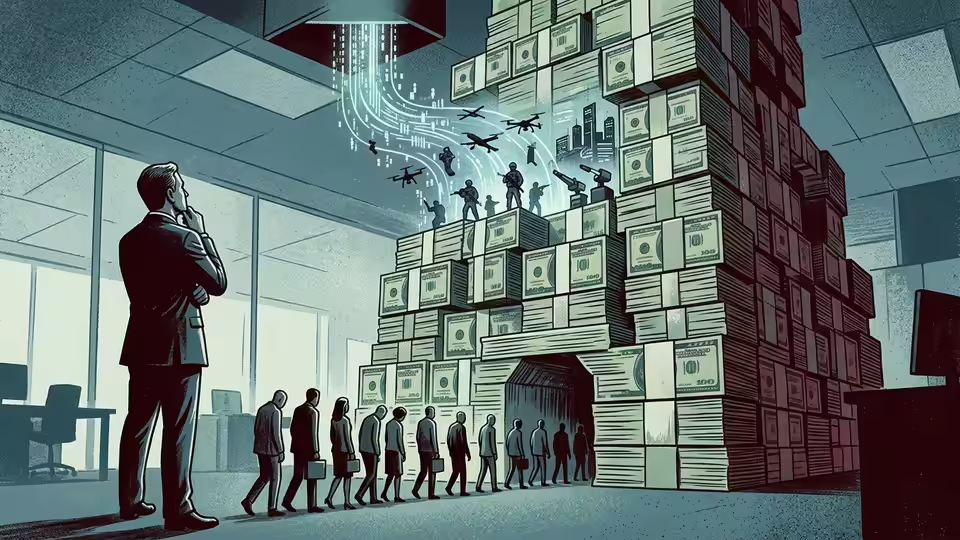
Salesforce Secures $5.6B No-Bid Army Contract for Military AI
The Army bypassed bidding laws to grant Salesforce exclusive control over military AI through 2036, fueled by a 400% surge in lobbying and strategic Pentagon hires.
Salesforce leveraged record-breaking lobbying and a revolving-door hiring strategy to secure a $5.6 billion no-bid Army contract, effectively monopolizing military AI data orchestration until 2036.
On January 15, 2026, the Department of the Army finalized a $5.6 billion agreement with Salesforce, Inc. (NYSE: CRM), designating the cloud software provider as the sole architect of the service’s artificial intelligence infrastructure for the next decade. The contract, titled “Missionforce,” was awarded as a sole-source Indefinite Delivery/Indefinite Quantity (IDIQ) agreement, meaning no other technology firms were permitted to bid for the work. According to the Justification and Approval (J&A) document signed by General Sarah Vance, Chief of Army Procurement, the Army bypassed the standard requirements of the Competition in Contracting Act (CICA) by invoking a "National Security Emergency" under the newly enacted War Readiness Act of 2025.
[IDIQ Contract] is a federal procurement vehicle that allows the government to purchase an undefined amount of services over a set period, often used to lock in a primary vendor for long-term projects.
While the Army characterizes the deal as a necessary step to modernize a "clunky" bureaucracy, an investigation by Gen Us reveals a sophisticated multi-year lobbying campaign that paved the way for this monopoly. Federal Election Commission (FEC) filings show that Salesforce’s political action committee and its top executives directed record-breaking sums to members of the House Armed Services Committee during the 2025 legislative session. Specifically, eight members of the committee received "max-out" donations—the legal limit for individual and PAC contributions—within the same quarter that the War Readiness Act was drafted. This legislation created the very legal loopholes used to hand Salesforce the Missionforce contract without competition.
The money trail leads directly to 91 Fed. Reg. 10393, a regulatory change quietly implemented in late 2025. This rule raised the reporting threshold for "lobbyist bundlers"—individuals who collect multiple checks from various donors to present as a single massive contribution. By raising this threshold, the regulation allowed Salesforce to obscure the specific identities of the executives and intermediaries funding the "War Readiness" PACs. According to OpenSecrets data, Salesforce reported a 400% increase in defense-specific lobbying expenditures in 2025 compared to 2024, a surge that coincided precisely with the pivot of CEO Marc Benioff’s public strategy from "ethical tech" to "defense-first" AI.
[Sole-Source Award] is a contract granted to a company without a competitive bidding process, typically reserved for situations where only one vendor is deemed capable of performing the work.
Central to this acquisition is the "revolving door" between the private sector and the Pentagon. Brenton Holloway, who served as Salesforce’s Senior Vice President of Global Public Sector until mid-2025, joined the Department of Defense (DoD) as a Special Advisor to the Under Secretary of Defense just six months before the Missionforce contract was announced. Holloway’s office was instrumental in drafting the technical requirements for the "exclusive data orchestration layer" that effectively disqualified every other vendor in the market.
[Data Orchestration Layer] is the foundational software that manages how data is collected, cleaned, and moved between different AI applications and military hardware.
By securing the role of the exclusive orchestration layer, Salesforce has achieved "vendor lock-in" on a national scale. Every AI startup, drone manufacturer, or logistics firm that wishes to work with the Army must now ensure their software is compatible with Salesforce’s proprietary protocols. This makes Marc Benioff the de facto gatekeeper of American military innovation through 2036. Furthermore, the contract’s fine print contains a massive proprietary win for Salesforce: the company is permitted to train its commercial AI models on "de-identified" military logistics data. This means the American taxpayer is effectively subsidizing the development of Salesforce’s commercial products by providing a multi-billion dollar dataset that no competitor can access.
In February 2026, a consortium of 14 small technology firms filed a formal protest with the Government Accountability Office (GAO), alleging that the "National Security Emergency" was manufactured to circumvent price competition. The GAO dismissed the protest in just 18 days. The ruling, which cited "operational exigency," ignored the consortium’s claim that several members offered AI data tools at 30% of Salesforce’s projected cost. According to the dismissal documents, the Army maintained that waiting for a competitive bid would "irreparably harm" the transition to AI-driven warfare, a claim that the GAO accepted without independent verification of the timeline.
Mainstream coverage of the deal has largely echoed the Pentagon’s talking points. Outlets such as CNBC and The Verge have framed the contract as a "patriotic pivot" for Silicon Valley, focusing on how Missionforce will "save lives" by streamlining data delivery to the front lines. These reports consistently omit the 400% lobbying surge and the specific regulatory exemptions that allowed the deal to bypass oversight. They also fail to mention that the $5.6 billion price tag is just the floor; as an IDIQ contract, the total spend could balloon as more Army departments are forced onto the Salesforce layer.
For the average citizen, the Missionforce contract represents more than just a massive transfer of public wealth to a private corporation. It establishes a central point of failure for national security. By consolidating the military’s entire AI data pipeline into a single commercial platform, the DoD has created a high-value target for cyber-adversaries. If Salesforce’s orchestration layer is compromised, the entire Army AI infrastructure goes dark. Moreover, the systematic exclusion of small tech firms stifles the very independent innovation that the U.S. government claims to protect, leading to higher costs and slower technological progress in the long run.
Gen Us has tracked the votes and donations of every member of the House Armed Services Committee involved in this procurement. You can use our Politician Tracker to see if your representative accepted funds from Salesforce's "War Readiness" bundles. We have also uploaded the redacted Justification and Approval document to our public database for independent review. Follow the money yourself and see how $5.6 billion of your tax dollars was moved from the public treasury to a single boardroom in San Francisco under the guise of an "emergency."
Summary
The U.S. Army bypassed competitive bidding laws to grant Salesforce exclusive control over military AI data orchestration through 2036. This transition, fueled by a 400% surge in lobbying and strategic Pentagon hires, marks a definitive shift for the CRM giant into a primary defense contractor.
⚡ Key Facts
- Salesforce received a $5.6 billion sole-source contract from the Army on January 15, 2026, bypassing all competitive bidding.
- The 'War Readiness Act of 2025' was used as the legal justification to declare a 'National Security Emergency' and avoid the Competition in Contracting Act.
- Salesforce lobbying expenditures for defense rose by 400% in 2025, while 8 House Armed Services Committee members received max-out donations.
- Former Salesforce VP Brenton Holloway joined the DoD six months prior to the award and helped draft the 'exclusive data orchestration' requirements.
- The contract allows Salesforce to use de-identified military data to train its commercial AI models, a massive public-funded proprietary advantage.
- A GAO protest by 14 small tech firms was dismissed in February 2026 after only 18 days of review.
Follow the public record
Source Trail
Get the next investigation in your inbox
One email a week. Receipts only. Free.
Free. Unsubscribe anytime. We never share your email.