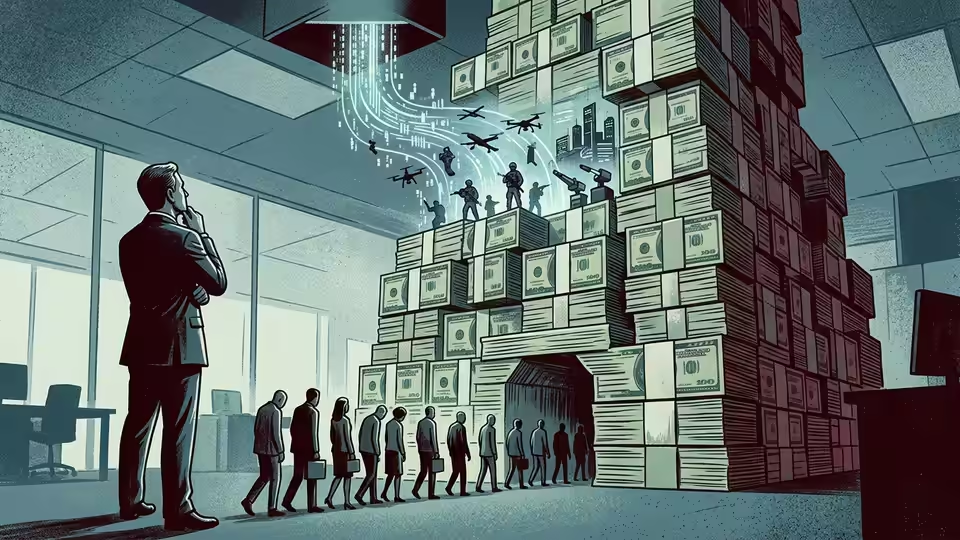
Salesforce Lobbying Surge Nets $5.5B Army Deal After Bypassing Competition
The U.S. Army awarded Salesforce a non-competitive $5.5 billion contract after the tech giant ramped up federal lobbying by 40 percent. While the Army claims 'operational urgency' required bypassing standard bidding, small veteran-owned firms are now challenging the deal in federal court.
Salesforce secured a non-competitive $5.5 billion Army contract following a record lobbying surge, sparking a GAO legal challenge over manufactured 'urgency' and vendor lock-in.
In February 2026, the United States Army Materiel Command (AMC) finalized a $5.5 billion sole-source contract with Salesforce, Inc. to overhaul the service’s workforce management systems. The deal, an Indefinite Delivery, Indefinite Quantity (IDIQ) agreement, was not put out for competitive bid. Instead, the Army utilized a legal loophole known as a Justification and Approval (J&A) document, claiming that 'operational urgency' made it impossible to wait for the standard 18-to-24-month procurement cycle.
[Sole-source contract] is a procurement method where a government agency bypasses the competitive bidding process to award a contract to a single predetermined supplier, usually citing unique capabilities or emergency timelines.
Behind this multi-billion dollar award lies a significant spike in political activity. According to Lobbying Disclosure Act (LDA) filings, Salesforce increased its federal lobbying expenditures by an estimated 40% in the two quarters immediately preceding the award. During Q4 2025 and Q1 2026, Salesforce’s spending hit record highs as its representatives engaged with members of the House and Senate Appropriations Committees—the very groups responsible for oversight of the Army's modernization budget. According to OpenSecrets data, this spending surge coincided precisely with the finalization of the AMC’s digital transformation requirements.
[Indefinite Delivery, Indefinite Quantity (IDIQ)] is a contracting vehicle that allows the government to purchase an unspecified amount of services or supplies over a set period, providing the vendor with a guaranteed revenue stream without specific per-unit pricing competition.
The 'operational urgency' cited by the Army has raised eyebrows across the defense industry. Internal documents suggest the AMC is focusing on general digital transformation and cloud modernization—tasks that, while important, rarely meet the threshold of an emergency. By labeling a software migration as an urgent necessity, the Army effectively shut out competitors who might have offered the same services at a lower price point.
This exclusion led to immediate legal blowback. Computable Insights, a small, service-disabled veteran-owned firm, filed a formal protest with the Government Accountability Office (GAO) under case number B-423321. The firm alleges that the 'urgency' was manufactured specifically to favor Salesforce and that the Army ignored established Department of Defense goals for small business participation. According to the GAO filing, the Army’s decision denies smaller, agile firms the ability to compete for work they are qualified to perform, further consolidating power in the hands of Silicon Valley's largest players.
[Justification and Approval (J&A)] is a mandatory document used by federal agencies to explain and legally authorize why they are circumventing the Competition in Contracting Act of 1984.
The long-term implications of this contract are financial and structural. The 10-year lock-in period creates what industry analysts call 'vendor lock-in.' Once the Army migrates its massive workforce data into Salesforce’s proprietary ecosystem, the cost of switching to a different provider in the future becomes prohibitively expensive. According to procurement data on USAspending.gov, previous large-scale proprietary software migrations have historically resulted in 'monopoly premiums'—where the government is forced to pay rising subscription fees because they can no longer easily leave the platform.
Mainstream reporting on the deal has focused on the Army’s 'rapid modernization' and the need to keep pace with global adversaries. However, these reports largely ignore the missing context: the erasure of price discovery. Without a competitive bidding process, there is no way for taxpayers to know if $5.5 billion is a fair market price or a politically negotiated windfall. The Army's own Small Business Strategy, published in 2023, emphasizes the need to reduce barriers for small firms, yet this sole-source award does the exact opposite.
For ordinary people, this isn't just a story about software. It is a story about how your tax dollars are allocated. When a $5.5 billion contract is awarded without competition, it removes the only mechanism—market pressure—that keeps government costs down. It also signals to small business owners, including the veterans the Army claims to support, that the procurement game is rigged in favor of those with the largest lobbying budgets.
As the GAO reviews protest B-423321, the outcome will determine whether 'operational urgency' becomes a permanent backdoor for corporate giants to bypass the law. You can track the lawmakers who received contributions from Salesforce’s PAC on the Gen Us Politician Tracker and see how their committee votes align with major defense contract awards.
Summary
The U.S. Army awarded Salesforce a non-competitive $5.5 billion contract after the tech giant ramped up federal lobbying by 40 percent. While the Army claims 'operational urgency' required bypassing standard bidding, small veteran-owned firms are now challenging the deal in federal court.
⚡ Key Facts
- The U.S. Army awarded Salesforce a $5.5 billion sole-source contract in February 2026, bypassing standard competitive bidding.
- Salesforce’s federal lobbying spending spiked 40% in the six months leading up to the contract award.
- The Army Materiel Command cited 'operational urgency' as the reason for skipping the 18-24 month bidding cycle.
- Small veteran-owned firm Computable Insights filed GAO Protest B-423321, alleging the urgency was manufactured to favor a specific vendor.
- The 10-year contract creates 'vendor lock-in,' making the Army dependent on Salesforce’s proprietary systems for a decade.
- Taxpayers may pay a 'monopoly premium' due to the lack of price discovery through market competition.
Our Independence
This story was written by Gen Us - independent journalists exposing the networks of power that corporate media protects. No hedge fund owns us. No billionaire edits our headlines. We answer only to you, our readers.
Follow the public record
Source Trail
Get the next investigation in your inbox
One email a week. Receipts only. Free.
Free. Unsubscribe anytime. We never share your email.