Salesforce Grabs $5.5B Army Monopoly After Shattering Lobbying Records
The U.S. Army bypassed bidding laws to hand Salesforce a decade-long monopoly. This investigation tracks how record-high lobbying spending silenced small-business protests.
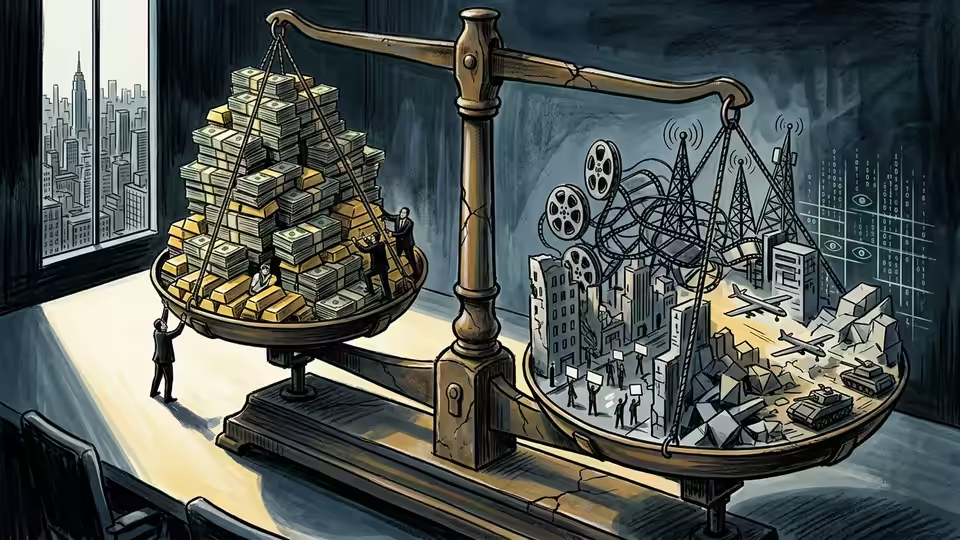
The U.S. Army used a regulatory loophole to hand Salesforce a $5.5 billion monopoly exactly when the company hit record-high lobbying spends, effectively killing competition and small business participation in defense tech.
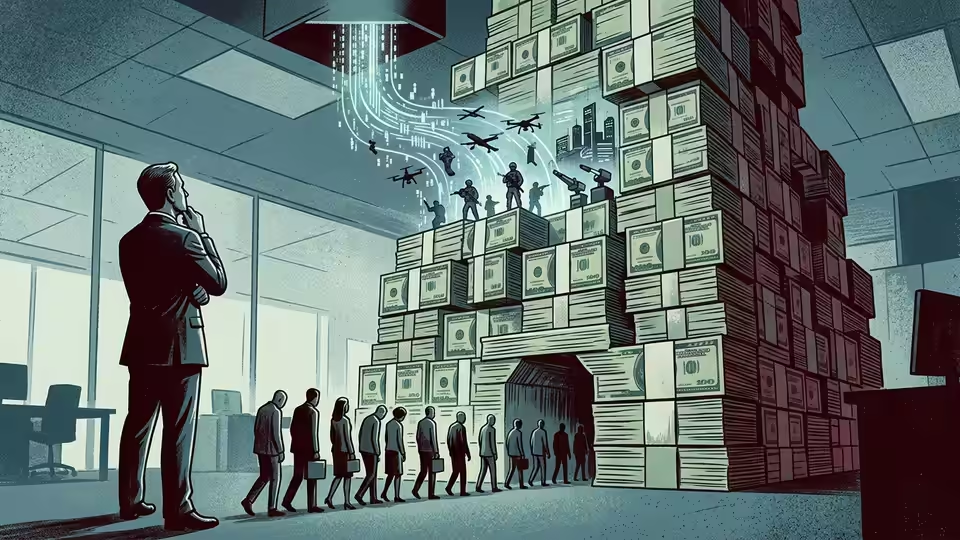
In February 2026, the U.S. Army Acquisition Executive (AAE) finalized a $5.5 billion sole-source contract for its Enterprise IT/Software platform. The recipient was Salesforce Inc. No other companies were permitted to bid, and the standard competitive process was entirely circumvented. This award was not an anomaly but a calculated utilization of a specific regulatory loophole known as FAR 6.302-1.
[FAR 6.302-1] is a federal regulation that allows government agencies to bypass competitive bidding requirements when they claim 'only one responsible source' can satisfy the agency's needs. In its Justification and Approval (J&A) document, the Army claimed that opening the contract to competition would result in 'unacceptable delays' and 'substantial duplication of costs.' However, the document fails to address why the Army did not initiate a competitive process years earlier to avoid this manufactured emergency.
While the Army was preparing to block competition, Salesforce was aggressively funding the gatekeepers. According to federal lobbying disclosures for Q1 2026, Salesforce spent $4.4 million on federal lobbying. This figure represents the highest single-quarter expenditure in the company’s history. Data from OpenSecrets and FEC filings reveal that this spending surge was strategically directed at members of the House and Senate Armed Services Committees—the very individuals who authorize the 'Army Modernization' and 'Cloud Migration' funds used to pay for this contract.
This sequence of events is a textbook case of [Regulatory Capture], a phenomenon where a government agency, created to act in the public interest, instead acts in the commercial interest of the industry it is supposed to oversee. By tailoring its technical requirements to mirror the specific, proprietary features of Salesforce’s platform, the Army Acquisition Executive effectively locked out all other vendors, including smaller, more agile competitors.
One such competitor, a veteran-owned small business, filed a formal bid protest with the Government Accountability Office (GAO). The firm argued it could provide modular, open-source alternatives for a fraction of the $5.5 billion price tag. Despite the fact that other Department of Defense agencies currently use these same open-source tools, the GAO dismissed the protest. This dismissal solidified a decade-long monopoly for Salesforce, ensuring a taxpayer-funded revenue stream for the corporation through at least 2036.
The long-term risk of this deal is [Vendor Lock-In], a situation where a customer becomes so dependent on a vendor's proprietary products that they cannot switch to a competitor without incurring prohibitive costs or technical failures. Because the Army’s digital infrastructure is now built on Salesforce’s closed-source code, future competition for this platform is functionally impossible. The Army has not just bought software; it has bought a permanent dependency.
Mainstream reporting on this deal has focused on the Army’s narrative of 'digital transformation' and 'staying ahead of global adversaries.' Outlets like Defense News have echoed the Army’s claims that a single, 'proven industry leader' is necessary for security. These reports consistently omit the financial premium associated with sole-source contracts. Historical data on federal procurement shows that a lack of competition typically results in a 20-30% premium over market rates. In this case, that premium represents over $1 billion in potential waste.
The human cost of this decision is the systematic exclusion of small businesses from the defense economy. The Small Business Act was designed to prevent exactly this type of corporate consolidation. Instead, the Army has prioritized a tech giant that spent $4.4 million in a single quarter to ensure its seat at the table. For regular citizens, this means their tax dollars are being used to inflate corporate profits rather than to procure the most efficient technology at the best possible price.
At Gen Us, we are tracking the members of the Armed Services Committees who received campaign contributions from Salesforce PACs during this procurement window. Our Politician Tracker shows a direct correlation between these donations and the legislative language that prioritized 'sole-source cloud modernization.' You can explore the full data set on our site, search the Army's J&A documents in our public repository, and see which representatives are signing off on the end of competitive bidding.
Summary
The U.S. Army bypassed federal bidding laws to award Salesforce a $5.5 billion enterprise software contract while the company's lobbying spending reached record highs. This investigation tracks how a regulatory loophole and a dismissed small-business protest secured a decade-long monopoly for the tech giant.
⚡ Key Facts
- The U.S. Army awarded a $5.5 billion sole-source contract to Salesforce in February 2026, bypassing all competitive bidding.
- Salesforce spent a record-breaking $4.4 million on lobbying in Q1 2026, targeting the committees that fund the contract.
- The Army utilized regulatory loophole FAR 6.302-1, claiming Salesforce was the 'only responsible source' available.
- The GAO dismissed a protest from a veteran-owned small business that offered a lower-cost, open-source alternative.
- The contract creates 'vendor lock-in,' making the U.S. Army technically dependent on Salesforce proprietary code until 2036.
Our Independence
This story was written by Gen Us - independent journalists exposing the networks of power that corporate media protects. No hedge fund owns us. No billionaire edits our headlines. We answer only to you, our readers.
Follow the public record
Source Trail
Get the next investigation in your inbox
One email a week. Receipts only. Free.
Free. Unsubscribe anytime. We never share your email.