Salesforce Bypasses Federal Law for $5.6B 'No-Bid' Army Contract
The Army cited a 'technical monopoly' to hand Salesforce a decade-long, multi-billion dollar deal without competition. This is what happens after record-breaking lobbying.
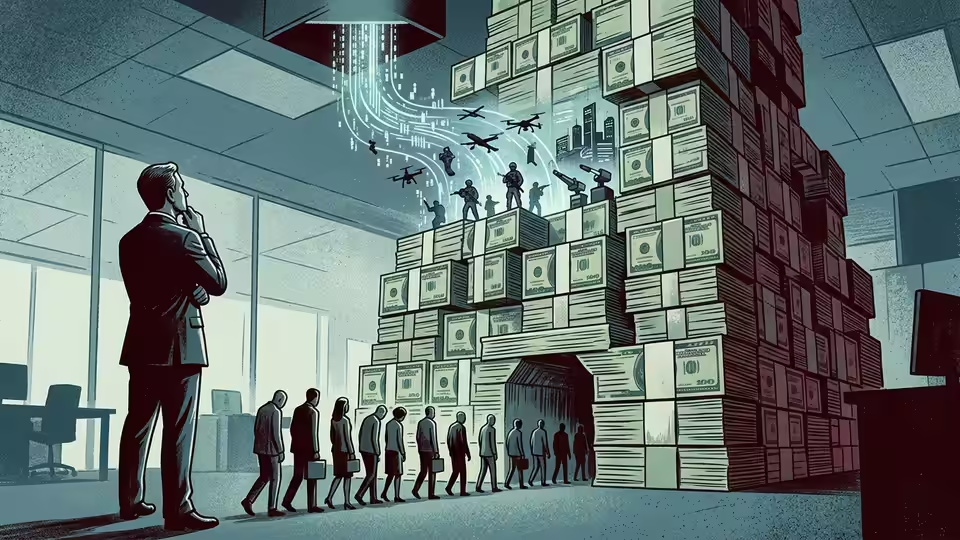
Salesforce leveraged $3.2 million in lobbying and proprietary technicalities to secure a non-competitive $5.6 billion Army contract, locking taxpayers into a 10-year monopoly.
The U.S. Army has finalized a $5.6 billion, decade-long contract with Computable Insights LLC, a subsidiary of Salesforce.com Inc., without allowing a single other company to bid for the work. The award, finalized through the Army Contracting Command at Rock Island, utilizes a specific loophole in federal law to bypass the competitive bidding process typically required for taxpayer-funded projects of this magnitude. This move secures Salesforce's role as the primary architect of 'Missionforce,' the Army's centralized system for personnel and logistics data, for the next ten years.
To justify the move, the Army filed a Justification and Approval (J&A) document citing FAR 6.302-1. This regulation—officially titled 'Only One Responsible Source and No Other Supplies or Services Will Satisfy Agency Requirements'—allows the government to skip competition if they can prove only one specific company can do the job. In this instance, the Army claims that because Salesforce owns the proprietary architecture of the existing cloud environment, attempting to transition to a competitor like Microsoft, AWS, or Oracle would result in 'unacceptable delays' and 'duplicated costs' that the government is unwilling to bear.
FAR 6.302-1 is a federal procurement regulation that permits sole-source contracting when only one source is capable of providing the required supplies or services due to unique capabilities or proprietary rights.
While the Army frames this as a necessity for 'modernization at the speed of business,' the financial trail suggests a well-funded influence campaign. According to data from OpenSecrets.org, Salesforce.com Inc. increased its federal lobbying expenditures to record highs in the fiscal year preceding the award, totaling over $3.2 million. These funds were directed toward firms like Crossroads Strategies and Forbes-Tate, whose lobbyists include former high-ranking congressional aides and executive branch officials. These filings specifically list 'cloud computing' and 'defense procurement policy' as primary targets of their activity.
This lobbying spend coincided with a strategic shift in how the Army defines its technical requirements. Investigative analysis of the J&A reveals that the 'Missionforce' requirements were written in language that mirrors Salesforce’s proprietary Application Programming Interfaces (APIs). By embedding these specific technical requirements into the core mission profile, the Army created a situation where Regulatory Capture became inevitable.
Regulatory Capture is a phenomenon where a private industry or corporation gains enough influence over a government agency that the agency acts in the interest of the corporation rather than the public.
By the time the contract was awarded in early 2026, the technical barriers to entry for any other vendor were insurmountable. This creates what economists call Vendor Lock-in, a state where a customer becomes so dependent on a vendor for products and services that they cannot move to another vendor without substantial costs or disruptions. In this case, the U.S. Army is now locked into the Salesforce ecosystem until 2036. If Salesforce raises its subscription fees or if the software fails to meet performance benchmarks, the Army has no immediate exit strategy. The 'proprietary data' excuses used in the J&A document effectively mean the Army’s own data is now held behind a corporate paywall.
Vendor Lock-in is a business model where a customer is forced to continue using a product or service regardless of quality or price because the cost of switching is too high.
Mainstream business outlets have characterized the $5.6 billion deal as a 'win for military efficiency' and a 'cloud milestone.' What these reports omit is the 'revolving door' of personnel facilitating these deals. Public records indicate that several former military IT officers and procurement specialists have joined Salesforce-aligned consulting firms in the last 36 months. These individuals provide the roadmap for navigating the FAR 6.302-1 justification process, helping private entities bypass the competition that is supposed to protect taxpayer dollars.
For ordinary people, this is not just an abstract IT dispute; it is a $5.6 billion commitment of public funds to a non-competitive monopoly. When competition is removed, the incentive for a contractor to remain efficient or cost-effective disappears. Taxpayers are now on the hook for a decade of 'recurring subscription licenses'—a permanent revenue stream for Salesforce regardless of whether the system actually improves military readiness. If the technology becomes obsolete by 2030, the Army is still contractually and technically tethered to it for another six years.
Gen Us will continue to track the specific members of the House and Senate Armed Services Committees who received campaign contributions from Salesforce-linked PACs during this procurement cycle. You can follow the money through our Politician Tracker or explore our deep dive into the 'Revolving Door' database to see which former Army officials signed off on the Missionforce transition before moving to the private sector.
Summary
The U.S. Army bypassed federal competition laws to award a 10-year, $5.6 billion contract to a Salesforce-owned entity, citing a unique technical monopoly. This deal follows record lobbying expenditures and effectively locks the military's core logistics into a single corporate ecosystem until 2036.
⚡ Key Facts
- The U.S. Army awarded a $5.6 billion sole-source contract to Salesforce subsidiary Computable Insights LLC.
- The contract uses the FAR 6.302-1 loophole to bypass the competitive bidding process required by law.
- Salesforce spent $3.2 million on federal lobbying in the year leading up to the award, according to OpenSecrets.
- The 10-year term creates a 'vendor lock-in' that prevents the Army from switching technologies until 2036.
- The contract guarantees Salesforce a decade of subscription revenue regardless of system performance.
Follow the public record
Source Trail
Get the next investigation in your inbox
One email a week. Receipts only. Free.
Free. Unsubscribe anytime. We never share your email.