Riyadh Re-Opens Airbase to U.S. Jets as Iranian Missiles Cripple Energy
Saudi Arabia flips its de-escalation policy, welcoming U.S. forces back to King Fahd Air Base. While legacy media focuses on 'regional stability,' we track the real motive: protecting the Gulf's oil infrastructure and the massive U.S. defense contracts fueled by Iranian drone waves.
Saudi Arabia is opening its airbases to the U.S. after Iranian strikes took out 17% of Qatar’s gas production. It’s a massive shift away from diplomacy toward a full-blown military buildup designed to protect the world's energy supply.
The decision to hand the U.S. access to King Fahd Air Base in Taif isn't just a minor shift in logistics. It's a survival tactic. Taif sits deep in Western Saudi Arabia, far from the Iranian launch sites that can easily reach Prince Sultan Air Base, the usual hub for U.S. operations. By shifting the heavy lifting to the Red Sea corridor near Jeddah, the U.S. and Riyadh are trying to sidestep the Strait of Hormuz entirely. Military intel suggests Iran basically has kinetic control of those waters now. This isn't just about moving planes; it’s a multi-billion dollar bet that the world’s energy supply can survive by pivoting away from the Persian Gulf.
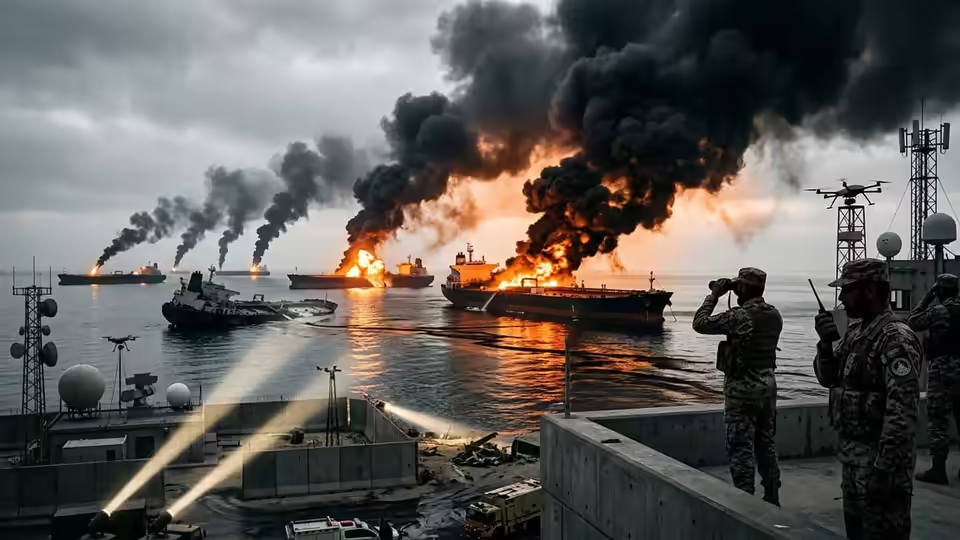
The real wake-up call came on March 1. That’s when the strike on Qatar’s Ras Laffan refinery hit, and the numbers are staggering. According to a GCC report from earlier this month, the attack crippled 17 percent of Qatar’s total gas production. Qatari Energy Minister Saad al-Kaabi didn't sugarcoat it: repairs will take three to five years. That’s a massive hole in the global LNG market right when demand is peaking. It’s why even the most cautious Gulf leaders are ditching their 'no launchpad' policies. The neutrality they tried to maintain when U.S.-Israeli operations started on February 28 just isn't an option anymore.
You have to look at who’s telling the story, too. Middle East Eye—funded by Qatari-linked Fadaat Media—has been calling the Pentagon the 'US Department of WarLoaded Language.' That’s a term that hasn't been official since 1947. It’s a deliberate editorial choice, a way to make Washington look like a 19th-century colonial power. But here’s the thing: while they focus on the political optics, they’re ignoring why the UAE and Saudi Arabia are actually playing along. They aren't being forced into this. They’re desperate for security guarantees to keep their energy monopolies and sovereign wealth funds from being incinerated by the next drone swarm.
“The damage will take three to five years to repair and affects 17 percent of Qatar’s gas production.”
Then there's the money. Follow the trail and it leads straight to American defense giants. The UAE claims it’s knocked down 338 ballistic missiles and over 1,700 drones lately. Even if those numbers are hard to verify, the math is terrifying. A single Patriot PAC-3 interceptor costs about $4 million. At the volume the UAE is reporting, they’ve spent over $8.2 billion on hardware alone. Most of this is flowing through fast-tracked deals signed during the Trump administration’s second term. Essentially, we’re seeing a massive transfer of Gulf oil wealth directly into the pockets of the U.S. defense industry.
[Shahed drones] are Iran's low-cost, high-impact solution for swarming sophisticated defenses. [Strait of Hormuz] is the world's most dangerous choke point—a narrow strip of water through which 20 percent of the world’s petroleum flows daily. [Ras Laffan] is the crown jewel of Qatar’s industrial sector and a critical node in the global energy web.
The politics here are purely transactional. Donald Trump and Crown Prince Mohammed bin Salman (MBS) are in constant contact, carving out a simple deal: base access for the U.S. in exchange for top-tier missile tech and political cover for the Kingdom. It’s a far cry from old-school multilateral diplomacy. But the bill is coming due. UAE Foreign Minister Sheikh Abdullah bin Zayed thinks this war could last nine months. If he’s right, the cumulative damage to energy plants could trigger a global recession, no matter how many missiles are intercepted over Taif.
There’s a massive legal elephant in the room: is this actually a war? Congress hasn't declared one, yet thousands of U.S. troops are currently being diverted from East Asia to the Gulf. This 'gray zone' conflict is convenient for leaders because it lets them escalate without the oversight of the War Powers Act. For the rest of us, it means energy prices are going to stay volatile and the risk of a wider conflict is the highest it’s been in decades. Watch the GCC summit in April. We might see the birth of a 'Middle East Treaty Organization,' a move that would lock this military realignment in place for the long haul.
Summary
Saudi Arabia is opening the gates of King Fahd Air Base in Taif to the U.S. military, marking a sharp U-turn from years of regional de-escalation. The catalyst? A March 1 missile strike on Qatar’s Ras Laffan refinery that wiped out nearly a fifth of the country’s gas production. While some outlets are using loaded, archaic language to paint the U.S. as an aggressor, the reality on the ground is simpler: Riyadh and Abu Dhabi are scrambling to protect their oil and gas from a relentless wave of Iranian drones. We’re also looking at the biggest winners here—U.S. defense contractors who are seeing a massive surge in business as the Gulf spends billions to keep its skies clear.
⚡ Key Facts
- Iran attacked Qatar’s Ras Laffan refinery, causing damage that affects 17 percent of Qatar’s gas production.
- Saudi Arabia and the UAE have shifted toward a policy of 'punishing' Iran following attacks on Riyadh and Yanbu.
- Marco Rubio is serving as US Secretary of State in a Trump administration.
Riyadh Re-Opens Airbase to U.S. Jets as Iranian Missiles Cripple Energy
Network of Influence
- Qatari-aligned interests (Fadaat Media) who seek to portray Saudi/UAE as escalating regional conflict.
- Political actors who want to frame US foreign policy under the Trump administration as hyper-militarized.
- Parties seeking to emphasize the failure of US security guarantees in the Gulf.
- The article fails to explain the specific legal or formal status of the 'US-Israeli war on Iran,' which is not a formally declared conflict.
- It omits Iran's stated justifications for its strikes on Gulf infrastructure.
- The historical context of the US-Saudi security relationship is simplified into a reaction to current 'Trump administration' actions.
The article frames regional geopolitical shifts as an inevitable march toward a catastrophic 'US-Israeli war,' centering a narrative of Gulf state victimhood and US unreliability while using archaic terminology to cast the US as an aggressor.
See how the story connects.
Select any actor or numbered connection, then inspect the evidence before drawing a conclusion.
Fadaat Media Ltd Owns Middle East Eye
Follow the public record
Source Trail
Independent reporting and analysis
Get the next investigation in your inbox
One email a week. Receipts only. Free.
Free. Unsubscribe anytime. We never share your email.