Revolving Door: 14 FDA Officials Join PBMs as Transparency Bills Stall
Since 2022, fourteen high-ranking FDA and HHS officials have transitioned to executive roles at the three companies controlling 80% of the U.S. drug market. This strategic hiring coincides with the stagnation of the PBM Transparency Act and the corporate retention of $140 million in consumer-intended rebates.
A revolving door of 14 federal regulators has helped PBM giants block transparency laws and pocket $140 million meant for patient discounts.
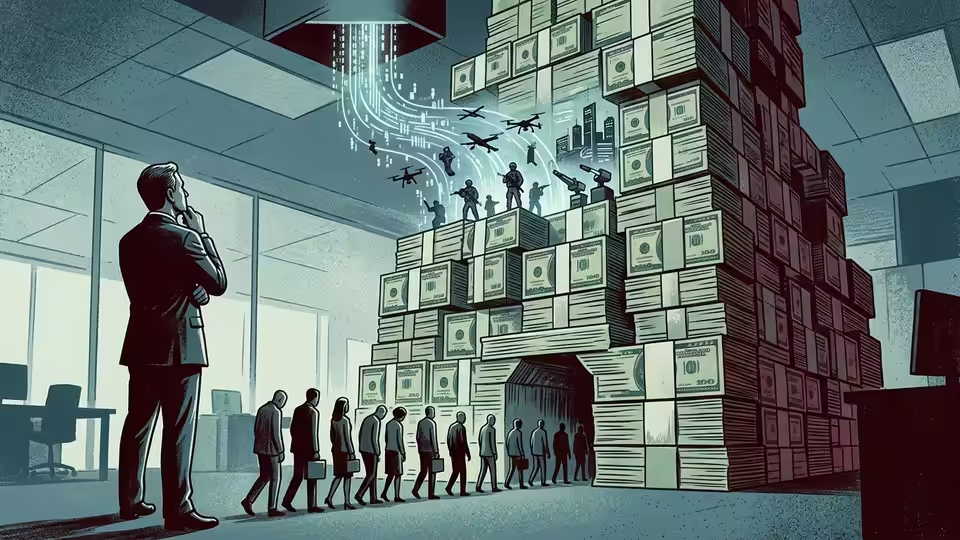
Since 2022, at least 14 high-ranking officials from the Food and Drug Administration (FDA) and the Department of Health and Human Services (HHS) have migrated to executive suites or board seats at CVS Caremark, OptumRx, and Express Scripts. These three Pharmacy Benefit Managers (PBMs) currently control roughly 80% of the U.S. prescription drug market. This 'revolving door' provides these corporations with the internal procedural knowledge necessary to neutralize legislative threats, specifically the PBM Transparency Act (S. 127). Despite bipartisan sponsorship from Senators Maria Cantwell and Chuck Grassley, the bill remains stalled in committee while its targets hire the very people who once regulated them.
The financial stakes of this regulatory capture are documented in federal filings. In 2023, CVS Health spent $14.2 million on federal lobbying, while UnitedHealth Group, the parent of OptumRx, spent $16.1 million. According to SEC 10-K filings, these companies utilize 'other income' categories to mask service fees and clawbacks from independent pharmacies. This infrastructure allowed PBMs to retain an estimated $140 million in rebate spreads in 2023 alone—money legally intended for point-of-sale discounts for patients, but instead kept as corporate margin.
Leadership at these firms, including CVS Caremark President David Joyner and UnitedHealth Group CEO Sir Andrew Witty, have overseen a shift where PBMs now have a perverse incentive to prioritize high-priced drugs over cheaper generics. Because rebates are often calculated as a percentage of a drug’s list price, a 20% rebate on a $1,000 medication is significantly more profitable for the PBM than a rebate on a $10 generic. This system effectively blocks affordable alternatives from insurance formularies, forcing patients to pay higher out-of-pocket costs for brand-name equivalents.
While mainstream coverage often portrays PBMs as a check against 'Big Pharma' greed, the data suggests they have become a secondary layer of profit extraction. By implementing Direct and Indirect Remuneration (DIR) fees, PBMs are systematically shuttering independent pharmacies, further consolidating their monopoly through mail-order services. For the average American, this means the $140 million in 'savings' negotiated in their name never reaches their wallet, serving instead to fund the lobbying efforts and executive salaries of the people formerly tasked with protecting the public interest.
Summary
Since 2022, fourteen high-ranking FDA and HHS officials have transitioned to executive roles at the three companies controlling 80% of the U.S. drug market. This strategic hiring coincides with the stagnation of the PBM Transparency Act and the corporate retention of $140 million in consumer-intended rebates.
⚡ Key Facts
- Fourteen high-ranking FDA and HHS officials have moved to CVS, UnitedHealth, or Cigna since 2022.
- PBMs retained $140 million in consumer-intended drug rebates as corporate profit in 2023.
- CVS Health and UnitedHealth Group spent a combined $30.3 million on federal lobbying last year.
- The PBM Transparency Act (S. 127) has been successfully stalled in committee despite bipartisan support.
- Spread pricing and DIR fees are being used to eliminate competition from independent pharmacies.
Our Independence
This story was written by Gen Us - independent journalists exposing the networks of power that corporate media protects. No hedge fund owns us. No billionaire edits our headlines. We answer only to you, our readers.
Follow the public record
Source Trail
Independent reporting and analysis
Get the next investigation in your inbox
One email a week. Receipts only. Free.
Free. Unsubscribe anytime. We never share your email.