Pentagon Killed 183 People at Sea Without Finding a Single Gram of Drugs
The military is using a legal loophole to bypass maritime law and 'shoot first' in the Pacific. 183 deaths later, the Pentagon still hasn't produced physical evidence of a single drug seizure to justify the campaign.
Since September, the U.S. military has killed 183 people in a maritime strike campaign. They're using legal loopholes to treat drug suspects as enemy combatants, blowing up boats without showing any proof of drug trafficking.
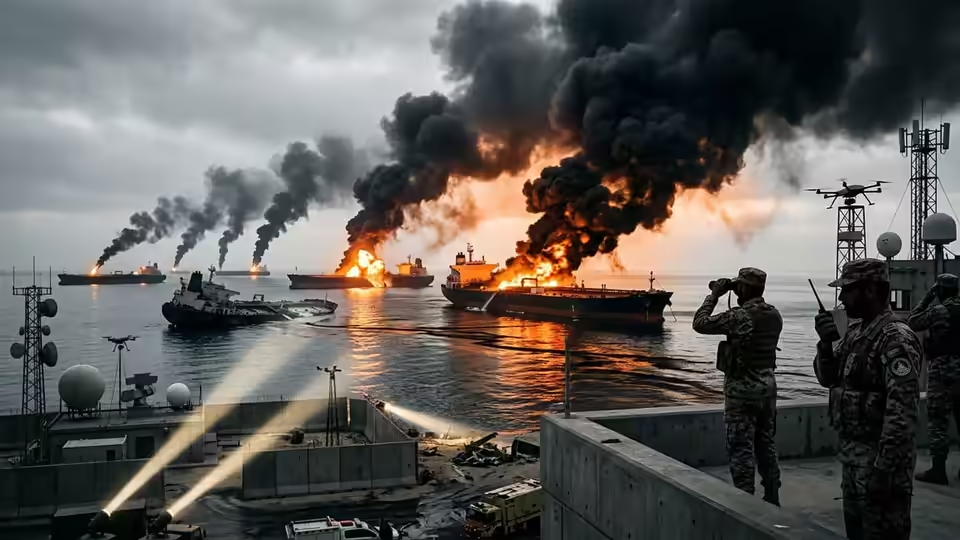
The latest strike happened Friday, April 24, confirmed by U.S. Southern Command and first reported by the AP. There's a grainy, unclassified video of the event showing a small boat getting incinerated by munitions under Gen. Francis L. Donovan's command. The military frames these strikes as a war on 'narco-traffickers,' but they haven't produced a single kilo of recovered drugs or a public manifest from any of the ships involved in these 183 deaths. It's a massive shift in transparency. Usually, the U.S. Coast Guard follows a board-and-seize protocol to get evidence and intel. Now, that's being skipped.
The legal logic behind this is controversial. The administration is essentially reclassifying drug cartels as 'enemy combatants' rather than criminals. They're using the Laws of Armed Conflict, the international rules like the Geneva Conventions that usually govern actual wars. By doing this, they're claiming the Pacific Ocean is a kinetic battlefield. That lets them destroy 'stateless' vessels without any of the due process you'd see in normal law enforcement. But here's the thing: while traffickers use stateless vessels to hide, so do plenty of legitimate artisanal fishers and migrants.
This 'sink-on-sight' policy is also changing where the money goes. Budget analysts say the military is now favoring expensive munitions over the labor-intensive boarding operations the Coast Guard used to do. Coast Guard budgets are flat, but the Pentagon's funding for 'Enhanced Maritime Domain Awareness' and lethal strikeLoaded Languages is way up. Major defense contractors are the ones winning here, supplying the Hellfire missiles and drones for these missions. Since September 2025, the cost of the missiles alone has topped $12 million. That doesn't even count what it costs to keep the carrier groups and drone units running.
“The U.S. military campaign has killed at least 183 people since last September, yet officials have not provided evidence that the vessels were actually carrying drugs.”
Critics say the human cost is hitting people who might not even be involved in crime. The families of two men from Trinidad, killed in a previous strike, have already filed a lawsuit. They say their relatives were just fishers lost at sea, not smugglers. Both the ACLU and UN officials say the U.S. is ignoring 'right to life' protections. Jamil Dakwar, director of the ACLU’s Human Rights Program, didn't mince words about the rising death toll. He said we're seeing a total collapse of the line between police work and high-seas warfare.
We still don't know what kind of intelligence the military uses to pick its targets. SouthCom won't say if they're using human informants, signal intercepts, or just visual profiling. Without that info, it's impossible to know if they're hitting the right boats. Historically, U.S. surveillance has a high rate of misidentification. Despite the lack of evidence, the administration says these strikes are a deterrent. Donald Trump has even called the campaign an 'act of kindness' meant to stop overdose deaths before they happen.
With the death toll nearly at 200, the next step for accountability is the Inter-American Commission on Human Rights. Watchdog groups want an independent audit of the videos to see if the people on those boats tried to surrender or were clearly unarmed. For regular citizens, this is a bellwether. It shows how a domestic policy like the 'War on Drugs' can be turned into an unchecked military campaign that bypasses the courts entirely, all funded by tax dollars meant for border safety.
Summary
The U.S. military conducted another lethal strike in the eastern Pacific on April 24, 2026. Two more people are dead, bringing the total body count to 183 since this maritime campaign started last September. Gen. Francis L. Donovan and his team at JTF Southern Spear claim these are counter-narcotics hits, but there's a problem: the Pentagon hasn't shown a single shred of physical evidence that any drugs were on the boats they destroyed. The administration is using specific legal loopholes to dodge international maritime law, shifting money away from law enforcement and into military missiles. It's a pivot toward a 'shoot first' doctrine that civil rights groups say violates the Fifth Amendment and basic human rights standards.
⚡ Key Facts
- The US military conducted a lethal strike on a boat in the eastern Pacific on Friday, killing two people.
- General Francis L. Donovan directed Joint Task Force Southern Spear to carry out the lethal strike.
- The Trump administration justifies these strikes as legal acts of war against drug cartels.
- Civil rights groups and the ACLU are challenging the legality of the strikes via the Inter-American Commission on Human Rights.
Pentagon Killed 183 People at Sea Without Finding a Single Gram of Drugs
Network of Influence
- Political opponents of the Trump administration
- Civil rights and human rights organizations (ACLU, UN) seeking legal precedents
- Narco-trafficking organizations benefitting from scrutiny of interdiction methods
- Law firms representing the families of those killed
- Specific intelligence or surveillance data leading to the identification of these specific vessels
- The total volume of illicit drugs seized during the overall campaign
- Detailed US maritime law regarding 'stateless' vessels on the high seas
- Historical context of 'Law of the Sea' conventions versus counter-narcotics treaties
The article frames US counter-narcotics maritime operations as a series of extrajudicial killings and human rights violations while casting doubt on the military's justification of drug interdiction.
See how the story connects.
Select any actor or numbered connection, then inspect the evidence before drawing a conclusion.
Scott Trust Limited Sole owner of Guardian Media Group (GMG)
Follow the public record
Source Trail
Independent reporting and analysis
Get the next investigation in your inbox
One email a week. Receipts only. Free.
Free. Unsubscribe anytime. We never share your email.