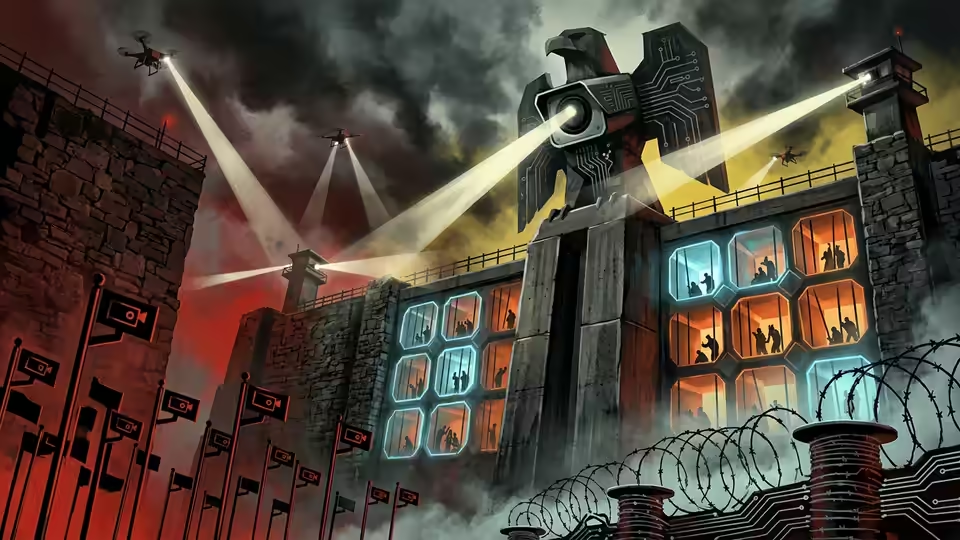
Panama Traded Indigenous Blood for $55M in Chinese Timber Deals
While denying land rights to the Wounaan people, Panama’s government facilitated a $55.5 million illegal rosewood trade. To the state, the trees were worth more than the people living among them.
The Wounaan people faced deadly violence while trying to protect rosewood forests that the Panamanian government refused to give them legal rights to, even as the state cashed in on $55 million in exports.
In early 2012, a logger named Ezequiel Batista killed Aquilino Opua Puchicama, a Wounaan leader, during a tense three-month standoff over illegalLoaded Language logging in eastern Panama. It wasn't an isolated tragedy. It was the direct result of a legal vacuum. Even though the Wounaan have lived in the Darién forests for generations, the Panamanian government has consistently dragged its feet on processing their land titles. Without those papers, their ancestral home became a free-for-all for outside interests. These loggers knew exactly what they were doing: they targeted unrecognized land because they knew the state wouldn't step in to help the people living there.
The money behind this violence is hard to wrap your head around. Fueled by a real estate boom in China and a hunger for luxury furniture, the price of Cocobolo rosewood went through the roof. In 2012, a cubic meter fetched $13,000. Today, that price has tripled to nearly $39,000. To put that in perspective, high-quality red oak sells for about $1,500. This massive gap sparked a green gold rush across Panama. By 2014, the country was the 16th-largest rosewood supplier to China, shipping $55.5 million worth of timber in a single year. Much of it came from the very forests the Wounaan were dying to protect.
In the industry, they call it Cocobolo. Scientists call it Dalbergia retusa. It's a rosewood prized for its density and deep red color, and it's now critically endangered because of this over-exploitationLoaded Language. To move this much wood, loggers took advantage of Panama's Comarca system. These are regions where Indigenous groups have collective land rights and some autonomy. But many Wounaan communities live outside these zones. Without that official status, they don't have the legal standing to kick loggers out or sue them in court. This structural exclusion is a win for the state: it gets to collect export duties on timber that's essentially been stolen from Indigenous families.
“In 2014, Panama was the 16th-largest supplier of rosewood to China, exporting $55.5 million worth of timber in a single year.”
In February 2026, the Panamanian Ministry of Environment (MiAmbiente) announced it's building nurseries and pushing for sustainable management in the Emberá-Wounaan Comarca. But let's be real: these programs are just treating the symptoms. A nursery doesn't stop a guy with a gun and a chainsaw. Records from 2014 and 2015 show that even when international CITES regulations got tougher, the wood kept flowing. It just became more dangerous for the Wounaan to get in the way. By 2019, the species was officially critically endangered, a grim testament to how badly the international community failed to rein in the trade.
The profits didn't just stay in the jungle. This trade was fed by the global market for musical instruments and high-end furniture in East Asia. Data shows that the $55.5 million export peak in 2014 happened right when Panamanian officials were being pressured to look the other way in the Darién Gap. Wounaan leaders filed complaint after complaint during the 2011 logging season, but the authorities didn't lift a finger until people started dying. And even then, the priority was clearly on the cargo, not the community.
We still don't know exactly which officials signed off on the permits for that $55.5 million worth of rosewood. But an operation of this scale doesn't happen in secret. You need heavy machinery, you have to pass through government checkpoints, and you have to move through major shipping ports. That suggests, at the very least, that the state was looking the other way. The Wounaan National Congress is still fighting for the Plan de Manejo Forestal Comunitario to try and get some control back. But without those formal land titles, these management plans are just a secondary thought to the immediate threat of land grabs.
This story follows a pattern we see all over the world. When a natural resource is worth more than a human life, and the government refuses to protect the rights of the people living on that land, you get a catastrophe. It's as simple as that. The thing to watch now is whether MiAmbiente's 2026 initiatives will actually lead to land titles for the Wounaan outside the Comarcas. Or will the government just keep talking about sustainability while the underlying land theft continues?
Summary
Between 2011 and 2014, the illegal trade of Cocobolo rosewood in Panama wasn't just a conservation crisis: it was a bloodbath. At least two people died while a species was pushed to the brink of extinction. While academic accounts often romanticize Indigenous resistance, the real story is about a government that refused to give the Wounaan people legal titles to their own land. In 2014 alone, Panama sent $55.5 million in rosewood to China, exploiting the fact that these territories were legally unprotected. This is what happens when a tree becomes more valuable than the people living next to it.
⚡ Key Facts
- In 2011/2012, a standoff between illegal loggers and Wounaan members resulted in the deaths of Wounaan authority Aquilino Opua Puchicama and logger Ezequiel Batista.
- Cocobolo (Dalbergia retusa) was reassessed as 'critically endangered' by the IUCN by 2019.
- In 2014, Panama was the 16th-largest supplier of rosewood to China, exporting US$55.5 million worth.
- The Wounaan National Congress and researchers have collaborated on a 2026 book and project titled 'Interwoven Rosewood'.
Panama Traded Indigenous Blood for $55M in Chinese Timber Deals
Network of Influence
- The Wounaan National Congress (political visibility)
- The authors and publishers of the book 'Interwoven Rosewood'
- Environmental NGOs and academic researchers specializing in collaborative conservation
- Details on the specific Panamanian laws regarding 'Comarcas' (Indigenous territories) and why title claims were stalled.
- Specific international regulatory efforts under CITES (Convention on International Trade in Endangered Species) that occurred during this period.
- The socioeconomic drivers for the non-Indigenous loggers, who are often impoverished locals exploited by larger cartels.
The story is framed as a moral struggle between Indigenous 'wisdom and beauty' and the destructive forces of global capitalism and colonial dispossession.
See how the story connects.
Select any actor or numbered connection, then inspect the evidence before drawing a conclusion.
The Conversation Trust Owns The Conversation
Follow the public record
Source Trail
Independent reporting and analysis
Get the next investigation in your inbox
One email a week. Receipts only. Free.
Free. Unsubscribe anytime. We never share your email.