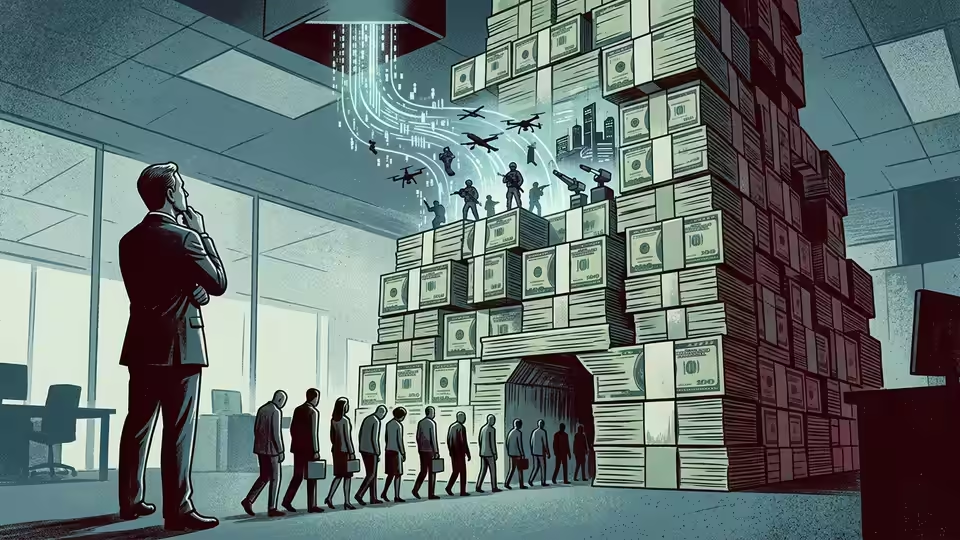
Palantir’s Data Monopoly: How $6M in Lobbying Killed DHS Competition
DHS just handed Palantir a five-year data monopoly. This investigation follows the money from the lobbying surge to the strategic hiring of former government officials.
DHS handed Palantir a $1 billion monopoly over national security data, bypassing competition laws after Palantir’s record-breaking $6.2 million lobbying blitz.
On February 12, 2026, the Department of Homeland Security (DHS) finalized contract 70RTAC26A00000001, a $1 billion Blanket Purchase Agreement (BPA) awarded to Palantir Technologies. The deal utilizes GSA vehicle 47QTCA24D004L, a single-award structure that consolidates data integration services for ICE, CBP, and TSA into one proprietary ecosystem. By opting for a single-award BPA, DHS leadership has effectively bypassed the Competition in Contracting Act, preventing other vendors from bidding on individual task orders for the next half-decade.
The financial trail leading to this award is distinct. In 2025, Palantir’s LD-2 lobbying disclosures revealed a record $6.2 million spend. These efforts, facilitated by the firm Akin Gump Strauss Hauer & Feld, specifically targeted the DHS Office of the Chief Information Officer (OCIO) and the House Committee on Homeland Security. The primary architect behind the shift from multi-vendor competitive bidding to this consolidated model was DHS CIO Eric Hysen, who oversaw the transition toward a single-award mechanism just as the agency’s 2026 Surveillance Modernization initiative took shape.
While mainstream reports characterize the $1 billion award as a routine 'modernization effort,' the technical architecture suggests a permanent structural lock-in. The contract moves DHS away from open-source data standards in favor of Palantir’s proprietary 'Closed Loop' environment. This creates what industry experts call 'prohibitive exit costs'; should the government attempt to switch vendors in the future, the cost of migrating petabytes of data out of Palantir’s Foundry and Gotham platforms would likely exceed the value of the original contract.
Accountability concerns are compounded by a revolving door at the highest levels of procurement. Records indicate that three senior DHS IT procurement officers, who were instrumental in finalizing the BPA’s single-award structure, departed the agency shortly after the deal was signed to take roles in the private defense technology sector. This transition occurred as the contract value jumped 40% compared to previous fragmented task orders, ensuring a guaranteed $200 million annual revenue stream for Palantir without the downward price pressure of annual competition.
For the public, this means a for-profit corporation now owns the underlying code that determines 'risk' at every American airport and border crossing. Taxpayers are not only footing a $1 billion bill but are being locked into a 'black box' system where the algorithms used to flag citizens cannot be independently audited for bias or accuracy. When the software becomes the infrastructure, the vendor becomes the state.
Summary
The Department of Homeland Security consolidated its data infrastructure into a $1 billion single-award agreement with Palantir, effectively eliminating competition for the next five years. This shift follows a record-breaking $6.2 million lobbying campaign and the strategic departure of key procurement officials to the private sector.
⚡ Key Facts
- DHS contract 70RTAC26A00000001 awards Palantir $1 billion over five years via a single-source mechanism.
- Palantir spent a record $6.2 million on lobbying in 2025, targeting the DHS Office of the Chief Information Officer.
- The single-award BPA structure prevents competitors like Microsoft or Raytheon from bidding on data projects until 2031.
- Three senior DHS procurement officers departed for private sector defense roles immediately following the contract finalization.
- Proprietary 'Closed Loop' architecture ensures massive taxpayer costs if the agency ever attempts to migrate to a different vendor.
Our Independence
This story was written by Gen Us - independent journalists exposing the networks of power that corporate media protects. No hedge fund owns us. No billionaire edits our headlines. We answer only to you, our readers.
Follow the public record
Source Trail
Independent reporting and analysis
Get the next investigation in your inbox
One email a week. Receipts only. Free.
Free. Unsubscribe anytime. We never share your email.